Abstract Ideology vs. Measurable Public Safety Results
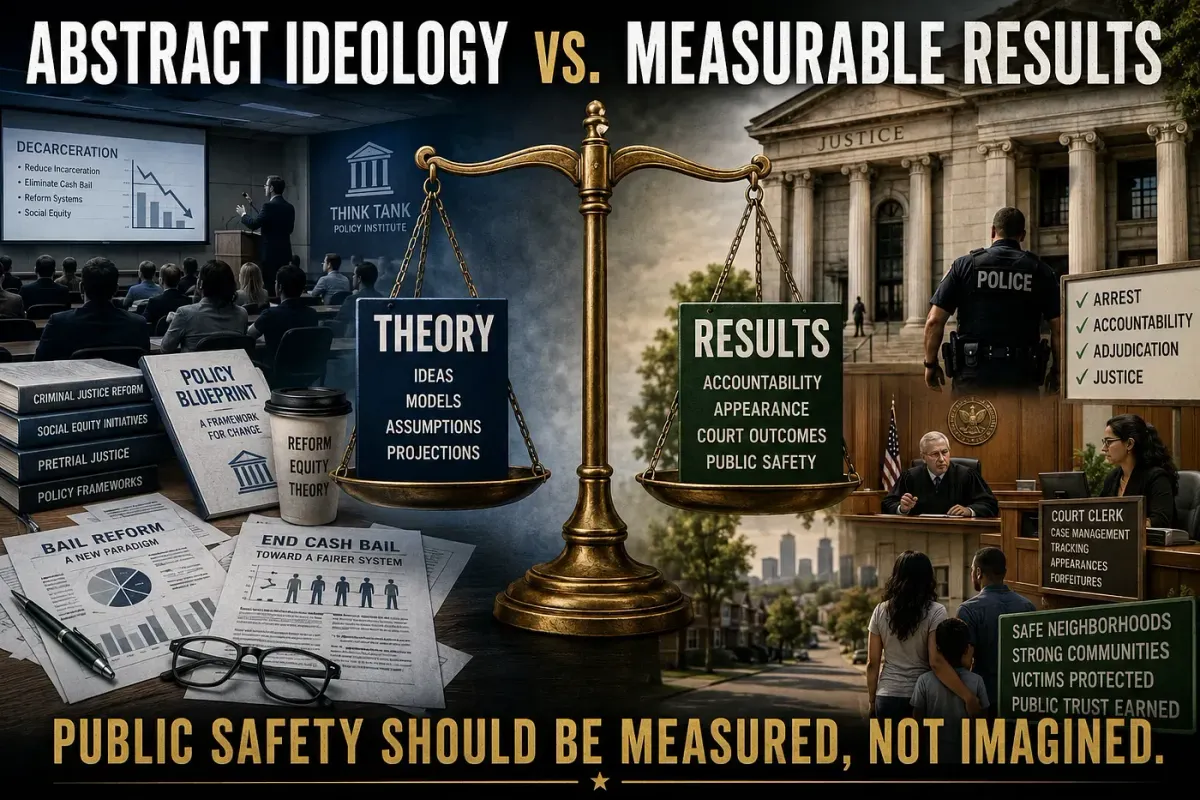
When Criminal Justice Theory Collides With Real-World Consequences
The narrative driving modern criminal justice reform in America is not a grassroots movement. It is a top-down, highly coordinated campaign engineered by a specific network of well-funded special interests. At the intellectual spearhead of this movement stands the Vera Institute of Justice. Vera serves as the primary policy engine and blueprint provider for a broader apparatus of progressive philanthropies, activist lawmakers, and compliance-driven prosecutors.
Over the last decade, and accelerating rapidly through the legislative cycles of the mid-2020s, Vera’s policy templates have successfully driven the systematic downscaling of our legal system. Their objectives are clear and uniform across the country: the broad implementation of “decarceration” policies, the near-total elimination of traditional commercial surety bail, and the systematic stripping of vital risk-assessment powers from state and local judges.
From the experimental legislative halls of Albany, New York, to the courtroom benches of California, these imported policy models have been written directly into municipal codes and state statutes under the banner of social equity. Yet, as these experiments move out of the abstract realm of progressive think tanks and land heavily on the pavement of our local communities, the real-world results paint a devastating picture.
By demanding the removal of commercial surety bail from the pretrial process, this reform infrastructure has fundamentally miscalculated human behavior and left our neighborhoods vulnerable. The facts demonstrate that when you dismantle a functioning system of deterrence to satisfy an academic theory, the immediate consequence is not equity. It is a sharp escalation in preventable victimization and a complete breakdown of public safety.
The Accountability Function of Commercial Surety Bail
To understand why this model fails so consistently, one must look at the complete disruption of pretrial accountability that occurs when commercial surety bail is dismantled.
For over a century, the commercial surety bail system has served as a highly efficient, private-sector mechanism for ensuring that individuals accused of crimes return to court to face justice.
The core strength of commercial surety bail lies in the concept of financial accountability, which gives the defendant, their family, and an independent third-party bondsman a direct stake in the legal process. If a defendant flees, the financial loss falls squarely on the private sector. The responsibility to locate and return that individual is borne by the surety. It costs the taxpayer absolutely nothing.
Critics of the bail industry frequently attack this model, targeting the private-sector nature of the business. They rely on predictable talking points, arguing that public safety should not involve a “profit motive” or that requiring financial collateral places an undue burden on a defendant’s family.
But this criticism completely ignores how human nature and real-world economics operate. That very profit motive is exactly what drives the bondsman to do what the state cannot or will not do: ensure absolute compliance. The financial risk forces the bondsman to actively monitor the defendant. It compels them to pick up the phone, check in, and physically hunt down a fugitive if they skip their court date.
Furthermore, the involvement of the family is not a systemic flaw; it is the system’s greatest asset. When a mother, aunt, or sibling signs for a bond, they create a secondary layer of community supervision that no state-funded caseworker can ever replicate.
When reform organizations successfully lobby to eliminate this mechanism, they do not eliminate the costs or risks of pretrial release. They merely transfer those burdens to the public.
Taxpayers are forced to fund bloated pretrial services agencies, purchase state-monitored electronic tracking equipment, and pull law enforcement officers away from proactive policing to chase down individuals who have failed to appear in court. The public system absorbs the financial shock, while the community absorbs the physical risk.
What the Real-World Data Shows
The human cost of this policy shift is no longer a matter of theoretical debate because the data from real-world trials has become absolute. Apologists for decarceration often attempt to hide behind broad, statewide studies or blame post-reform crime spikes entirely on pandemic-era anomalies. However, when we isolate the variables and look at localized, controlled environments, the rhetoric completely collapses.
The data released from a comprehensive, multi-year tracking study by Yolo County District Attorney Jeff Reisig provides a devastating, side-by-side indictment of the reform narrative. Over an eighteen-month tracking period, individuals released under emergency Zero Bail mandates experienced an average recidivism rate of seventy-eight percent. This represents a staggering seventy percent increase in re-offenses compared to those who posted traditional commercial surety bail.
More alarming still was the severity of the behavior. Felony offenses nearly doubled. Misdemeanors increased by over one hundred and twenty percent. Repeat offenders who committed two or more new crimes surged by nearly one hundred and fifty percent. Most critically, new violent offenses, including homicides, domestic violence, and armed robberies, tripled under the zero-bail framework.
These numbers do not lie. They expose the fatal flaw of treating a diverse pool of defendants with a one-size-fits-all policy of leniency. When you remove commercial surety bail and individualized judicial risk assessment, prolific offenders cycle rapidly back onto the streets to create new victims.
Who Pays the Price?
This brings us to the profound ideological disconnect regarding who actually pays the price for weakened enforcement.
The rhetoric originating from progressive think tanks often frames the reduction of incarceration as a victory for civil rights and community equity, backed by selective statistics that intentionally conflate low-level, first-time offenders with dangerous recidivists. However, policy researchers have repeatedly documented that violent crime is not distributed evenly across society. It is heavily concentrated in specific, high-crime neighborhoods that are predominantly low-income and minority communities.
When proactive policing is dialed back, when prosecution is minimized, and when repeat offenders are immediately released back into the neighborhood on their own recognizance, it is the law-abiding residents of these vulnerable communities who suffer the immediate consequences.
The historic crime drops of the late twentieth century were driven by focused, data-driven enforcement and the strategic incapacitation of dangerous individuals.
Pretending that incarceration is purely crime-causing ignores the fundamental protective value of removing a prolific offender from a neighborhood block. Abandoning that protective barrier leaves inner-city families to navigate the chaos of unchecked disorder.
The Limits of Social Experimentation
Furthermore, the alternative solutions proposed by progressive reform groups consistently lack the empirical backing required to replace traditional public safety measures.
The prevailing advocacy emphasizes shifting resources away from law enforcement and into community-based social investments, housing programs, and violence interrupter initiatives.
While long-term community development is a noble and necessary pursuit for any society, it operates on a timeline of decades. It offers absolutely no protection against an active, armed offender operating in real time.
Moreover, objective evaluations of community violence interrupter programs show a highly inconsistent track record, with many initiatives failing to demonstrate scalable or sustained reductions in serious firearm violence.
Relying on unproven social experiments while dismantling functioning systems of deterrence is a reckless approach to public administration that erodes trust in the entire judicial system.
Accountability Does Not End at Release
Yet true accountability does not begin and end with the pretrial release decision.
A functioning justice system requires every single component of the court apparatus to perform its statutory role with precision. Law enforcement must make targeted arrests, but the courts must move those cases efficiently through the docket without crippling backlogs or endless, unmerited continuances.
Prosecutors must be prepared to proceed with timely adjudication, and circuit clerks must accurately track cases, enforce appearance obligations, and aggressively comply with statutory bond forfeiture mandates when a failure to appear occurs.
Judges must exercise firm follow-through, executing bench warrants swiftly rather than letting them gather dust.
When any link in that operational chain fails — whether through administrative neglect, prosecutorial delay, or a lack of judicial resolve — public confidence suffers and victims are left waiting indefinitely for justice.
Pretrial accountability is a critical battleground, but it is ultimately just one component of a comprehensive justice system that must produce measurable results from the initial arrest all the way through final disposition.
Results Matter More Than Ideology
True professionalism and advocacy in the justice system demand measurable, results-oriented outcomes rather than comforting slogans.
The data proves that effective policy requires a precise balance. It means utilizing smart rehabilitation programs for individuals genuinely amenable to change while maintaining firm, unyielding accountability and incapacitation for serious or repeat threats.
By treating the entire justice system as something to be systematically downscaled, these ideological models misdiagnose the nature of crime and minimize the protective rights of victims.
The commercial surety bail profession and traditional law enforcement have generations of proven efficacy showing that accountability works.
Protecting our communities requires us to stand on the side of factual evidence, uphold the rule of law, and reject any ideology that prioritizes the comfort of the offender over the concrete safety of the public.
About the Author
Mike Morrison is the 2026 PBUS National Bail Agent of the Year, President of the Mississippi Bail Agents Association, and owner of Mike Morrison Bail Bonding in Hattiesburg, Mississippi. A licensed bail agent with more than 35 years of experience, he writes on bail bonds, pretrial release, public safety, criminal justice, and court accountability. Morrison's work is based on daily experience in the courtroom and has reached more than one million readers across social media in 2026. Learn more at https://linktr.ee/mdmorrison.