Alexander Hamilton and the Energy of Government: How the Anti-Surety Movement Erodes the Vigorous Administration the Founders Deemed Essential to Liberty and Public Safety
Alexander Hamilton, the Energy of Government, and the Architecture of Enforced Accountability: How Vigorous Administration Still Safeguards Liberty and Public Safety Today
If Washington warned of the spirit of party, Madison designed auxiliary precautions against it, Franklin insisted on the civic virtue required to keep a republic, and Paine demanded systems built for real accountability rather than good intentions, then Alexander Hamilton supplied the indispensable final element: the energy to make any of it work in practice.
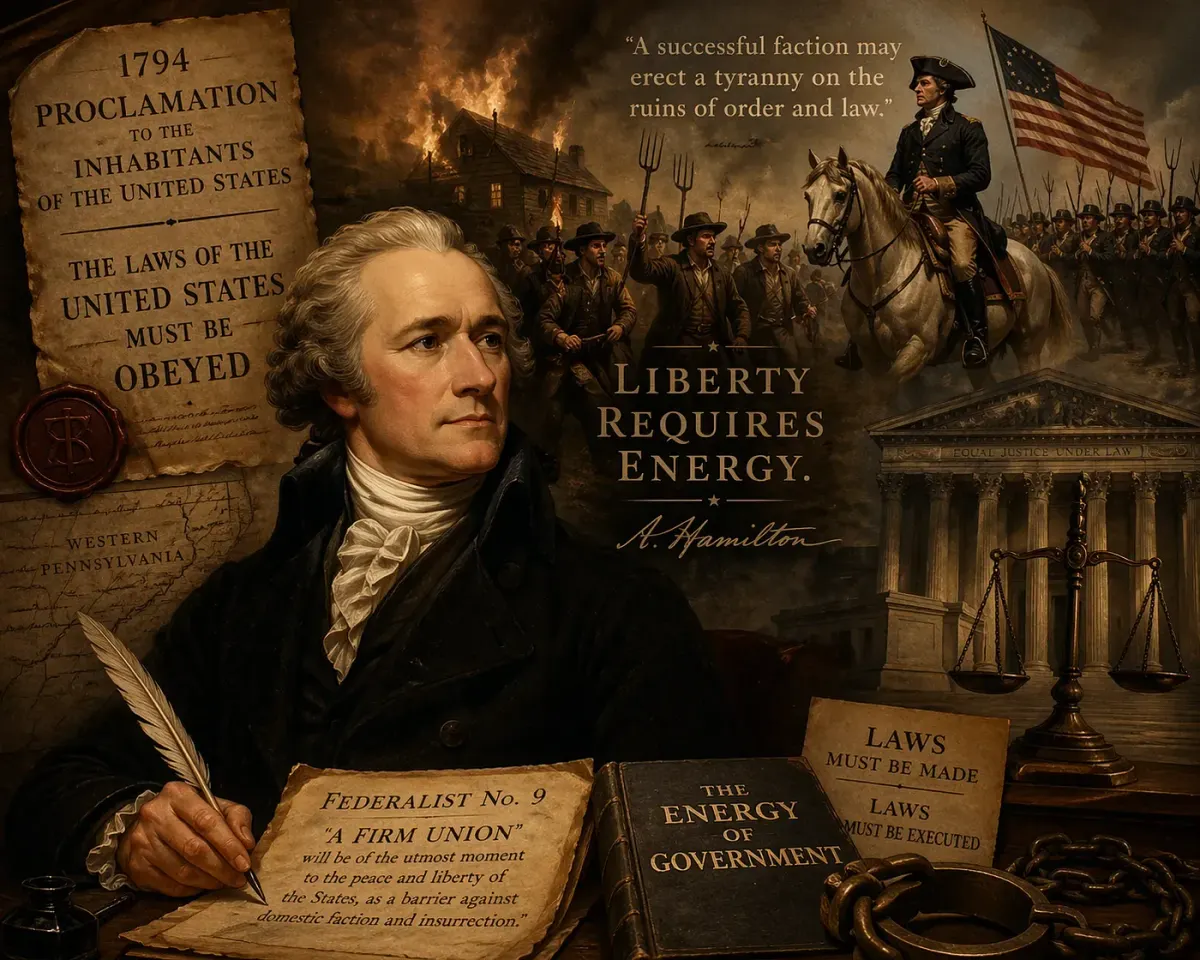
Picture this: 1794. Western Pennsylvania is in open defiance of federal law. Armed farmers, furious over a whiskey excise tax, have tarred and feathered tax collectors, burned the home of a federal inspector, and formed extralegal committees to nullify congressional statutes. Factional rage is threatening the very authority of the new republic. Secretary of the Treasury Alexander Hamilton doesn’t wring his hands or call for more studies. He drafts the presidential proclamation himself, rides out with President Washington at the head of 13,000 militia, and personally oversees the suppression of what he calls a dangerous insurrection. For Hamilton, this wasn’t overkill. It was the republic proving it could enforce its own laws.
He had been warning about exactly this moment since the Federalist Papers. In Federalist №9, he declared:
“A FIRM Union will be of the utmost moment to the peace and liberty of the States, as a barrier against domestic faction and insurrection.”
He knew factions were inevitable. What mattered was whether the government possessed the vigor — the energy — to check them before they eroded order itself. Hamilton had watched weak confederations collapse under the weight of “the most fatal disease” of popular governments: the spirit of party and faction. He had seen how “a successful faction may erect a tyranny on the ruins of order and law.” And he refused to let the infant United States repeat the mistakes of ancient republics or the failed Articles of Confederation.
Hamilton’s entire political project was built on one conviction: liberty without energetic administration is an invitation to chaos. Government must not only make laws — it must execute them with consistency, speed, and consequence. In his view, the “energy of the executive” and the steady hand of independent courts were not luxuries; they were the structural backbone that prevented factional passion from substituting caprice for justice. Without that backbone, even the best-designed institutions would drift into weakness.
Fast-forward to 2026. That same erosion Hamilton feared is happening in slow motion inside America’s courthouses — and the anti-surety movement is the quiet vehicle carrying it forward.
The justice system, like the republic Hamilton helped build, runs on enforced accountability. A defendant is released pretrial with a clear court order: appear, comply, or face consequences. When that order carries real weight — financial stake, third-party oversight, personal and familial pressure — the system functions. When ideology removes those mechanisms in favor of risk-assessment checklists and “trust-based” releases, the energy drains out. What remains is hope dressed up as policy.
Look at the jurisdictions that embraced the anti-surety experiment most aggressively:
New Jersey’s 2017 cash-bail overhaul.
Illinois’ 2023 SAFE-T Act.
The no-cash-bail experiments in Philadelphia and Chicago.
In each case, the results followed the pattern Hamilton would have recognized instantly: rising failures to appear, more violations of release conditions, backlogged courts, and overloaded law enforcement left to chase what used to be prevented upfront. The financial incentive and personal responsibility that once motivated defendants? Replaced by bureaucratic optimism. The independent third-party enforcement that surety bonds provide? Dismissed as outdated. The practical “energy” that kept the machinery of justice moving? Deliberately diffused.
This is not reform. It is degradation of the very architecture Hamilton insisted upon — the energetic administration required to keep factional passion from substituting its own preferences for consistent, enforceable law. When courts lose the practical tools to compel compliance, they don’t become more humane. They become less authoritative. And a justice system that cannot enforce its own orders is no longer a system of laws; it is a system of wishes.
Hamilton was never a romantic about human nature. He understood, as clearly as Madison, that factions arise from “common impulse of passion or of interest.” But where Madison focused on structural precautions to control effects, Hamilton focused on the daily, operational vigor needed to meet those factions in the moment and say: the law will be obeyed. That is precisely what professional bail agents still deliver — one bond at a time. They put real skin in the game. They coordinate with families. They track, remind, and, when necessary, bring defendants back to court. They supply the independent, energetic enforcement layer that prevents the quiet surrender of accountability.
Hamilton did not ride to Pennsylvania in 1794 because he enjoyed military parades. He did it because he knew that once the government’s authority is successfully defied in one place, the precedent spreads. The same principle applies today. When pretrial release becomes optional for some but mandatory for others, public faith in equal justice collapses. When ideology overrides evidence-based enforcement, the “ruins of order and law” Hamilton warned about begin to form — not with muskets and tar, but with missed court dates, dismissed cases, and victims left wondering why the system no longer works for them.
The republic Hamilton helped found does not endure through good intentions alone. It endures through institutions that possess both the wisdom to design safeguards and the energy to enforce them. In 2026, that energy still lives in the daily work of surety bail: the phone calls at 2 a.m., the family meetings, the financial risk willingly assumed, the court appearances successfully compelled.
If we allow the anti-surety movement to continue stripping away those practical mechanisms, we are not advancing liberty. We are repeating the very mistake Hamilton spent his life preventing — trading energetic administration for factional convenience, and slowly dismantling the architecture of enforced accountability the Founders knew was essential.
Hamilton’s lesson remains as urgent now as it was in 1794: a government that cannot or will not enforce its own rules will eventually face the choice between weakness and force. Better to maintain the steady, distributed energy of accountability — one bond, one appearance, one preserved measure of public trust — than to discover too late that the quiet surrender has already succeeded.
Because once the energy of enforcement is gone, restoring it is never quiet, and never cheap.
About the Author
Mike Morrison is a Hattiesburg, Mississippi bail bondsman, owner of Mike Morrison Bail Bonding, President of the Mississippi Bail Agents Association, and the 2026 PBUS National Bail Agent of the Year. For more than 35 years, he has worked in Mississippi's criminal justice system while writing about bail bonds, pretrial policy, public safety, and court accountability. His commentary has reached more than one million readers across social media in 2026. Learn more at https://linktr.ee/mdmorrison.
© 2026 Mike Morrison. All rights reserved.