Bail Agents and John Adams: Defending Liberty and Accountability Since 1770
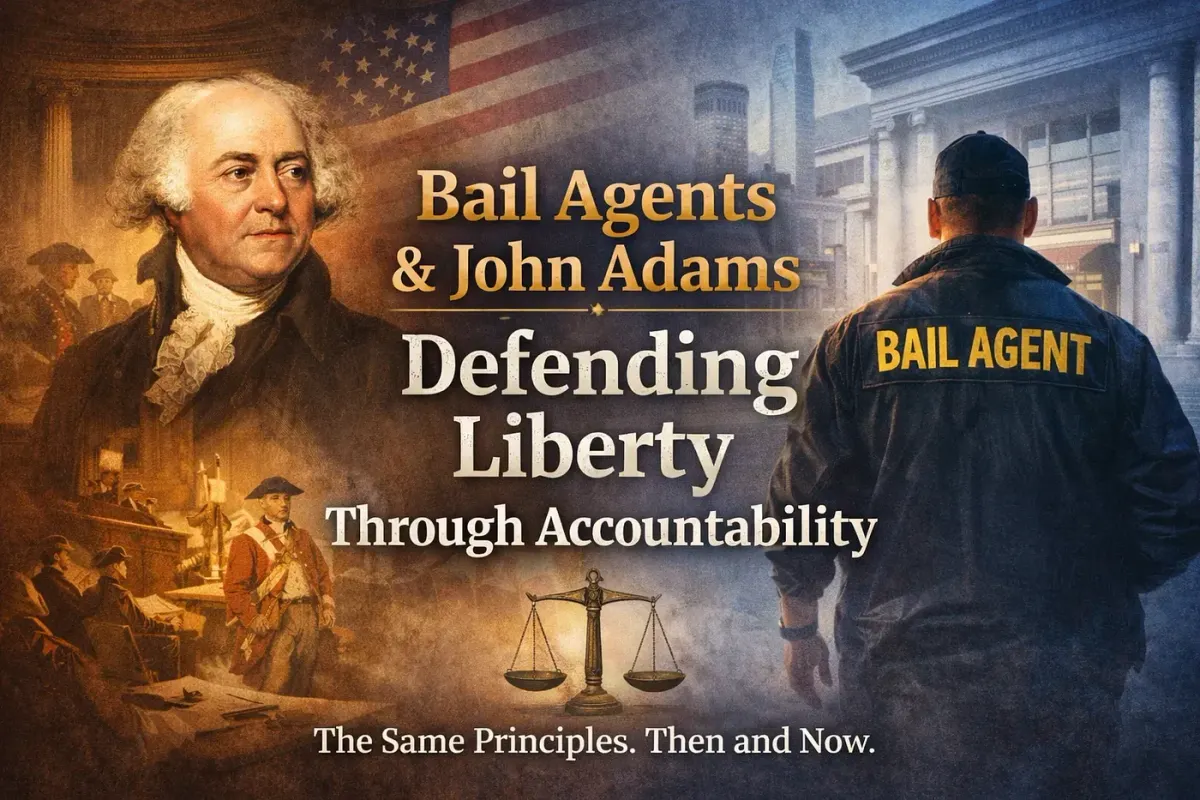
Bail Agents: You’ve Got Serious “Bail Agent Energy” in Common with John Adams
If you want to understand the role of a bail agent in its proper historical context, you do not need to look at modern policy debates or media narratives. You can return to the very foundations of this country, where the principles that guide your profession are clearly reflected in the actions of one man — John Adams.
Long before he became the second President of the United States, Adams made a courageous decision in colonial Boston that continues to define what it means to stand on principle in a functioning justice system. He chose to defend the British soldiers charged after the Boston Massacre, at a time when public anger had reached a boiling point and the community had already decided the outcome in the court of popular opinion. Taking that case was neither politically safe nor popular, and it carried genuine personal and professional risk. Yet Adams understood a truth that remains as relevant today as it was in 1770: the law cannot survive if it is applied only when it is convenient or emotionally acceptable.
This is not an abstract philosophical idea. It is the daily operational reality that bail agents navigate. Your work exists at the precise intersection of personal liberty and legal accountability. You regularly deal with individuals who have already been judged harshly in the court of public opinion, often long before any evidence has been tested or facts established. The pressure to yield to that public judgment is constant, but the responsibility of the profession is to uphold the structure of the system itself, rather than follow the tide of emotion.
Adams recognized that if the law can be bent or ignored for defendants whom people dislike, then it can eventually be twisted against anyone. That principle serves as the essential safeguard preventing the justice system from becoming a tool of convenience instead of a framework of consistent rules. His words from the closing argument in the Boston Massacre trials remain one of the clearest expressions of this truth: “Facts are stubborn things; and whatever may be our wishes, our inclinations, or the dictates of our passions, they cannot alter the state of facts and evidence.”
That same standard applies directly to the bail industry. Whether you are handling a high-risk defendant, a routine bond, or a challenging recovery, your work is grounded in objective facts and obligations — the conditions of the bond, the requirements of the court, and the enforceable responsibility that accompanies pretrial release. It is not shaped by headlines, narratives, or external pressures. That commitment to facts is what allows the system to function effectively.
The Founding Fathers clearly understood the dangers of unrestrained government authority in this area. They had witnessed how bail could be manipulated in English courts — often set at levels designed not to ensure appearance, but to guarantee detention without trial. That history of abuse directly inspired the inclusion of the Eighth Amendment in the Bill of Rights, which prohibits excessive bail. This provision was never meant as a mere philosophical statement; it was a practical safeguard against the misuse of power.
What the Founders envisioned was balance. They did not support a system that released individuals without meaningful accountability, nor one that detained people without fair recourse. Instead, they recognized that genuine public safety requires both structure and incentive: clear rules, predictable outcomes, and mechanisms that encourage defendants to return to court and answer the charges against them.
This is precisely the role that the surety bail system fulfills. Every bond written carries a real financial obligation. Every release includes enforceable accountability. Every failure to appear activates processes designed to recover the individual and preserve the integrity of the court. These elements are not accidental byproducts — they represent the system operating as the Founders intended.
In today’s environment, it is more important than ever for bail agents to remain engaged and informed. There are ongoing efforts to redefine public safety in ways that minimize or eliminate these proven accountability mechanisms, often under polished messaging that does not always align with real-world results.
Understanding the historical foundation of your work provides the clarity and confidence needed to speak effectively about the essential role bail agents play.The legacy of John Adams is not confined to the past. It lives on in the daily efforts of bail agents who recognize that liberty and accountability are not opposing forces — they are complementary elements of the same justice system. Both must be protected if that system is to function properly and safeguard the public.
About the Author
Mike Morrison is a Hattiesburg, Mississippi bail bondsman, owner of Mike Morrison Bail Bonding, President of the Mississippi Bail Agents Association, and the 2026 PBUS National Bail Agent of the Year. For more than 35 years, he has worked in Mississippi's criminal justice system while writing about bail bonds, pretrial policy, public safety, and court accountability. His commentary has reached more than one million readers across social media in 2026. Learn more at https://linktr.ee/mdmorrison.
© 2026 Mike Morrison. All rights reserved.