Bail Agents and the Responsibility to Lead by Example
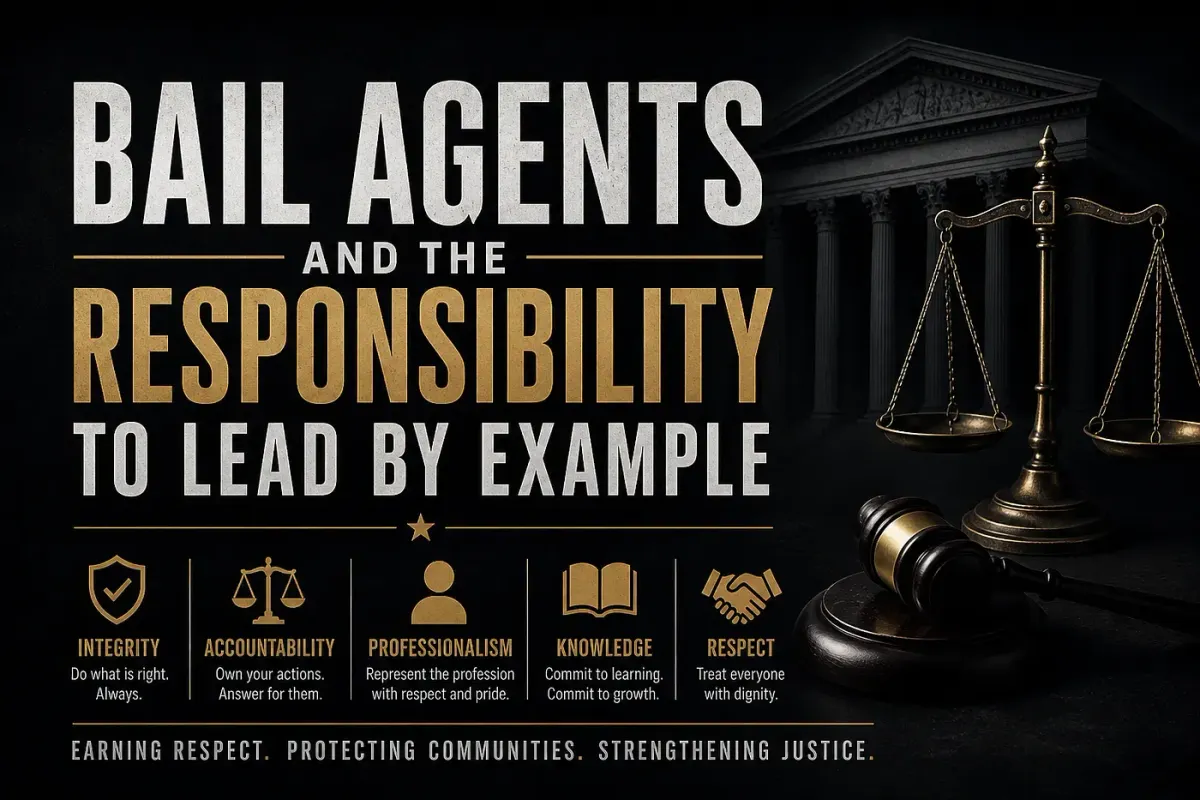
Elevating the Profession Through Conduct, Discipline, Training, and Accountability
For the bail profession to earn respect as an equal and essential part of the criminal justice system, it must first accept the responsibilities that come with that role. Respect is not demanded — it is earned. Authority is not built through loudness, intimidation, or the appearance of toughness. Professional standing comes from consistent conduct, lawful action, ethical judgment, training, restraint, and the willingness to hold one another accountable when the profession is undermined from within.
Bail agents and bail enforcement agents occupy a unique position. They are not simply private business operators working outside the system. Their work is embedded in the criminal justice process and directly impacts defendants, families, courts, jails, victims, clerks, attorneys, law enforcement officers, insurers, and entire communities. In states such as Mississippi, professional bail agents, soliciting bail agents, and bail enforcement agents are licensed and regulated. No person may act in these capacities without proper qualification and licensure under state law.
This legal framework reinforces a critical truth: bail work carries public responsibility. A license is more than permission to operate a business. It is a formal expectation that the holder understands the gravity of functioning inside the criminal justice system.
Leading by example means recognizing that every action matters. Every phone call, every bond written, every indemnitor meeting, every surrender decision, every courthouse appearance, every social media post, every recovery operation, and every interaction with law enforcement either strengthens or weakens the credibility of the entire profession.
The same principle applies to bail enforcement agents. Their conduct in the field can demonstrate lawful, disciplined professionalism — or it can supply opponents with the exact imagery they use to attack surety bail.
“Lead by example” has a specific meaning in this profession. It means holding yourself to the same standards you expect from courts, clerks, judges, attorneys, law enforcement officers, and defendants. It means knowing the law before invoking it. Documenting actions before defending them. Treating families with honesty even when they are under stress. Handling collateral, premiums, refunds, receipts, notices, and surrender decisions with precision and transparency. The PBUS Code of Ethics rightly emphasizes full compliance with state laws and regulations, including the fiduciary responsibilities tied to money or property securing a bail undertaking.
The profession must be honest with itself. The “hard ass” image may earn likes on the internet, but it undermines credibility in courtrooms, legislative hearings, regulatory offices, and public debate. The criminal justice system does not need reckless behavior dressed up as toughness. It needs reliable professionals who understand procedure, respect boundaries, follow the law, and deliver results without creating unnecessary liability.
A bail enforcement agent who substitutes intimidation for training does not protect the profession. A bail agent who talks down to clients, disrespects court staff, mishandles paperwork, ignores statutory requirements, or uses social media as a stage for personal ego is actively harming it. Such conduct hands opponents precisely the ammunition they need.
Ethics are not abstract. FBI law enforcement leadership materials note that criminal justice organizations often focus heavily on firearms and use-of-force training while under-emphasizing ethics — despite the fact that ethical decisions arise far more frequently than force incidents. This principle applies directly to bail work. A professional reputation is built primarily through ordinary daily decisions: explaining an indemnity agreement clearly, documenting payments properly, communicating respectfully with clerks, surrendering defendants lawfully, verifying information before acting, and admitting mistakes when they occur.
Recovery work demands courage, but courage without discipline is dangerous. Professional bail enforcement agents must master legal authority, state-specific limitations, identification requirements, arrest procedures, transport safety, law enforcement communication, and thorough report writing. They must internalize that one reckless encounter can damage an entire industry. Quality training materials in the field already stress responsibility, lawful decision-making, and protecting both the individual agent and the broader surety relationship.
If bail agents want to be treated as equals in the criminal justice system, the profession must operate like one. Continuing education cannot be a mere checkbox. It must become cultural. Comprehensive training should cover ethics, statutory compliance, courtroom procedure, documentation, client communication, financial handling, recovery coordination, mental health awareness, de-escalation, constitutional limits, and professional appearance. Public trust is built on visible competence. As the Department of Justice COPS Office has emphasized, trust in criminal justice work grows through professionalism, training, evaluation, and accountability systems.
Professional appearance matters. This does not mean uniformity or losing personal identity. It means understanding the environment. Courtrooms, legislative hearings, police departments, and judicial meetings are professional settings. When bail agents enter these spaces, they represent more than themselves — they represent the argument that surety bail is a legitimate, necessary, and responsible component of justice. If appearance, language, or behavior contradict that message, credibility is lost before the conversation begins.
True leadership requires internal accountability. A profession cannot demand accountability from courts and government while refusing it among its own members. When an agent harms the public, misleads a family, operates outside the law, abuses authority, mishandles funds, or acts recklessly, silence becomes complicity. The strongest professions protect their standards because standards are the foundation of public trust. The IACP policing ethics framework highlights honor, integrity, accountability, and public trust as essential. The bail profession should hold itself to the same standard.
This does not mean becoming passive or apologetic. The profession should be confident. It should defend its role, challenge false narratives, confront bad policy, and highlight the failures of unsecured release systems, government pretrial models, and processes that erode accountability. Professionalism and confidence are not opposites — they reinforce each other. A well-trained, well-documented, well-spoken bail agent carries far more influence before a judge, legislator, reporter, or regulator than someone relying on attitude alone.
Every element of the work matters: the bond application, the indemnitor explanation, the receipt, the courthouse conversation, the recovery report, the treatment of defendants and families, online presence, and the way professionals speak about judges, clerks, law enforcement, defendants, and victims. The public is watching more closely than many realize.
The profession must also stop equating independence with isolation. Bail agents operate within a larger system. Professional maturity…
About the Author
Mike Morrison is the 2026 PBUS National Bail Agent of the Year, President of the Mississippi Bail Agents Association, and owner of Mike Morrison Bail Bonding in Hattiesburg, Mississippi. A licensed bail agent with more than 35 years of experience, he writes on bail bonds, pretrial release, public safety, criminal justice, and court accountability. Morrison's work is based on daily experience in the courtroom and has reached more than one million readers across social media in 2026. Learn more at https://linktr.ee/mdmorrison.