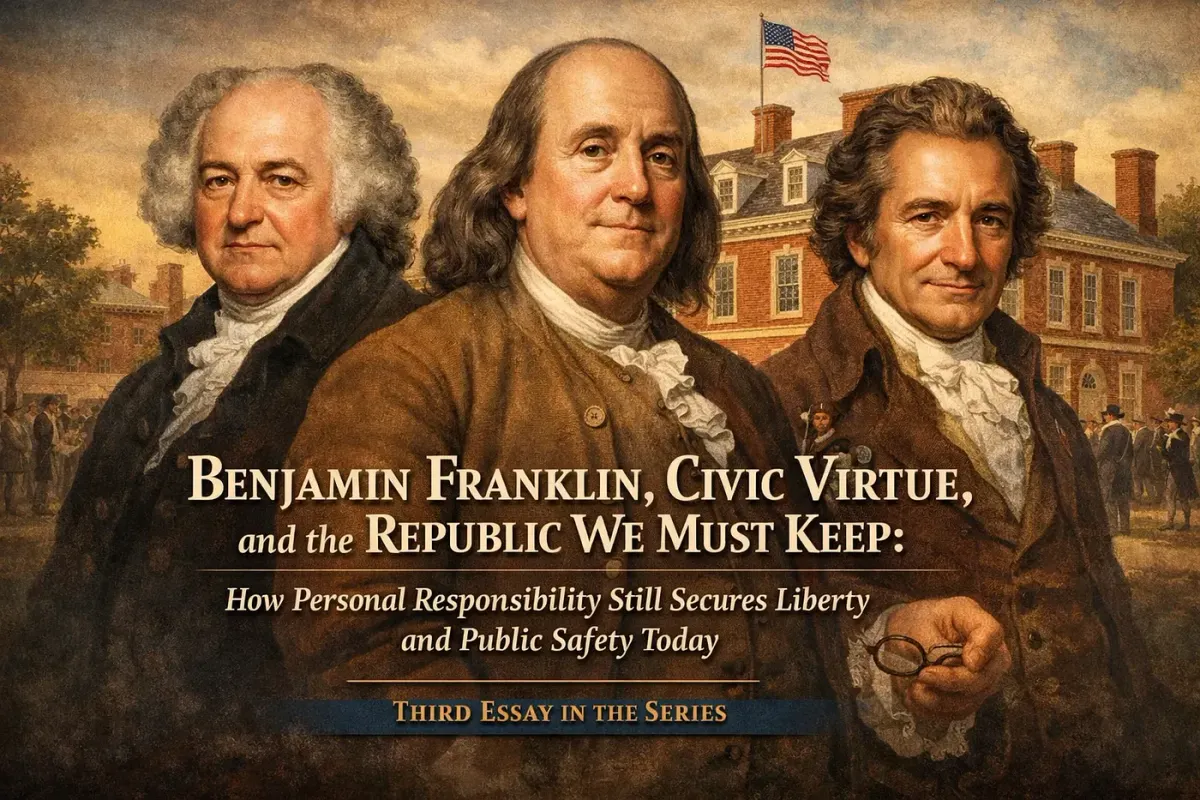
Benjamin Franklin, Civic Virtue, and the Republic We Must Keep: How Personal Responsibility Still Secures Liberty and Public Safety Today
This is the third installment in a series exploring American history through the lens of accountability — how the Founders constructed systems that balanced liberty with genuine responsibility, and why those hard-won lessons continue to shape the work of public safety in our own time.
In the first piece, we examined how John Adams stood in the courtroom at great personal risk, insisting that the rule of law must apply even to those the public had already condemned, because consistency and courage in justice are never optional. That same standard of principled accountability is what professional bail agents practice daily when they ensure that defendants return to face their charges, no matter how inconvenient or unpopular the obligation may be.
In the second, Thomas Paine challenged us to look deeper at the architecture of governance itself, exposing how systems that diffuse responsibility inevitably fail under pressure and demanding instead structures that actually incentivize compliance and consequence. His insistence on real accountability rather than comfortable assumptions still echoes through today’s debates over pretrial release and public safety.
Now we turn our attention to Benjamin Franklin, not as a courtroom advocate like Adams or a radical critic like Paine, but as the consummate practitioner of civic virtue — a self-made man who rose through discipline and practical wisdom, who built lasting institutions, and who understood, perhaps better than any of his contemporaries, that liberty cannot long endure without a foundation of personal and collective responsibility beneath it. Franklin recognized that even the most carefully designed mechanisms of accountability will gradually erode unless the people themselves cultivate the habits of industry, justice, moderation, and resolution. If you want to understand why the work of bail agents remains essential in 2026 — not as a historical artifact but as a living expression of the character required to sustain a free republic — then Franklin’s life and his quiet warning at the close of the Constitutional Convention offer the clearest guidance. When a citizen outside the hall asked what the delegates had produced, Franklin replied with characteristic directness: “A republic, if you can keep it.” That single “if” still carries the full weight of our profession today.
Benjamin Franklin approached the challenge of self-government with the same methodical determination he brought to his printing business and his scientific inquiries. Born into modest circumstances and largely self-educated, he did not rely on inherited status or fiery rhetoric. Instead, he committed himself to a deliberate program of character development that he recorded in his Autobiography with remarkable honesty. He set out to master thirteen virtues — temperance, silence, order, resolution, frugality, industry, sincerity, justice, moderation, cleanliness, tranquility, chastity, and humility — treating them not as abstract ideals but as daily practices to be tracked and refined week by week. These virtues were practical tools by which an ordinary man could rise, contribute meaningfully to his community, and help sustain a society capable of governing itself. Resolution meant the steady determination to perform what one ought and to follow through without fail. Industry demanded that no time be wasted and that every effort be turned toward something useful. Justice required that no one be wronged either by action or by the failure to act when duty called.
This disciplined framework is not an abstract philosophical exercise. It is the quiet foundation that makes systems of accountability effective. In pretrial work, bail agents combine financial stake, family involvement, and direct enforcement in ways that turn personal virtue into reliable compliance. When you track a defendant through the process, coordinate with family members who have a real stake in the outcome, bear financial risk on the bond, and ensure appearance in court, you are exercising precisely those virtues of resolution, industry, and justice — holding individuals to real consequences rather than leaving outcomes to diffuse oversight.
Franklin never tired of reminding his fellow citizens that freedom carries prerequisites. “Only a virtuous people are capable of freedom,” he wrote. “As nations become corrupt and vicious, they have more need of masters.” He understood that when personal discipline and a sense of justice weaken across a society, the natural drift is toward greater external control — toward systems that promise greater efficiency, equity, or automation through centralized risk-assessment tools and unsecured release, yet deliver lower court appearance rates and weakened incentives for defendants and families to meet their obligations. In such an environment, even well-intentioned mechanisms of pretrial accountability face constant pressure to loosen expectations and shift real consequences away from the individual. Both history and daily experience in our profession show that when accountability becomes diffuse in this way — with more missed court appearances and reduced follow-through from those released without stake — public safety does not improve. It becomes more fragile as compliance erodes and the stabilizing force of personal responsibility diminishes. Franklin’s insight remains as relevant now as it was in the early years of the republic: the strength of any justice system ultimately rests on the character of the people who live within it and the professionals who help administer it with consistency and care.
By the time the Constitutional Convention convened in Philadelphia in 1787, Franklin had become the elder statesman whose practical wisdom helped bridge deep divisions among the delegates. He spoke little during the heated debates, but when he did, his words carried the weight of long experience and hard-earned humility. In his final address, read aloud because of his frailty, he confessed that he did not entirely approve of the Constitution as it had been drafted, yet he consented to it because he expected no better and because he doubted his own infallibility on every point. He urged every member still harboring objections to set aside absolute certainty for the sake of unanimity and the greater good. Outside the hall, when asked what form of government the Convention had given the country, Franklin offered his now-famous reply: “A republic, if you can keep it.” That conditional phrase was no casual remark. It was a sober recognition that institutions alone are never enough. Republics endure only when citizens and those who serve the justice system continue to practice the virtues that make self-government possible.
In our own day, this means resisting the temptation to trade proven, incentivized accountability for administrative convenience. It means continuing to uphold systems that place real responsibility on defendants, their families, and the bail agents who stand behind every bond. The legacy of Benjamin Franklin is not found in grand theories but in the daily resolution to keep what the Founders entrusted to us — one case, one appearance, one restored measure of trust at a time.
The story of the American founding is not a closed chapter in a textbook. It is a living inheritance that professional bail agents help carry forward every time they facilitate the difficult but necessary balance between liberty and accountability. Franklin showed us that the republic survives not because it is perfect, but because enough people resolve to perform what they ought, with industry, justice, and moderation.
In 2026 and in the years ahead, your continued commitment to that standard is not only important and honorable — it remains one of the surest stabilizing forces against the erosion of accountability and one of the most necessary ways we can answer Franklin’s challenge and keep the republic we were given. That work has never been more important — or more honorable.
About the Author
Mike Morrison is a Hattiesburg, Mississippi bail bondsman, owner of Mike Morrison Bail Bonding, President of the Mississippi Bail Agents Association, and the 2026 PBUS National Bail Agent of the Year. For more than 35 years, he has worked in Mississippi's criminal justice system while writing about bail bonds, pretrial policy, public safety, and court accountability. His commentary has reached more than one million readers across social media in 2026. Learn more at https://linktr.ee/mdmorrison.
© 2026 Mike Morrison. All rights reserved.