Follow the Money: Who Really Profits From Ending Cash Bail?
Updated and expanded — July 2026
A look at the compensation, funding, and organizational ties behind the movement to abolish professional bail — and what its own IRS filings, corporate marketing, and contract records show.
A cottage industry has grown up around the idea that professional bail is cruel, unnecessary, and worth abolishing. Organizations like the Vera Institute of Justice, the Bail Project, the Brennan Center for Justice, and Arnold Ventures have built national platforms on this premise, positioning themselves as disinterested reformers speaking for the voiceless. Yet a look at their own IRS Form 990 filings tells a different story about who benefits most from the anti-bail movement: the people running it. These are not scrappy grassroots efforts. They are well-funded institutions whose leadership draws salaries most working Americans will never see, funded in part by foundations with hundreds of millions in assets, all while campaigning against an industry that operates on private money and imposes no cost on taxpayers.
When this article first ran on July 1, it focused on one side of the ledger: who runs and funds the movement to end professional bail. Since then, criminal justice researcher JL Fullerton’s seven-part series, The Business of Bail Reform — spotlighted by AIA Surety on July 14, 2026 https://www.aiasurety.com/bail/the-business-of-bail-reform/ — has documented the other side: who gets paid once professional bail is gone. This updated edition adds his findings to the record. Two independent examinations, one conclusion.
What the Filings Show
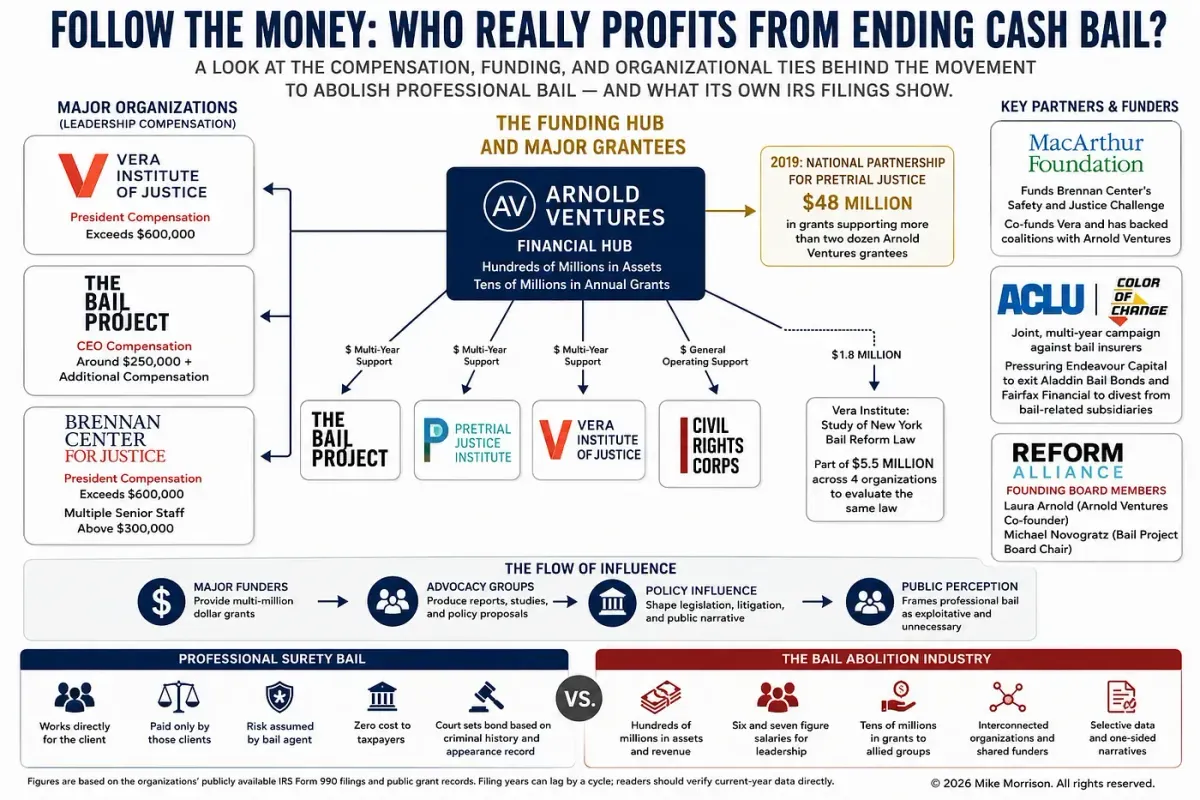
The numbers, as reported in each organization’s own published Form 990s, are not subtle. The Vera Institute president’s compensation package has exceeded $600,000 in recent filings (Vera Institute — ProPublica Nonprofit Explorer). The Bail Project’s CEO compensation has been listed around $250,000, plus additional compensation (Bail Project — ProPublica Nonprofit Explorer). The Brennan Center’s president has drawn compensation exceeding $600,000, with multiple senior staff above $300,000 (Brennan Center for Justice — ProPublica Nonprofit Explorer). Arnold Ventures, through the Laura and John Arnold Foundation, has reported hundreds of millions of dollars in annual revenue and tens of millions in grants distributed to allied advocacy efforts. Readers who want exact current-year figures should pull the latest filing directly, since 990 data updates annually and filing years can lag by a cycle. These organizations are not merely commenting on the bail system — they are a bail-adjacent economy unto themselves, and their leadership is compensated accordingly, while professional bail agents, who work directly with clients and are paid only by those clients, are cast by these groups as the predatory ones.
The Replacement Economy
Eliminating professional bail does not take money out of the pretrial system. It reroutes it. Fullerton’s series documents exactly where it goes — and it starts with the most revealing fact in this entire debate: the world’s largest private prison company is one of bail reform’s loudest advocates.
BI Incorporated — acquired by GEO Group for $415 million in 2011 — markets its ankle monitors on a corporate page titled “Electronic Monitoring Solutions to Support Bail Reform,” openly advising government agencies to prepare for a growing pretrial monitoring population as cash bail is legislated away. Think about what that means. The company that profits when a defendant is locked in a cell also profits when that defendant is released with a monitor strapped to his ankle. According to Fullerton, BI monitors more than 150,000 people and generates roughly $750 million a year, while GEO Group spent $5.1 million in the 2024 election cycle, including lobbying on alternatives to detention and location-monitoring services. If ending secured bail were about justice rather than money, the private prison industry would not be cheering it on.
The economics explain the enthusiasm. Fullerton’s reporting shows monitoring companies charging defendants $10 to $40 per day while billing governments as little as $2 to $3 per day, plus setup fees of $100 to $300 that — unlike a bail premium tied to a contract — are never refunded, even when charges are dismissed. In Mountlake Terrace, Washington, the city reportedly charges defendants $20 a day, pays its contractor $5.75, and pockets the difference from people who are legally presumed innocent. The growth has been explosive precisely where bail reform took hold: Harris County, Texas went from 27 monitored defendants in 2019 to nearly 4,000 in 2021; San Francisco from 60 in 2016 to more than 1,600 in 2021; New York’s pretrial monitoring population rose 64 percent in two years; and after Illinois eliminated secured bail, the state expanded monitoring into 70 of its 102 counties, many of which had never used it.
And here is the part the reform groups never lead with: it doesn’t work. An MDRC study cited in the series found electronic monitoring neither increased court appearances nor reduced new arrests. Even the Vera Institute has acknowledged that monitoring expansion often is not associated with a reduction in jail population. Jails in San Francisco, Harris County, and Cook County held steady or grew while monitoring exploded. Taxpayers are now financing both systems at once.
Drug testing is another layer of the same machine. Per Fullerton, Averhealth paid $1.34 million in 2023 to settle federal False Claims Act allegations over improper drug-test billing in Michigan, after a whistleblowing former lab director testified that up to 30 percent of the results reported to the state’s child-welfare agency were wrong. Cordant Health Solutions paid $11.9 million in 2020 to resolve kickback allegations tied to urine-testing referrals. Both companies kept their government contracts. Defendants, meanwhile, pay $10 to $30 per rapid test out of their own pockets — recurring charges that, unlike a one-time bail premium, never stop as long as the case drags on.
Then there are the “free” risk-assessment tools. Arnold Ventures gives its Public Safety Assessment away to jurisdictions at no upfront cost — while funding the adoption, funding the researchers who study the outcomes, and funding the technical-assistance providers who implement the reforms. Fullerton notes that in Kentucky, the gap in recognizance release rates between white and Black defendants widened from 2 to 10 percentage points after the PSA was implemented, and that by 2020 even the Pretrial Justice Institute — a flagship reform organization — publicly disowned pretrial risk-assessment tools altogether. The reform movement’s own house is divided on its own product.
Charitable Bail Funds: The Unlicensed Competition
Charitable bail funds expose the double standard most clearly. Roughly $90 million flowed into these funds during 2020, and the Bail Project alone reportedly held $68.5 million in assets by 2024. These are not shoestring community efforts. They are well-capitalized organizations performing the same financial function as a bail agent — with none of the licensing, none of the oversight, and none of the financial consequence when a defendant disappears.
The human cost is documented. A CNN investigation cited in Fullerton’s series found that in Hennepin County, Minnesota alone, at least 65 defendants bailed out by the Minnesota Freedom Fund while facing violent or sex-crime felony charges were later convicted. The Bail Project posted $5,000 for Samuel Scott on a domestic violence charge in Kentucky; after release, he beat his wife to death. The Minnesota Freedom Fund posted bond for George Howard on a domestic violence charge; he later committed murder in a road-rage shooting. The failure-to-appear numbers tell the same story: 42 percent for Minnesota Freedom Fund defendants versus 22.5 percent for commercial bail, and 52 percent for Seattle’s Northwest Community Bail Fund versus 24 percent for traditional bail. A licensed bail agent posting those numbers would be out of business and out of a license. The funds faced no comparable accountability until states like Indiana began legislating it.
A Selective Evidence Base
What’s missing from the reform groups’ reports is any real accounting of the other side of the ledger. These groups routinely lean on COVID-era data — a period of court closures, suspended dockets, and abnormal case processing — and frequently cite each other’s studies in what looks, from the public record, like a mutually reinforcing loop that can create the impression of independent confirmation, even when the underlying research shares funders. What they consistently omit is why a person was arrested in the first place, what happened to the business that was robbed or the person who was assaulted, and what it costs a community when someone found by a judge to be a flight or public-safety risk is released without any structure of accountability. A bail system built around behavior and choices — not sympathy narratives — exists because those choices have consequences for real victims, not just for defendants.
And note the sleight of hand in how success gets measured. The expansion of a program is presented as proof the program works. It isn’t. More people on monitors, more supervision officers hired, more defendants enrolled — that proves the system grew, not that more defendants showed up for court, that fewer crimes occurred, or that taxpayers got a better result. Growth is revenue. It is not performance.
The Case for Professional Surety Bail
By contrast, the professional surety bail model these groups attack is built on mutual obligation, not one-sided punishment. A bail agent works for the client: explaining court dates, appearance requirements, how to dress, what to do if they can’t afford an attorney, and what happens if a date is missed or needs to be rescheduled. If a defendant skips court, it is the bail agent — not the taxpayer or the arresting agency — who bears the cost of locating and returning them, at zero expense to the government. Judges, meanwhile, retain discretion to set bond amounts based on a defendant’s criminal history and appearance record, which is how a risk-calibrated, case-by-case system is designed to work. That is not a broken system; it’s a functioning one that the abolition movement rarely describes accurately.
Follow the Funding
The apparent overlap between these groups isn’t just rhetorical — it shows up in the public record of who funds whom. Arnold Ventures operates as the movement’s financial hub: in 2019 it launched the National Partnership for Pretrial Justice with $48 million in grants supporting more than two dozen Arnold Ventures grantees, a roster that includes the Bail Project, the Pretrial Justice Institute, and the Vera Institute of Justice. Civil Rights Corps also receives Arnold Ventures general operating support. Vera’s ties go further still: it received a $1.8 million grant to study the impact of New York’s own bail reform law. That grant was part of a larger $5.5 million commitmentArnold made across four organizations to evaluate that same law — meaning the funder of the policy also funded research assessing whether the policy worked. The Brennan Center has drawn Safety and Justice Challenge funding from the MacArthur Foundation, which co-funds Vera and has backed cross-ideological coalitions with Arnold as well. The ACLU and Color of Change have run a joint, multi-year campaign against bail insurers, pressuring Endeavour Capital to exit its ownership of Aladdin Bail Bonds and Fairfax Financial to divest from bail-related subsidiaries — one coordinated campaign under two organizational names, not two independently arrived-at conclusions. Board rosters overlap too: Arnold Ventures co-founder Laura Arnold and Bail Project board chair Michael Novogratz both sit as founding board members of REFORM Alliance.
Fullerton’s series puts a price tag on the whole network: the MacArthur Foundation’s Safety and Justice Challenge at $381.5 million across 57 jurisdictions since 2015; Arnold Ventures at more than $142 million in criminal-justice reform investment; Open Society Foundations at more than $90 million, including roughly $40 million spent electing prosecutors; and the Ford Foundation at more than $47 million — a combined $700 to $800 million by his estimate. The Vera Institute alone has drawn more than $30 million from all four foundations while simultaneously serving as a technical-assistance provider to their initiatives. Taken together, the public record suggests that what gets presented as separate organizations independently reaching the same conclusions is, in a number of documented cases, the same funder, the same coalition, or the same individuals operating under different letterhead — with the better part of a billion dollars behind it.
A Standard That Should Cut Both Ways
None of this is to say bail reform conversations are illegitimate — court delays, indigent defendants, and pretrial detention length are real issues worth examining. But the organizations leading that conversation are not neutral observers, and neither are the corporations waiting downstream. Nonprofit executives earning six and seven figures, a private prison giant marketing bail reform as a growth market, monitoring and testing vendors billing the accused by the day, and a foundation network spending upward of $700 million to move policy — all while telling the public that anyone who profits from the bail process is inherently exploitative. If accountability and transparency matter — and these groups say they do — that standard should apply to them too. Their own 990s, grant records, corporate marketing, and settlement agreements show they are not outside the system they criticize; they are a larger, richer, and far less scrutinized part of it.
Professional bail is visible, licensed, regulated, and financially accountable. The bail-reform economy is bigger, more dispersed, and far less understood. Two independent examinations of the record — this one and Fullerton’s — now point to the same conclusion. The question worth asking is simple: if this much money and overlap runs through the reform side of the ledger, why has so little of the coverage looked there first?
About the Author Mike Morrison is the 2026 PBUS National Bail Agent of the Year and President of the Mississippi Bail Agents Association. With more than 35 years of hands-on experience as a licensed bail agent and owner of Mike Morrison Bail Bonding Company in Hattiesburg, Mississippi, he brings real-world insight to America’s most important conversations on criminal justice, pretrial policy, public safety, and good governance.
Morrison writes and speaks from the front lines — courtrooms, jails, and communities — rather than from theory. His commentary on policy, taxes, justice reform, and the daily realities facing working Americans has earned more than one million views across social media in 2026 alone. He regularly presents on bail policy and professional standards at the Mississippi Judicial College and leads ethics and training programs for bail professionals nationwide.
Independent, plain-spoken, and grounded in practical experience, Mike is committed to clear-eyed analysis that cuts through political noise — whether the topic is public safety, government accountability, or the true cost of policy decisions on Mississippi families and the nation.
© 2026 Mike Morrison. All rights reserved.