James Madison, Auxiliary Precautions, and the Architecture of Enduring Accountability: How Institutional Design Still Protects Liberty and Public Safety Today
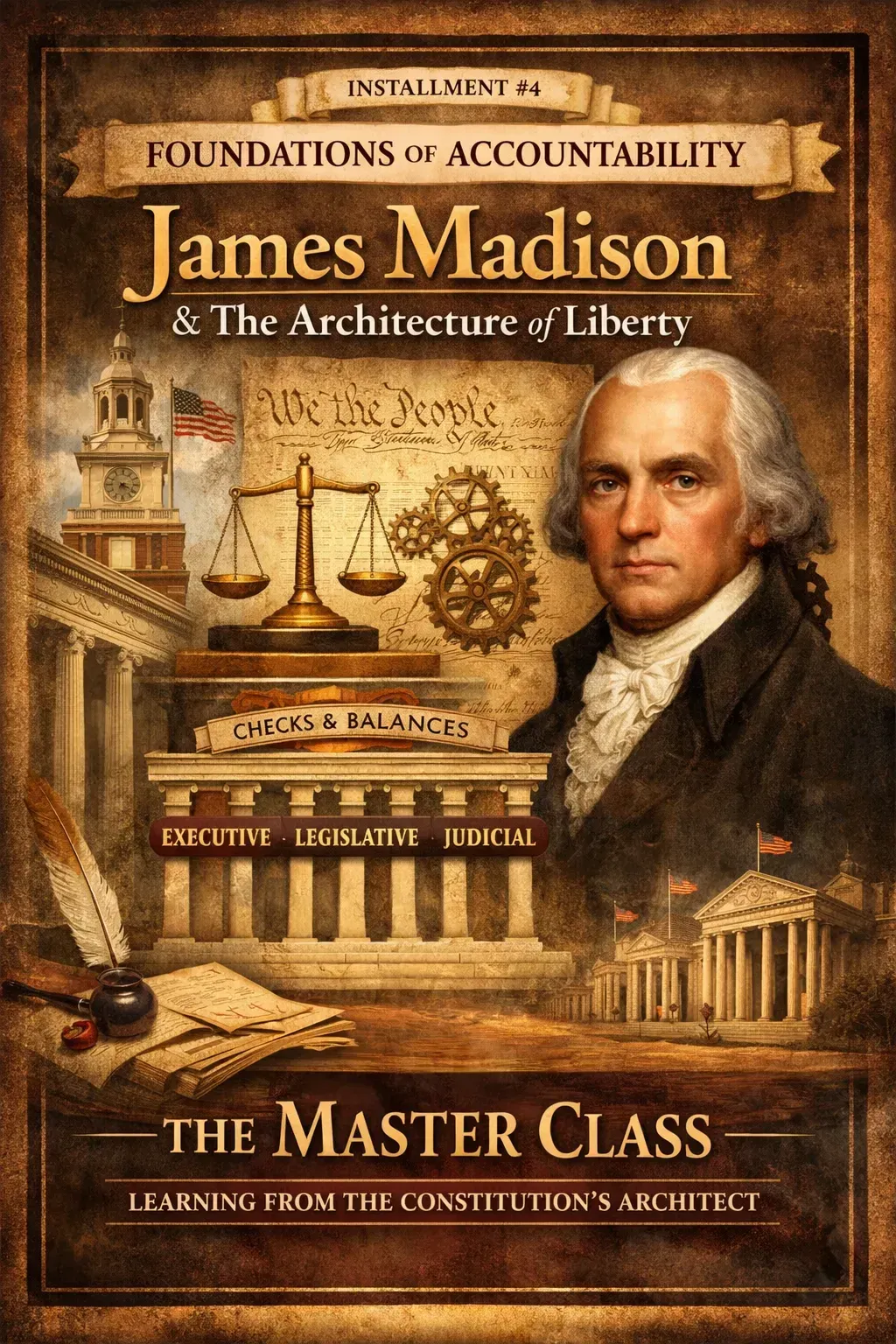
James Madison, Auxiliary Precautions, and the Architecture of Enduring Accountability: How Institutional Design Still Protects Liberty and Public Safety Today
This is the fourth installment in a series exploring American history through the lens of accountability — how the Founders constructed systems that balanced liberty with genuine responsibility, and why those hard-won lessons continue to shape the work of public safety in our own time.
In the first, we saw John Adams stand firm in the courtroom under intense public pressure, insisting that the rule of law must apply equally even to the most unpopular causes because consistency and courage in justice are never optional. In the second, Thomas Paine challenged us to examine the deeper architecture of governance itself, exposing how systems that diffuse responsibility inevitably fail and demanding instead structures that actually incentivize compliance and consequence. In the third, Benjamin Franklin reminded us that even the best-designed mechanisms will erode without a foundation of personal and civic virtue beneath them, warning that a republic can be kept only if the people cultivate the habits of resolution, industry, and justice.
Now we turn to James Madison, not as a courtroom defender like Adams, not as a structural critic like Paine, and not as the practitioner of personal virtue like Franklin, but as the deliberate architect of institutional endurance — the man who understood that liberty and accountability require more than good character or bold ideas; they demand auxiliary precautions built into the very framework of government to protect against the predictable weaknesses of human nature. Madison recognized that factions, passions, and the natural tendency of power to concentrate would always test any system, and he designed safeguards to distribute responsibility, channel ambition, and prevent any single interest from undermining due process or public safety. If you want to understand why the role of professional bail agents remains not merely useful but structurally vital in 2026 — as a living expression of distributed accountability rather than centralized convenience — then Madison’s clear-eyed realism in the Federalist Papers offers some of the most practical guidance the Founders left us.
James Madison approached the challenge of self-government with a profound awareness of human imperfection. While others placed primary hope in the virtue of the people or the wisdom of leaders, Madison accepted that ambition, interest, and passion would always be present in political life. In Federalist №51, he laid out the core insight with characteristic precision: a dependence on the people is the primary control on government, but experience has taught mankind the necessity of auxiliary precautions. He argued that ambition must be made to counteract ambition, connecting the interest of the officeholder with the constitutional rights of the position so that each branch and level of government would have both the means and the motive to resist encroachments by the others. These were not abstract theories. They were practical engineering for a republic that could endure beyond the fleeting moments of public virtue or popular consensus.
This institutional realism is not an abstract constitutional lesson. It is the quiet foundation that makes systems of accountability resilient. Where personal virtue seeks to improve the individual, Madisonian design distributes power and incentives so that self-interest itself becomes a counterbalancing force. In pretrial work, professional bail agents embody this approach through structural redundancy: the financial stake shared by the agent and the defendant’s family, combined with direct enforcement and personal coordination, creates multiple layers of accountability that incentivize compliance more reliably than any single administrative authority. When you track a defendant through the process, coordinate with families who share real consequences, bear financial risk on the bond, and ensure appearance in court, you are helping operate one of those auxiliary precautions — a mechanism that harnesses individual interests toward the broader goal of ordered liberty and public safety.
Madison never underestimated the danger of factions — groups united by common passion or interest adverse to the rights of others or the permanent interests of the community. In Federalist №10, he explained that factions are sown in the nature of man and cannot be removed without destroying liberty itself. The remedy lies in controlling their effects through an extended republic and separated powers, making it more difficult for any single faction to dominate or for temporary majorities to override the steady administration of justice. In our own time, this insight speaks directly to pretrial policy debates. When accountability becomes too concentrated — whether through risk-assessment algorithms that promise scientific neutrality or through unsecured release programs that remove meaningful personal stakes — the system grows more vulnerable to the very passions and interests Madison warned against. Both history and daily experience in our profession show that when real consequences are diffused or removed, compliance weakens, follow-through declines, and public safety becomes more fragile as the stabilizing force of structured responsibility erodes.
By the time the Constitutional Convention met in Philadelphia, Madison had already devoted years to studying ancient and modern confederacies, searching for designs that could withstand the pressures that had destroyed earlier republics. His notes from the Convention, his leadership in shaping the Virginia Plan, and his later defense of the Constitution in the Federalist Papers all reflect the same steady conviction: good government requires not only virtuous citizens but institutions carefully constructed to compensate when virtue is insufficient. He helped craft a system where power is divided, ambition is harnessed, and rights — including protections against excessive or arbitrary pretrial detention — are shielded from momentary majorities or administrative overreach.
In our own day, resisting the temptation to trade proven, distributed accountability for centralized administrative convenience means continuing to uphold systems that place real responsibility on defendants, their families, and the bail agents who stand behind every bond with skin in the game. The legacy of James Madison is found in the deliberate design of mechanisms that keep liberty and accountability in balance across generations — one bond, one appearance, one preserved measure of trust at a time.
The story of the American founding is not a closed chapter. It is a living inheritance that professional bail agents help carry forward every time they participate in the practical architecture of justice. Madison showed us that republics endure not only through the virtue of the people but through institutions wisely engineered to protect against our predictable failings. In 2026 and in the years ahead, your continued commitment to that standard is not only important and honorable — it remains structurally necessary, one of the surest safeguards against the erosion of accountability and one of the most vital ways we can honor the Founders’ design and keep the republic we were given. That work has never been more important — or more honorable.
About the Author
Mike Morrison is a Hattiesburg, Mississippi bail bondsman, owner of Mike Morrison Bail Bonding, President of the Mississippi Bail Agents Association, and the 2026 PBUS National Bail Agent of the Year. For more than 35 years, he has worked in Mississippi's criminal justice system while writing about bail bonds, pretrial policy, public safety, and court accountability. His commentary has reached more than one million readers across social media in 2026. Learn more at https://linktr.ee/mdmorrison.
© 2026 Mike Morrison. All rights reserved.