Public Safety in Mississippi: The Arrest Is Only the Beginning
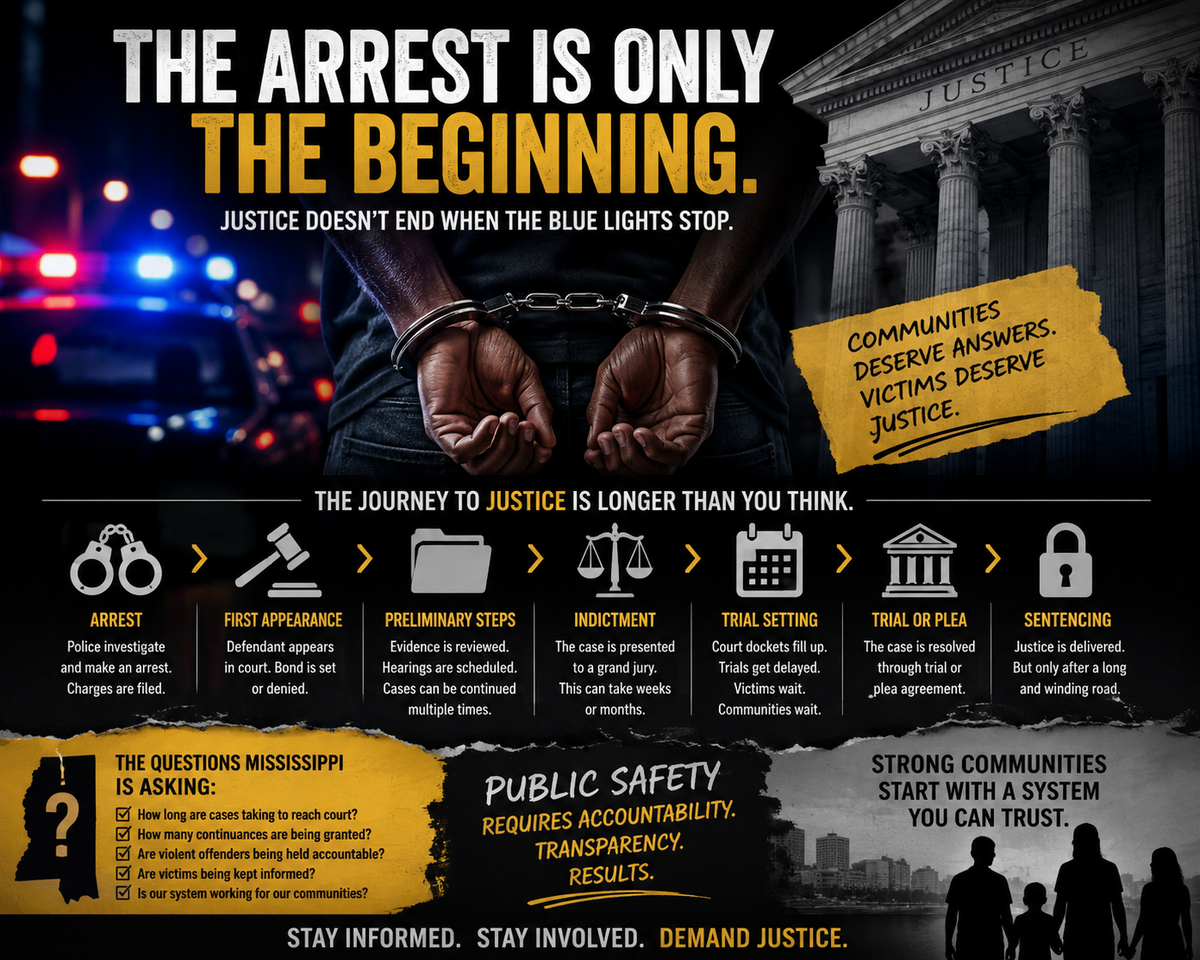
What happens after the arrest may matter more than the arrest itself.
Over the past several days, Mississippi has once again found itself reading headline after headline about violent crime. A horrific triple homicide in Jackson claimed the lives of two young women and a two-year-old child. Along the Gulf Coast, another fatal shooting left a young woman dead and others fighting for their lives. These are not isolated stories anymore. They are becoming part of a pattern that is deeply concerning to families across our state.
Every time one of these tragedies occurs, we see the same cycle. Police officers respond. Detectives work tirelessly. Arrests are made. Prosecutors announce charges. The suspects appear before a judge. The news cameras move on.
But what happens next?
That is the question Mississippi should begin asking far more often.
An arrest is not justice. It is only the beginning of what can become a long and complicated court process. Families deserve to know whether these cases are moving through the courts in a timely manner or whether they are sitting for months—or years—without resolution. Victims deserve to know whether justice is progressing. Communities deserve to know whether the criminal justice system is functioning the way it was intended.
Too often, the public is left in the dark.
News organizations do an excellent job covering the crime scene, the investigation, and the arrest. Yet very little attention is given to what happens after the handcuffs are put on. Was bond granted or denied? Were there conditions of release? How many continuances have been granted? Has the case been indicted? Has it been set for trial? Has a plea agreement been reached? If justice is delayed, why?
Those are not insignificant questions. They are fundamental to understanding whether our criminal justice system is working.
As someone who has spent more than 35 years working inside Mississippi's courts, I believe public safety is measured by far more than arrest statistics. Real public safety requires accountability. It requires transparency. It requires victims and citizens to have confidence that violent offenders are being prosecuted fairly, efficiently, and without unnecessary delay.
Today, many Mississippi residents are asking whether public safety feels absent in their communities. They see the news every night. They hear about another homicide, another shooting, another robbery. They wonder whether their neighborhoods are becoming less safe. They question whether the system is capable of keeping violent offenders off the streets while their cases are pending. Those concerns are real, and they should not be dismissed. Local officials themselves have acknowledged growing concern about the recent increase in violence, particularly in Jackson, while announcing additional public safety initiatives.
This conversation should never become political.
It should become practical.
Every part of Team Criminal Justice has an important responsibility. Law enforcement investigates the crime. Prosecutors present the evidence. Defense attorneys protect constitutional rights. Judges make difficult decisions every day. Bail agents ensure defendants who are released return to court. Each plays a different role, but they all serve the same goal: protecting the integrity of the justice system.
The public deserves to understand how those decisions are being made.
If violent crime is increasing, we should certainly ask why. But we should also ask whether violent criminal cases are moving through our courts efficiently. Are repeat offenders being identified? Are witnesses being protected? Are victims being kept informed? Are court dockets moving at a pace that inspires confidence?
Those are conversations worth having.
Mississippi has no shortage of dedicated police officers, prosecutors, judges, clerks, and criminal justice professionals. What we need is greater transparency so the public can see not only the arrest but the entire journey to justice.
Because justice is not measured by the number of arrests announced at a press conference.
Justice is measured by accountability.
And accountability doesn't end when the blue lights turn off.