Rebuttal: Vera's “Teen Takeover” Guide Has a Missing Word — Victims
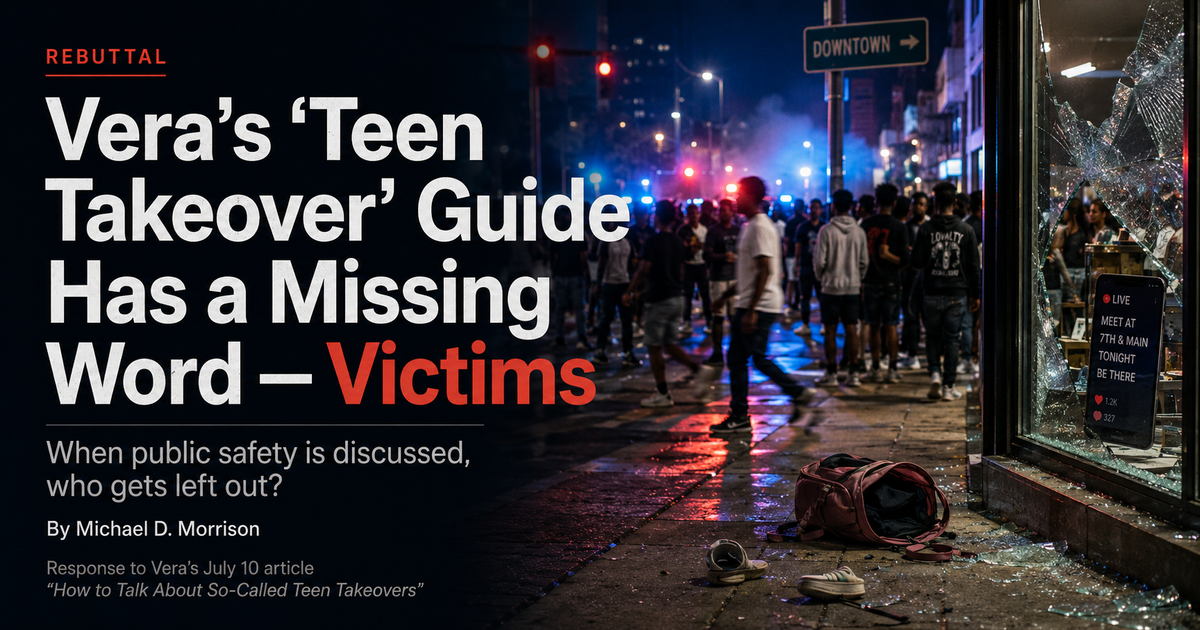
On July 10, the Vera Institute of Justice published a piece titled “How to Talk About So-Called Teen Takeovers.” The title is the most honest thing about it. This is not research. It is a messaging guide, written by a senior writer and filed under the organization's news section, instructing readers on how to reframe a summer of violent mass gatherings — the July 6 NBC News footage of fights and arrests in North Charleston and Raleigh among them — as a media-amplified and misleading narrative. The article concedes, in its own third paragraph, that some of these events have involved serious violence and that they raise legitimate public safety issues requiring thoughtful policy responses. It then spends every remaining paragraph arguing against nearly every enforcement response on the table. The concession is cover. The substance never arrives.
A concession the article never honors
Once an author admits that real violence has occurred, the author owes readers an answer to it. Vera's answer is parks, recreation centers, third spaces, and summer youth employment. Those are prevention investments, and some of them are worthwhile — more on that below. But they are not an operational answer to an imminent gathering. None of them answers the question a police chief in North Charleston actually faces: what do you do when several hundred teenagers, summoned by social media, converge downtown next Saturday night and the fights start? Prevention answers next summer's problem. Vera offers nothing for this weekend's. An article that promises thoughtful policy responses to serious violence and delivers a communications strategy has not kept its promise.
Evidence borrowed from different problems
The article's empirical case is built on studies of things that are not teen takeovers. Its anti-curfew evidence — a 2016 Campbell Collaboration systematic review and a study of Washington, DC's standing curfew — examined broad, standing juvenile curfew policies. Neither study evaluated targeted responses to large, rapidly organized gatherings promoted through social media. Vera therefore treats evidence about one policy problem as though it resolves a materially different one. Its centerpiece prevention evidence, the One Summer Plus study published in Science, found a 43 percent reduction in violent-crime arrests among Chicago summer-job participants over 16 months. That is a real and important finding. It is also a finding about individual program participants over more than a year — not about mass gatherings organized on Instagram in a single afternoon. Vera presents both as settled science on a phenomenon neither one studied.
The political evidence is thinner still. The article cites polling commissioned by Vera Action — Vera's affiliated advocacy organization — and conducted by YouGov Blue, along with a single Washington, DC, mayoral primary, to claim that its approach works politically. But the polling was hardly decisive: one comparison divided voters evenly, while another produced only a 52-to-48 split. That may show that prevention messages can compete with enforcement messages. It does not independently validate Vera's policy conclusions.
The word that never appears
Search the article for the word “victim.” It is not there. The teenager beaten at one of these events is not there. The store owner whose windows came down is not there. The officers assaulted are present only secondhand, through a quotation from someone else's Washington Post op-ed warning that these gatherings too often spiral into fights, robberies, and assaults on police. In Vera's own prose, parents appear only as potential defendants who deserve resources instead of prosecution. The young people who attend appear as misunderstood. The people harmed appear not at all.
This is not an oversight. It is a pattern. Vera's recent earned-time survey — a document urging expanded early release for people convicted of violent crimes — likewise contains no substantive discussion of victims’ interests, no acknowledgment that survivors rely on the finality of a sentence, no accounting of the cost when higher-risk individuals return to communities sooner. In this guide and in Vera's recent earned-time advocacy, the framework is consistent: the only harm worth measuring is the harm of punishment. The harm that made punishment necessary goes unrecorded.
Accountability is older than the republic
Vera treats accountability as a rhetorical trick played on the public by cable news. History says otherwise. The principle that wrongs must be answered runs back at least to Magna Carta in 1215, which promised that justice would be neither sold, denied, nor delayed — a promise made to the injured, not the accused alone. In the English common law the colonists inherited, crimes had injured parties whose claims on justice were real, and in colonial and early America it was frequently the victim who initiated and carried the prosecution. The Founders who wrote “excessive bail shall not be required” into the Bill of Rights did so within a system that took for granted the other half of the bargain: the accused would appear, answer, and — if convicted — be held to account. Accountability is not a modern punitive invention or an outdated “narrative.” It is the oldest promise the law makes, and it is made to the community and the victim as much as to the defendant.
What Vera gets right — and what it refuses to say
Fairness requires granting the article its strongest points. The shortage of safe places for teenagers to gather is real; the Chicago Tribune's interviews with young people describing neighborhoods with nothing to do reflect a genuine failure of civic investment. The summer-jobs research deserves to be taken seriously, and cities should fund those programs on their own merits.
But prevention and accountability are not rivals, and the article's entire architecture depends on pretending they are. No one defunds a recreation center by prosecuting the organizer of a violent event. The Florida strategy the article derides actually draws the distinction Vera claims to want: it focuses on organizers, coordinated criminal activity, and crimes committed during these events — not mere attendance at a gathering. The parental-accountability policy in Washington, DC requires evidence that a parent knew, should have known, permitted, or failed to prevent delinquent conduct. It is not automatic punishment of every parent whose child happens to be outside after dark. Those distinctions matter. Vera flattens targeted enforcement and indiscriminate punishment into the same category because acknowledging the distinction would weaken its argument.
A better standard for policymakers
The article makes one claim worth holding it to: that it is “difficult to assess how common or how dangerous these events actually are.” Notice what Vera does with that uncertainty. It does not suspend judgment. It concludes — confidently — that enforcement responses are wrong, that the cause is boredom, and that the cure is recreation funding. If the data is too thin to justify a curfew, it is too thin to justify Vera's causal story, which rests principally on one 19-year-old's interview. Uncertainty that cuts in only one direction is not uncertainty. It is a conclusion looking for cover.
Policymakers should demand better from everyone in this debate: real incident data before declaring the problem either a crisis or a myth; enforcement tools that distinguish organizers from attendees and violent events from harmless ones; prevention investment funded on its own merits rather than offered as a substitute for consequences; and a documented seat at the table for the people these events have hurt. And they should read Vera's guide to the end while asking one question the authors never do: where are the people who were harmed? In Vera's telling, they do not exist. A guide to talking about crime that cannot say the word victim is not a guide to public safety. It is a guide to looking away.
About the Author Mike Morrison is the 2026 PBUS National Bail Agent of the Year and President of the Mississippi Bail Agents Association. With more than 35 years of hands-on experience as a licensed bail agent and owner of Mike Morrison Bail Bonding Company in Hattiesburg, Mississippi, he brings real-world insight to America’s most important conversations on criminal justice, pretrial policy, public safety, and good governance.
Morrison writes and speaks from the front lines — courtrooms, jails, and communities — rather than from theory. His commentary on policy, taxes, justice reform, and the daily realities facing working Americans has earned more than one million views across social media in 2026 alone. He regularly presents on bail policy and professional standards at the Mississippi Judicial College and leads ethics and training programs for bail professionals nationwide.
Independent, plain-spoken, and grounded in practical experience, Mike is committed to clear-eyed analysis that cuts through political noise — whether the topic is public safety, government accountability, or the true cost of policy decisions on Mississippi families and the nation.
© 2026 Mike Morrison. All rights reserved.