Same Money, New Costume: Arnold Ventures Rebranded. The Playbook Didn't.
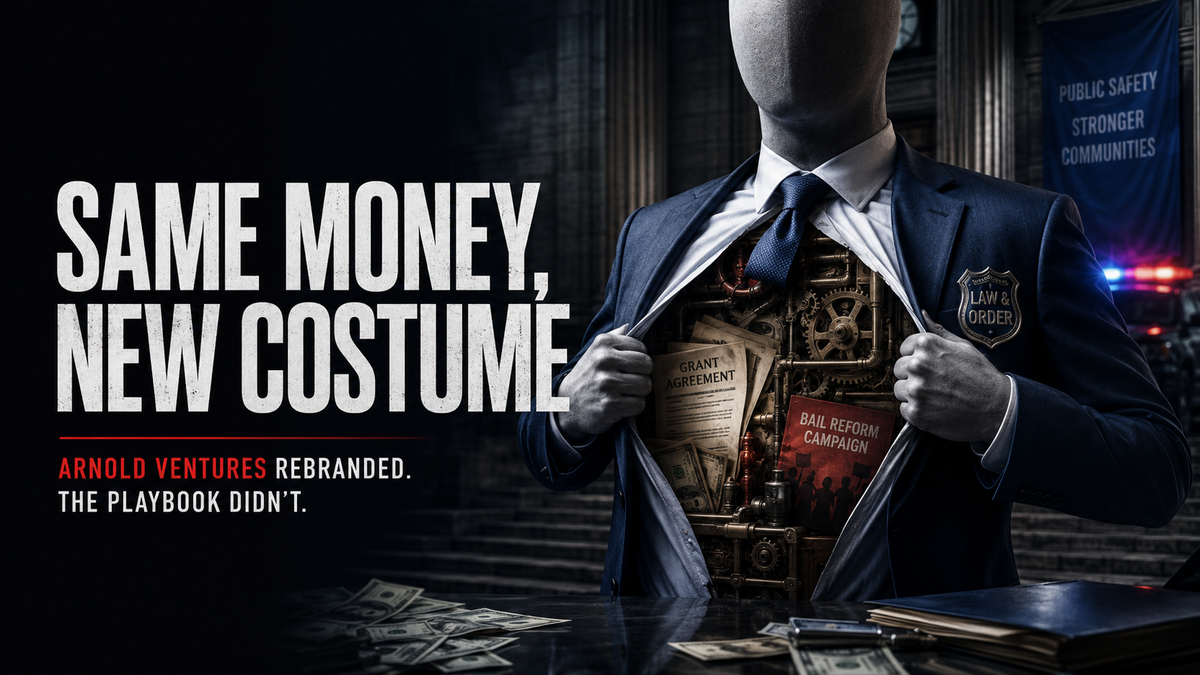
The funders behind bail reform now lead with cops and clearance rates — because their original mission collapsed and the country rejected it.
Visit Arnold Ventures' criminal justice page today and you'll see a police officer high-fiving a child. You'll see press releases applauding the Pennsylvania legislature for helping solve violent crimes faster. You'll see Arnold Ventures matching Utah's investment in law enforcement and celebrating clearance-rate legislation. Podcasts about how to train a cop. If you didn't know better, you'd think you were looking at a law-and-order foundation.

You do know better. This is the money behind the bail reform movement — the philanthropic engine that spent years funding the researchers, the advocates, and the policy shops working to dismantle the commercial bail system. The costume changed. Look closer and the playbook didn't.
The cheeseburger trick, at scale
At the top of the page, four numbers in giant type. The one that matters: 465,000 “unconvicted people in jail.”
That's it. No context. Nothing about what those people are charged with. Nothing about their criminal histories, their prior failures to appear, their pending cases, or their risk scores. Just a number engineered to make you picture half a million innocent Americans rotting in cells for no reason.
If that technique sounds familiar, it should. Last week I showed you how the Bail Project — an Arnold Ventures-style advocacy operation — built a national story around a $7 cheeseburger while deleting the defendant's 60-plus prior convictions and his record of violating pretrial release. Same move here, just bigger. “Unconvicted” is doing the work “cheeseburger” did: it strips out the record so the number can lie to you without technically lying. How many of those 465,000 are repeat offenders? How many have failed to appear before? How many were assessed as high-risk by the courts that hold them? The page doesn't say. The page is designed not to say.
Their own algorithm agrees with the bail industry
Here's what Arnold Ventures would rather you not connect. They built a pretrial risk algorithm — the Public Safety Assessment, the PSA — developed from roughly 750,000 cases across nearly 300 jurisdictions and licensed to courts through Arnold Ventures itself. Their researchers tested hundreds of factors to find what actually predicts whether a defendant will come back to court or reoffend.
What did their own science land on? Prior convictions. Prior incarceration. Prior failures to appear. Violent offenses. Pending cases.
Read that list again. It is the exact list every judge and every licensed bail agent in America has used for generations. Arnold Ventures spent a fortune building an algorithm, and the algorithm concluded that criminal history and failure-to-appear history predict pretrial risk — the very factors their grantee network attacks judges for using. When a judge weighs a defendant's record, it's called injustice. When their algorithm weighs the same record, it's called evidence-based reform. You cannot have it both ways. Their own tool is a signed confession that the traditional criteria were right all along.
They fund the evidence, the advocates, and the applause
The page describes the model in plain sight: Arnold Ventures funds the research, then funds the “policy and advocacy” to “achieve impact at scale.” Follow that sentence to its conclusion. Their grants produce the studies. Their grantees cite the studies. Their press office then applauds the legislation — sometimes alongside other organizations they also fund. The referee, the players, and the cheering section all share one checkbook.
The funding is so pervasive that even independent academics have to disclose it. When the California Policy Lab validated the PSA in San Francisco, the researchers added a disclaimer noting their lab receives general operating support from Arnold Ventures — and stating they deliberately declined to seek Arnold funding for that particular study to avoid the appearance of a conflict. Think about what that tells you. The people evaluating Arnold's tool had to build a firewall against Arnold's money, because Arnold's money is already everywhere in the field. That is not a research ecosystem. That is a company town.
Arnold Ventures publishes summaries of its research grants, and to their credit, the list is public. I encourage every bail professional to read it. It is the map of the machine: who got paid, how much, and for what conclusions.

The mission failed. So the mission changed.
Don't take my word for it that the original mission collapsed. Take theirs.
Start with the mission in Arnold Ventures' own 2019 statement of principles: the goal was eliminating what they called unjust pretrial detention, and the PSA was one of their earliest and proudest investments — funded since 2013, piloted quietly, then released nationwide in 2018 as the tool that would replace the judgment of judges and the bail industry alike.
Then their own movement turned on them. In November 2020, the Pretrial Justice Institute — for decades the flagship advocacy organization of pretrial reform — published a formal paper titled “The Case Against Pretrial Risk Assessment Instruments.” In it, the movement's own institute reported that the failure-to-appear model in Arnold's PSA scored 0.644 in predictive accuracy, on a scale where 0.5 is a coin flip. Sit with that. The reform movement's own experts concluded that the flagship funder's flagship tool predicts flight risk barely better than flipping a quarter. Around the same time, reform-friendly outlets were reporting data showing risk assessment tools had little measurable impact on pretrial incarceration at all, and a 2024 UCLA study found California's celebrated Humphrey ruling produced no detectable reduction in the state's pretrial jail population, bail amounts, or time spent in jail.
 • Locations: United States of America • Topics: Bail/Pretrial Release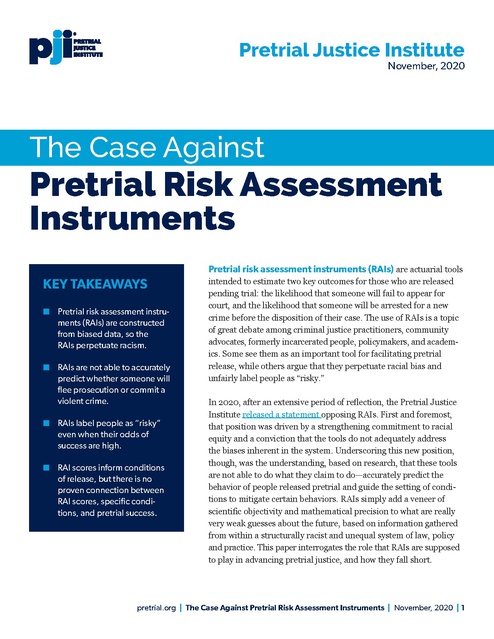
Then the voters weighed in. Look at the scoreboard the Marshall Project itself laid out this spring: New Hampshire rolled back its bail reforms and lowered the bar for prosecutors to deny bail, with state officials pointing to rising jail populations as proof the correction is working. Alabama voters are deciding this month whether to expand the list of charges where judges can deny bail outright. Indiana voters will decide in November on a constitutional amendment dramatically expanding judges' power to hold defendants pretrial. In Illinois — the no-cash-bail showcase — lawmakers renewed calls to tighten the law after a Chicago police officer was killed, allegedly by a man out on electronic monitoring. And the President of the United States signed an executive order targeting cashless bail by name. That is not a policy debate. That is a nationwide rejection, in legislatures, at ballot boxes, and in the White House.
A movement whose own institute repudiated its tool, whose own data showed no results, and whose product voters are repealing state by state had exactly two options: admit the mission failed, or change the subject. Arnold Ventures changed the subject. Safety first. Police partnerships up front. The word “bail” nowhere near the headline.
What never happened was an accounting. No acknowledgment of what the earlier funding built. No reckoning with the victims created along the way. The same foundation that bankrolled the movement now positions itself as the friend of law enforcement, and it is counting on you not to remember. The 465,000 figure at the top of the page is the tell: the rebrand is cosmetic. The method — strip the records, fund the echo chamber, applaud your own results — is fully intact.
Judges saw through the cheeseburger. Voters are seeing through the statistics. And the industry they spent a decade trying to bury is still here, still writing bonds, still getting defendants to court — no algorithm, no grant network, and no costume required.
Sources: Arnold Ventures, “Criminal Justice” program page, arnoldventures.org; Arnold Ventures, Statement of Principles on Pretrial Justice, 2019; Pretrial Justice Institute, “The Case Against Pretrial Risk Assessment Instruments,” November 2020; California Policy Lab, “Validation of the PSA in San Francisco,” July 2021; The Appeal, February 2020; UCLA School of Law pretrial report, 2024; The Marshall Project, “Did the California Supreme Court Just Remake the State's Bail System?” May 9, 2026; Arnold Ventures Summaries of Research Grants.
About the Author Mike Morrison is the 2026 PBUS National Bail Agent of the Year and President of the Mississippi Bail Agents Association. With more than 35 years of hands-on experience as a licensed bail agent and owner of Mike Morrison Bail Bonding Company in Hattiesburg, Mississippi, he brings real-world insight to America’s most important conversations on criminal justice, pretrial policy, public safety, and good governance.
Morrison writes and speaks from the front lines — courtrooms, jails, and communities — rather than from theory. His commentary on policy, taxes, justice reform, and the daily realities facing working Americans has earned more than one million views across social media in 2026 alone. He regularly presents on bail policy and professional standards at the Mississippi Judicial College and leads ethics and training programs for bail professionals nationwide.
Independent, plain-spoken, and grounded in practical experience, Mike is committed to clear-eyed analysis that cuts through political noise — whether the topic is public safety, government accountability, or the true cost of policy decisions on Mississippi families and the nation.
© 2026 Mike Morrison. All rights reserved.