Stop Calling It Fraud. It’s Theft.
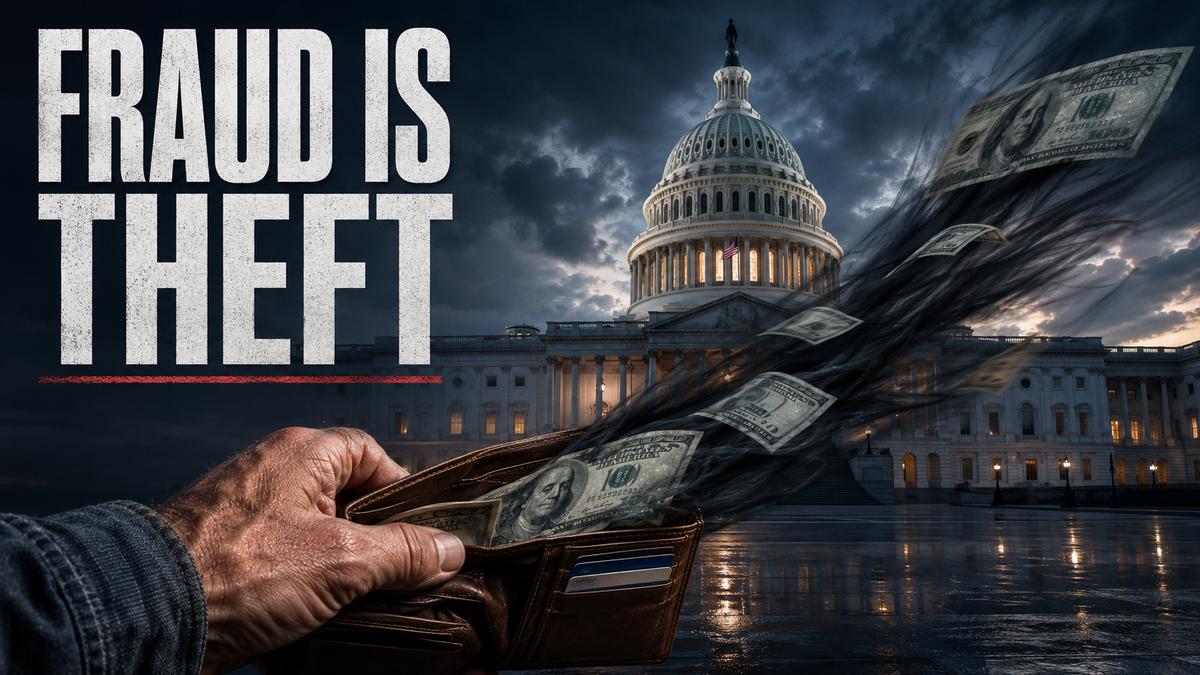
Every dollar stolen from a government program is a dollar taken straight out of the pocket of every working American — and it's past time we treated it that way.
Call it what it is. When someone bills the federal government for autism therapy that was never delivered, that is theft. When a nonprofit collects $250 million to feed children and pockets the money, that is theft. When a person carries three different Social Security numbers to collect benefits under three different names, that is theft. The word “fraud” makes it sound like an accounting problem. It isn’t. It is stealing — from the taxpayer, from the working family, from the neighbor who actually needs the program the thief just looted.
I am tired of watching this country treat government fraud as a budget line item to be managed. I want to talk about what it actually costs every working American — and what real accountability looks like.
The Number Nobody Puts on the Evening News
The Government Accountability Office — the nonpartisan federal watchdog — has estimated that the federal government loses between $233 billion and $521 billion every single year to fraud. GAO is careful to call this an estimate of potential fraud losses, not a final tally of proven criminal convictions — because the systems to count it precisely don’t fully exist. That caveat does not comfort me. It should alarm you.
On top of that, federal agencies reported $186 billion in improper payments in fiscal year 2025 alone. To be fair, not every improper payment is deliberate theft — some are administrative errors, missing paperwork, or payments sent to the right person in the wrong amount. But here is what that admission actually tells you: Washington cannot keep track of its own paperwork. A government that cannot catch its clerical errors is not going to catch a determined criminal. The sloppiness and the fraud live in the same ecosystem, and they feed each other. Since 2003, cumulative improper payments total roughly $3 trillion.
Three trillion dollars. Stolen, misdirected, or lost to bureaucratic incompetence. If you put that money in a line, it would cover the entire federal budget for nearly five months.
And yet Washington treats it as background noise.
Minnesota: What It Looks Like Up Close
If you want to see fraud in action, look at Minnesota. A nonprofit called Feeding Our Future collected more than $250 million from a federal program meant to feed children during the pandemic. The money went to fictitious meal sites, phantom children, and the bank accounts of people who saw a government program with low barriers and no oversight and treated it as a personal ATM. In May 2026, ringleader Aimee Bock was sentenced to nearly 42 years in federal prison and ordered to repay $243 million. Seventy defendants charged. Sixty-five convicted.
That was just one program. Federal prosecutors have now identified 14 Minnesota state programs as high-risk for fraud. The First Assistant U.S. Attorney for Minnesota has said the total could surpass $9 billion — one preliminary federal estimate suggesting that more than half of roughly $18 billion spent across those programs since 2018 may have been fraudulent. Autism therapy billed for children who were never treated. Housing assistance claimed for addresses that didn’t exist. Medicaid dollars funneled through shell companies with no employees and no patients.
Minnesota is not an exception. It is an example of what happens in every state when government programs grow faster than oversight, when political pressure discourages scrutiny, and when the penalty for getting caught is treated as a cost of doing business.
The Social Security Problem Nobody Can Fully Count
Here is something the auditors will tell you and the politicians won’t: we do not know the full scope of Social Security fraud, because the systems to detect it comprehensively have never been fully built.
What we know is this. From 2015 through 2022, the Social Security Administration paid out nearly $8.6 trillion in benefits. Its own Inspector General found $71.8 billion in improper payments during that period — less than one percent. The agency says its records are highly accurate. That may be true as far as the agency can see. The problem is what the agency cannot see.
The use of multiple Social Security numbers by living individuals — obtained through identity theft, immigration fraud, or deliberate manipulation of a system never designed to cross-reference itself in real time — is documented anecdotally and known to prosecutors. What we cannot tell you is how many people are doing it and how much it costs, because the data systems to detect it at scale have never been fully built. That is not an accident. That is a choice. GAO has been recommending real-time cross-agency data matching for years. Congress has been slow to fund it. The crime here is not just the potential theft — it is the intentional blind spot. When you cannot see the fraud, the audit says there is no fraud. And the thief keeps cashing the check.
What It Would Mean for Every Working American
Here is the math, plainly stated. Washington spent roughly $7 trillion in fiscal year 2025 and collected about $5.2 trillion. The deficit — the amount borrowed — was approximately $1.8 trillion.
If every dollar of documented fraud were recovered — every dollar of GAO’s upper estimate of $521 billion — it would cover roughly 28 percent of the annual deficit. Taxes don’t automatically drop, because the recovered money goes to reduce borrowing first. But the downstream benefit to every working American is real: less borrowing means less interest on the national debt, which already consumes more than $1 trillion a year and crowds out every other national priority.
And if Congress chose to return recovered fraud dollars directly — to reduce rates, to offset payroll taxes, to fund programs honestly — even a fraction of that recovery would mean real money in real paychecks. Half of GAO’s midpoint estimate returned to taxpayers works out to roughly $1,200 per household. That is not nothing. That is a car payment. A utility bill. A month of groceries.
More than the dollars, though, is the principle. Every dollar stolen from a government program is a dollar that was supposed to go somewhere legitimate — to a child who actually needed a meal, to a senior who actually needed housing help, to a veteran who actually earned the benefit. Fraud doesn’t just cost money. It hollows out the programs that working Americans pay for and depend on.
What Real Accountability Looks Like
I am not interested in task forces and awareness campaigns. I am interested in consequences.
Fraud is theft. Theft has a penalty. In this country, if you steal a car, you go to jail. If you steal $250 million from a children’s feeding program, you should go to jail for a very long time — and Aimee Bock’s 42-year sentence is a start. But prosecution after the fact is not enough when the fraud happens in the first place because nobody was watching the register.
Real accountability means three things. First, restitution is mandatory. You stole it, you pay it back — every dollar, not a negotiated fraction. Asset confiscation should be the first step, not the last. Every property, every vehicle, every bank account touched by fraud proceeds is forfeit.
Second, the politicians and administrators who ignored warning signs, killed audits, or looked away for political reasons bear responsibility too. Minnesota’s Feeding Our Future fraud was flagged by auditors years before the full scope was exposed. The state hesitated to act. That hesitation has a cost, and the people who made that choice should answer for it.
Third, the systems that make fraud easy have to be rebuilt. Real-time cross-agency data matching. Mandatory cross-referencing of Social Security numbers against death records, Medicaid rolls, and benefit databases before a check is cut — not after. Licensing requirements for providers in Medicaid-funded programs. Independent Inspectors General with real authority and real budgets. These are not radical ideas. GAO has been recommending most of them for a decade. The only thing missing is the political will to fund them and the political courage to stop treating fraud enforcement as an attack on the programs themselves.
The Question Worth Asking
Every politician in Washington claims to oppose waste, fraud, and abuse. It is the safest position in American politics. Nobody is in favor of fraud.
So why is $3 trillion missing since 2003?
Why does GAO keep issuing the same recommendations year after year, and Congress keeps nodding and moving on? Why do states like Minnesota expand programs faster than they can monitor them, then act surprised when the money disappears? Why are the data systems that could catch duplicate benefits and phantom providers still not built?
The answer, in most cases, is that somebody benefited from the fraud — or from the conditions that allowed it — and had enough influence to keep the oversight light. That is not a Democratic problem or a Republican problem. It is a power problem. And the working American who pays the bill has less power than the people cashing the fraudulent checks.
Fraud is theft. Theft has victims. In this case, the victim is every man and woman who gets up and goes to work and pays taxes in good faith, trusting that the money goes where it is supposed to go. They deserve better than a $3 trillion betrayal and a task force.
They deserve accountability. And I intend to keep demanding it.
About the Author
Mike Morrison is the 2026 PBUS National Bail Agent of the Year and President of the Mississippi Bail Agents Association. With more than 35 years of hands-on experience as a licensed bail agent and owner of Mike Morrison Bail Bonding Company in Hattiesburg, Mississippi, he brings real-world insight to America’s most important conversations on criminal justice, pretrial policy, public safety, and good governance.
Morrison writes and speaks from the front lines — courtrooms, jails, and communities — rather than from theory. His commentary on policy, taxes, justice reform, and the daily realities facing working Americans has earned more than 1.25 million views across social media in 2026 alone. He regularly presents on bail policy and professional standards at the Mississippi Judicial College and leads ethics and training programs for bail professionals nationwide.
Independent, plain-spoken, and grounded in practical experience, Mike is committed to clear-eyed analysis that cuts through political noise — whether the topic is public safety, government accountability, or the true cost of policy decisions on Mississippi families and the nation.