Surety Bail Was Always the Answer. Bail Reform Spent a Decade Attacking It — and Hinds County Is the Result
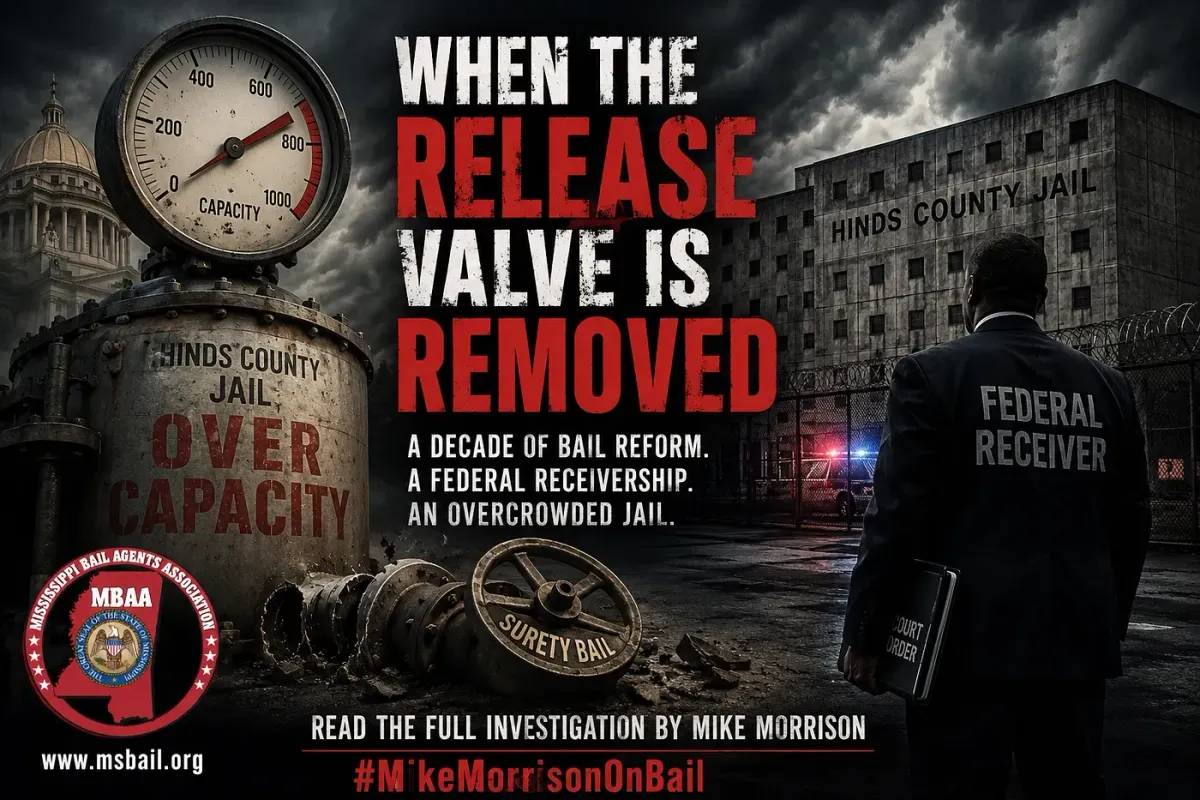
For nearly ten years, an organized movement told Mississippi that secured bail was the enemy of justice. They got much of what they wanted. Now a federal receiver runs the Hinds County jail, hundreds sit inside without an indictment, and the county is shipping the overflow out of county at $67 a head. This is what happens when you dismantle the one release valve that costs taxpayers nothing — and promise a government replacement that never arrives.
On October 1, 2025, Hinds County lost control of its own jail. A federal receiver, Wendell M. France Sr., took over operational command of the Raymond Detention Center after more than a decade of litigation that began with a 2016 Justice Department lawsuit and ran through two contempt findings against the county in 2022. The facility was built for roughly 600 people. Seven detainees died there in 2021. Monitors reported that the jail needs around 250 staff to run its two pods, and that the county had only 71 positions budgeted — under 29 percent of what the building requires. This is not a system with margin to spare.
Within weeks of taking over, the receiver did something telling. According to The Marshall Project, France wrote to District Attorney Jody Owens to say, in plain terms, that he cannot fix the jail while it stays this full. Holding hundreds of people is expensive for county taxpayers, he wrote, and the staff and money that should be going toward repairs are instead being burned managing a swollen pretrial population. His instruction to the DA was to address the delays immediately.
Read that again. The man brought in by a federal court to remedy unconstitutional conditions identified the single most actionable lever available to him: fewer bodies in the building. Release the people who can be safely released, and do it faster.
That is precisely what commercial surety bail is built to do — and it does it without spending a dollar of public money. It is also precisely the tool that a well-funded reform movement has spent the last decade trying to strip out of Mississippi. To understand how Raymond got this bad, you have to understand what was done to the release valve that used to keep jails like it from filling up.
How we got here: the reform experiment
For years, Mississippi has been a marquee target of the national campaign against secured bail. The Roderick and Solange MacArthur Justice Center at the University of Mississippi School of Law, often partnered with the Southern Poverty Law Center, ran a sustained litigation drive against money bail across the state. Jackson, Biloxi, Moss Point, Corinth, and Meridian all entered settlements that ended or sharply curtailed secured money bail and pushed courts to release most arrestees on their own recognizance — a bare promise to appear, with no bondsman and no money on the line. The 2017 Mississippi Rules of Criminal Procedure reworked how courts set conditions of release statewide.
The campaign’s central claim was explicit. As MacArthur’s director has put it, the law should require release at the first appearance on conditions that don’t include buying one’s way out through a bail bondsman, and judges who keep using money bail are filling jails with poor people. Reform’s promise, in other words, was that Mississippi could safely empty its jails by releasing people without secured surety — on recognizance, on supervision, on the honor system — and that doing so would be both more humane and cheaper.
Take that promise seriously, because Hinds County did. The reform vision suppresses the secured bond on the front end — through litigation, through the threat of litigation against individual judges, through a political climate in which setting a money bond is cast as criminalizing poverty. But it only works if something replaces the bond: real pretrial-services infrastructure, staffed supervision, fast case processing, someone whose job and budget are dedicated to making sure released defendants come back and their cases move. That is the half of the bargain government was supposed to deliver.
It never did. And the result is the jail France now runs.
The numbers describe a release problem, not a charging problem
Look at who is actually in the Raymond jail. These are overwhelmingly pretrial detainees — people who have been arrested but not convicted of anything, and in a striking number of cases not even formally accused. WJTV reported in November 2025 that the Hinds County jail system was running in excess of 900 pretrial detainees, roughly 200 over what Raymond was built to hold, with another 200 shipped to Tallahatchie County at a cost of $67 per detainee, per day. At an August board meeting, the sheriff put the count above 800 and pointed to arrest volume — Capitol Police alone, he said, were booking more than 100 people into the jail.
The most disturbing figures come from the reporting on indictment delays. The Marshall Project and Mississippi Today documented that at least 60 people had sat in Hinds County detention for more than three months with no indictment filed — at least five of them for over a year, and one man for 18 months on drug charges, with no attorney assigned to move his case. Mississippi is one of the few states that allows a person to be jailed indefinitely without an indictment at all.
The local press has traced the immediate delays to an expanded Capitol Police force feeding more arrests into the system, an overwhelmed state crime lab, and a shortage of prosecutors and public defenders. The county’s public defender, Gail Wright Lowery, said five attorneys had recently left an office funded for just fourteen, and that every departure strands roughly a hundred detainees without counsel. She and the DA jointly asked the Board of Supervisors for $700,000 in emergency money just to begin digging out.
None of that absolves the administrative failures. But administrative failures happen everywhere, all the time. The question is why these particular failures metastasized into a federal receivership and a humanitarian emergency instead of being quietly absorbed. The answer is that the shock absorber was gone. In a functioning system, a large share of those 900 pretrial detainees would never have piled up, because eligible defendants would have been written out on secured bonds within days of arrest — by private bondsmen, at no cost to the county, with a private party on the hook to bring them back. Strip that mechanism out, demonize the judges who use it, and never build the public alternative you promised, and arrest volume has nowhere to go but into the cells. That is not a charging problem the county stumbled into. It is the predictable endpoint of the reform experiment.
Surety is the one release valve that costs the public nothing
When a judge sets a secured bond, a defendant has a fast, private path out of jail. As even The Marshall Project’s own defendant guide explains, a bonding company typically takes a premium of around 10 percent and assumes responsibility for the full bond amount if the client fails to appear. That single transaction does three things no government program in Hinds County is currently positioned to do:
It moves an eligible person out of an overcrowded, understaffed, federally supervised jail today, not after a grand jury that the guide itself notes faces no time limit and may not act for a year or more.
It does so at zero taxpayer cost. Every defendant a bondsman writes is one fewer body the county pays $67 a day to warehouse in Tallahatchie, and one less unit of pressure on a facility the receiver is straining to stabilize.
And it puts a private party with real money on the line in charge of making sure that defendant comes back to court — and of finding them if they don’t. That is supervision and accountability the county does not have to staff, fund, or manage.
In a jail running at under 29 percent of required staffing, with a public defender’s office hemorrhaging lawyers and a DA begging for emergency funds, the reform prescription — that government should take on more, building a publicly funded pretrial-services bureaucracy and supervising releases itself — collides with an obvious fact. A county that cannot staff its jail or its public defender’s office is in no position to replace a privately funded release mechanism with another taxpayer-funded one. Surety bail already works, already exists, and already costs the public nothing. The reform agenda would dismantle it and hand the bill to the same taxpayers now paying $100 million for a new jail and $67 a head for overflow beds.
The reform pitch doesn’t survive contact with Hinds County
The case against commercial bail usually runs on two themes: that it punishes the poor, and that recognizance or supervised release works just as well. Hinds County is the place those arguments go to die.
On poverty: the people genuinely abandoned by this system are not the ones a bondsman could get out for a 10 percent premium. They are the ones with no secured bond path and no indictment — held for a year, eighteen months, with no lawyer and no court date in sight. A robust surety market is a lifeline for low-income defendants who can access a few hundred dollars and a bondsman, but cannot post a full cash bond and have no patron in the system. Weakening that market doesn’t help them. It removes one of the few exits they have, and it is the reform movement, not the bail industry, that has spent a decade trying to weaken it.
On the claim that recognizance substitutes cleanly for surety: a bare promise to appear puts no one on the hook to ensure the defendant returns and no one financially motivated to chase a no-show. The bail industry has long argued that Mississippi districts which rely on professional bondsmen tend to avoid the worst pretrial pileups, while jurisdictions that drift toward unsecured release lose their only free pressure valve and watch appearance rates slide. That comparison deserves to be tested with hard data rather than asserted — but Hinds County is itself the cautionary tale. When the public system meant to backstop recognizance release is staffed at 29 percent, the promise to appear is worth exactly what the documented indefinite-detention numbers suggest.
The bottom line
The receiver running Hinds County’s jail has told the district attorney, in writing, that the population must come down for the constitutional crisis to end. The fastest, cheapest, most accountable mechanism for bringing it down already exists in Mississippi law, requires no new appropriation, and shifts the cost and risk of pretrial release off the taxpayer and onto a private surety with skin in the game. It was always the answer.
But for ten years, an organized movement told Mississippi that this answer was the problem. It sued to suppress secured bail, pressured judges to stop using it, and promised that recognizance release and government supervision would do the job better and cheaper. Jackson and Hinds County absorbed that message. The bondsman was pushed aside; the promised public replacement never materialized; and when arrest volume, a clogged crime lab, and a hollowed-out courthouse hit a county with no release valve left, the jail filled until a federal judge took it away.
The Marshall Project’s guides are useful explainers, and families navigating an arrest in Jackson should read them. But the broader reform project they belong to has been pointed at the wrong target all along. The bondsman was never what was filling Raymond Detention Center. He is the most cost-effective tool available to empty it — and the one Mississippi’s reformers keep trying to take away.
Sources: The Marshall Project / Mississippi Today (Dec. 5, 2025; Oct. 1–2, 2025; Hinds County felony-court guides, Jan. 2024); WJTV (Aug. 4 and Nov. 19, 2025); WLBT (Sept. 15 and Oct. 6, 2025); Magnolia Tribune (Sept. 18, 2025); MacArthur Justice Center and Southern Poverty Law Center press materials on Mississippi bail litigation (Corinth, Jackson, Meridian settlements; 2017 Mississippi Rules of Criminal Procedure); court records cited therein.
About the Author
Mike Morrison is the 2026 PBUS National Bail Agent of the Year, President of the Mississippi Bail Agents Association, and owner of Mike Morrison Bail Bonding in Hattiesburg, Mississippi. A licensed bail agent with more than 35 years of experience, he writes on bail bonds, pretrial release, public safety, criminal justice, and court accountability. Morrison's work is based on daily experience in the courtroom and has reached more than one million readers across social media in 2026. Learn more at https://linktr.ee/mdmorrison.