The 340-Million-Person Question
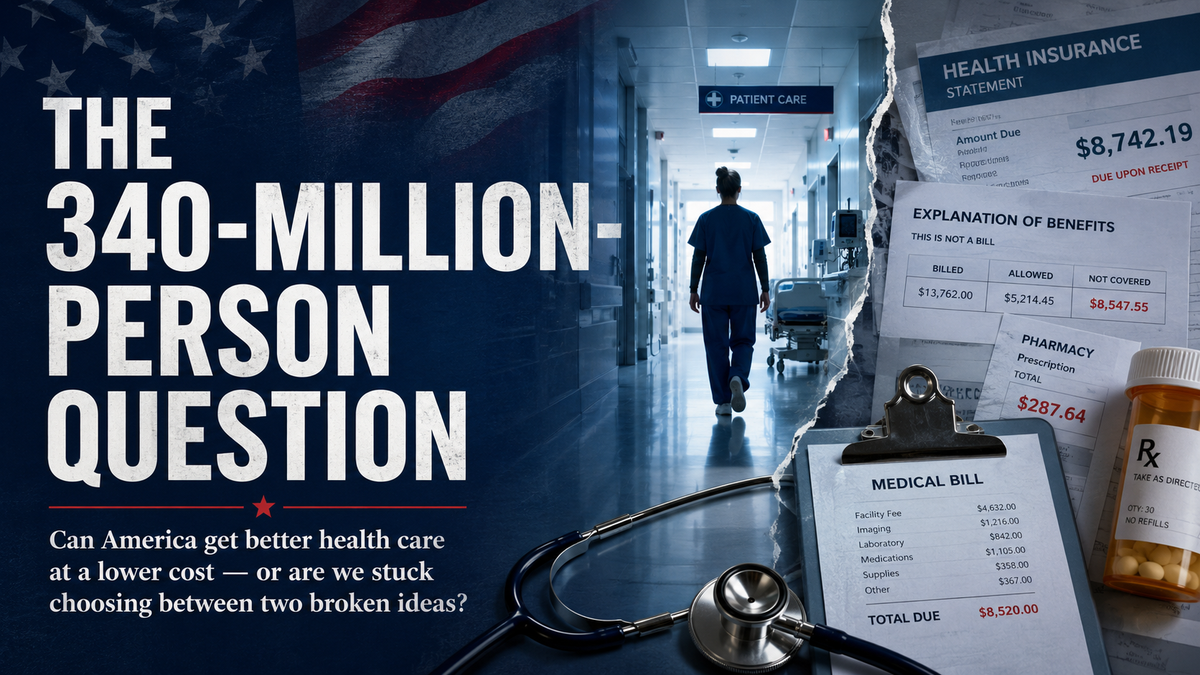
Can America get better health care at a lower cost — or are we stuck choosing between two broken ideas?
By Mike Morrison
Ask any working family what happened to their health insurance this year. The premium went up. The deductible went up. And when somebody finally got sick, a company that never laid eyes on the patient decided whether the doctor’s recommendation would be paid for.
I believe the American medical and insurance system is broken. Not broken the way politicians say it when they want your vote — broken at the kitchen table, broken at the pharmacy counter, broken in the emergency room billing office. And before anyone tells me the fix is to hand the whole thing over to Washington, I want to walk through what we actually have, what’s actually being proposed, and the hard questions nobody in either party seems eager to answer.
What We Spend Now
In 2024, the United States spent $5.3 trillion on health care — $15,474 for every man, woman, and child — 18 percent of our entire economy, according to the federal government’s own actuaries. No nation on earth comes close. For that money, we should have the finest care in human history for all 340 million of us. Instead, we have families crushed by medical debt, prescriptions skipped, and rural hospitals hanging on by a thread.
So where is the money going? Some of it is going exactly where you think it is. According to an analysis by former insurance executive Wendell Potter, the seven largest for-profit health care conglomerates took in nearly $1.7 trillion from their customers in 2025 and booked more than $54 billion in profits — while covering 10 million fewer people and spending $12 billion buying back their own stock. That followed a record $71.3 billion in combined profits in 2024. UnitedHealth Group alone brought in $447.6 billion in revenue and roughly $12 billion in net profit in 2025. And I call them conglomerates deliberately: these companies no longer just sell insurance. They own pharmacy-benefit managers, drugstore chains, clinics, and physician practices — increasingly employing the very doctors whose claims their insurance divisions decide whether to pay. The middlemen are buying both ends of the transaction, and the people getting squeezed are the patients and the independent providers left outside the tent.
And profit is only part of the overhead. Traditional Medicare reports far lower administrative spending as a share of benefits than private insurance — the commonly cited comparison is roughly 2 percent versus 12 to 18 percent — though honest analysts disagree about the true size of the gap, because the two serve different populations and count expenses differently. Broader accounting puts Medicare’s administrative share above 6 percent and private insurance’s around 12. Grant every caveat, and the gap is still wide: a meaningful slice of what American families pay for coverage never touches a doctor, a nurse, or a patient.
To be clear, insurer profits and overhead alone don’t explain a $5.3 trillion bill — prices, utilization, an aging population, and new technology drive most of the growth. And some overhead pays for legitimate work: claims processing, fraud controls, customer service. But cost that delivers no care itself, collected while the collectors decide whose claims get paid, deserves far harder scrutiny than it gets — and the sheer scale of it is the part nobody can defend.
The System We Have
Today’s American system is really three systems stacked on top of each other.
The largest group — about 178 million Americans — gets private insurance through an employer, with the company and the worker splitting the premium. It feels “free market,” but it isn’t: the tax code quietly subsidizes it by hundreds of billions a year by excluding those premiums from taxable income.
Seniors and low-income Americans are covered by Medicare and Medicaid, which together account for 39 percent of all national health spending — over $2 trillion a year, paid by taxpayers.
Everyone in between shops the Obamacare marketplaces — and 2026 has been brutal there. During open enrollment, 23.1 million people selected or were automatically reenrolled in marketplace plans, most with taxpayer-funded subsidies. But signing up is not the same as paying the bill. By February 2026, actual paid-up enrollment had fallen to 19.2 million — about 3 million fewer than the year before, the largest drop since the marketplaces opened — after average premium payments jumped 58 percent following the expiration of the COVID-era enhanced subsidies. The administration says part of that decline reflects its removal of roughly 1.5 million improper enrollments — people dually enrolled in Medicaid, who failed to reconcile their tax credits, or who never authorized enrollment at all; health policy analysts say the price spike did most of the damage. Both can be true — and either way, the Congressional Budget Office says restoring those enhanced subsidies would cost taxpayers another $350 billion over ten years. The taxpayer is already deep in this business.
Three systems, three sets of rules, three armies of billing clerks — and one patient stuck in the middle.
What Medicare for All Would Actually Do
Medicare for All is not an expansion of the current system. It is a replacement. Private health insurance would be eliminated for covered services. Every American — all 340 million — would be enrolled in a single government plan with no premiums, no deductibles, and no copays. Every hospital bill in the country would be paid by Washington.
In fairness, the case for it is real: near-universal coverage, no premiums or cost-sharing at the doctor’s office, genuine bargaining power over drug and hospital prices, and the elimination of a great deal of billing bureaucracy. The Congressional Budget Office acknowledges those potential gains — alongside the risks that follow.
Here is the honest math. The nonpartisan Committee for a Responsible Federal Budget reviewed the major studies in 2020 and found Medicare for All would increase federal costs by $25 to $35 trillion over ten years. Financing the midpoint would require the equivalent of a 32 percent payroll tax, a 42 percent national sales tax, doubling all income tax rates, or a mandatory public premium averaging about $7,500 per person, per year. Supporters answer, fairly, that this money doesn’t appear out of thin air — it replaces the premiums, deductibles, and employer contributions families already pay. Total national spending might land close to where it is now. But the check would be written by the government, the taxes would be real and permanent, and the decisions about covered care would move from thousands of private plans to one centralized federal system — with a different appeals process and no other insurer to switch to if you don’t like the answer.
What It Would Mean for Your Doctor
This is the part of the debate that gets skipped. Commercial insurers today generally pay doctors and hospitals well above Medicare rates — often one and a half to two times more, though it varies widely by service and region. A Medicare for All plan that paid providers at or near current Medicare rates would substantially cut the revenue they now receive from commercial insurance — a pay cut imposed on the entire medical profession, with the size and speed depending entirely on how the legislation was written.
The Congressional Budget Office’s warning was conditional, and it should be quoted that way: expanded coverage would increase demand for care, and if the supply of doctors and hospital capacity didn’t keep pace, “patients might face increased wait times and reduced access to care,” and quality could suffer. CBO also noted the government could invest in training and capacity to offset that risk. And lower payment rates would put added financial pressure on already fragile hospitals, with struggling rural facilities at the front of the line. Here in Mississippi, where rural hospitals are already closing under the current system, “might” is not a word that lets anyone sleep easy. The communities with the least slack in the system are the ones that absorb the shock if Washington gets the payment rates wrong.
What Other Countries Teach Us — and What They Don’t
Advocates point out, correctly, that every other wealthy nation covers all its people for roughly half what we spend per person. That fact should embarrass us. But the trade-off is real, and it shows up in the waiting room. A peer-reviewed analysis of Commonwealth Fund survey data found that 62 percent of Canadians waited a month or more to see a specialist, compared with 31 percent of Americans. Separately, the Fraser Institute’s 2022 physician survey reported a median wait of 27.4 weeks between referral by a general practitioner and receipt of treatment. Britain’s National Health Service reports a median wait of about 12 weeks to start non-urgent treatment — but its waiting list stood at 7.2 million cases this spring, with 2.5 million people waiting past the 18-week standard and roughly 100,000 waiting more than a year. Meanwhile, Americans skip care because of cost more than patients anywhere in the developed world. Every system rations somehow. America rations more heavily by price; Canada and Britain ration more heavily by the queue. Neither a bill you can’t pay nor a specialist you can’t see is good quality care.
And there is one fact that gets left out of every comparison: no nation has ever run a single-payer system at anything close to American scale. Canada has about 40 million people. The United Kingdom has 67 million. We have 340 million, spread across a continent, with higher baseline prices, more specialists, and fifty different state systems. Anyone who tells you the Canadian model would simply transplant here is guessing — with your family’s health care.
The Questions Nobody Wants to Answer
So here are the difficult questions, and I intend to keep asking them.
Why does a nation spending $15,474 per person still produce families ruined by medical debt?
If insurance middlemen are extracting more than $50 billion a year in profit, plus tens of billions more in administrative overhead, executive pay, and stock buybacks — what exactly are patients getting for that money that a simpler system couldn’t provide?
If a Medicare for All plan pays doctors and hospitals at or near current Medicare rates, who keeps the rural emergency room open, and who is left practicing medicine in towns like ours?
Is a coverage card worth anything if the line to use it is months long?
And the biggest one: why is this debate always all-or-nothing? Why are the only two choices on the table a broken system that profits from sickness and an untested national experiment on 340 million people? Federal law and CMS regulations now require hospital price transparency, and the first Medicare-negotiated drug prices finally took effect this January — so where is the serious conversation about enforcing and expanding those reforms, broadening drug negotiation beyond a handful of medicines, forcing real competition among insurers, cutting administrative waste, and prosecuting fraud? Those tools exist. They are being used timidly.
I don’t claim to have the full answer. But I know this: 340 million Americans deserve better than a choice between a system that treats their sickness as a revenue stream and a promise that has never been tested at anything close to our size. The first step toward better care at lower cost is asking these questions out loud — and refusing to accept talking points as answers.
About the Author Mike Morrison is the 2026 PBUS National Bail Agent of the Year and President of the Mississippi Bail Agents Association. With more than 35 years of hands-on experience as a licensed bail agent and owner of Mike Morrison Bail Bonding Company in Hattiesburg, Mississippi, he brings real-world insight to America’s most important conversations on criminal justice, pretrial policy, public safety, and good governance.
Morrison writes and speaks from the front lines — courtrooms, jails, and communities — rather than from theory. His commentary on policy, taxes, justice reform, and the daily realities facing working Americans has earned more than one million views across social media in 2026 alone. He regularly presents on bail policy and professional standards at the Mississippi Judicial College and leads ethics and training programs for bail professionals nationwide.
Independent, plain-spoken, and grounded in practical experience, Mike is committed to clear-eyed analysis that cuts through political noise — whether the topic is public safety, government accountability, or the true cost of policy decisions on Mississippi families and the nation.
© 2026 Mike Morrison. All rights reserved.