The Bail Project Found a Real Problem—Then Blamed the Wrong Thing
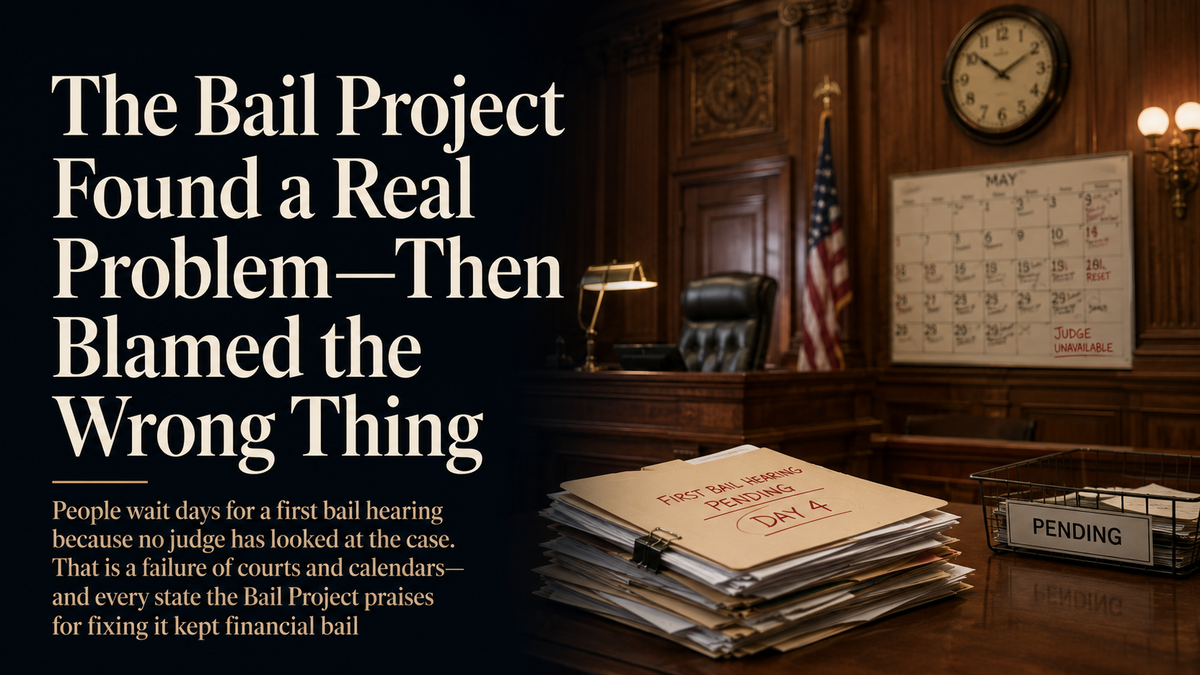
People wait days for a first bail hearing because no judge has looked at the case. That is a failure of courts and calendars—and every state the Bail Project praises for fixing it kept financial bail.
The Bail Project has published an article describing a genuine problem in the American pretrial system. In “Waiting for a Judge: Why People Sit in Jail for Days Before Their First Bail Hearing,” the organization argues that too many arrested people wait too long for their initial appearance before a judicial officer, and it calls for a national standard guaranteeing that appearance within 48 hours of arrest.
On the core complaint, the organization is correct. Delayed initial appearances are real, they are documented, and they harm people who are legally presumed innocent. The surety bail profession has no interest in defending them. No bail agent benefits when a defendant sits in a cell without a bail determination, because until a judge sets the conditions of release, there is no bond to write, no release to arrange, and nothing the commercial bail system can do for anyone. Every hour a person waits for a bail hearing is an hour the bail system the Bail Project blames has not even entered the case.
That last point deserves a moment of attention, because it is the entire problem with the article.
Every harm the Bail Project describes—the uncertainty after arrest, the inability to contact family, the lost jobs, the housing instability, the pressure to plead guilty—occurs during a period when no bail has been set. There is no bond amount to criticize, no premium to condemn, and no bail agent anywhere in the picture. The person is not detained because they cannot afford bail. The person is detained because no judicial officer has yet looked at the case at all.
That is not a cash bail problem. It is a court administration problem. It is a problem of judicial staffing, weekend and holiday scheduling, magistrate availability, and county funding. And the distinction matters, because the remedy for an administrative failure is administrative: more judicial officers, more arraignment sessions, video appearances where appropriate, and clear statutory deadlines.
The Bail Project understands this well enough to propose exactly that remedy. Its recommended solution is a 48-hour deadline for initial appearances. Not the elimination of financial conditions. Not the replacement of secured bonds. A scheduling deadline for courts.
Yet the article is packaged within the organization's campaign against cash bail, framed by its standing claim that money bail is the central injustice of the pretrial system, and closed with an appeal for donations so the organization can pay people's bail. Consider what that donation appeal means in the context of this particular article. A charitable bail fund cannot help a single person described in this piece. A person waiting for a first appearance has no bail to pay. The Bail Project's revolving fund is useless to them by definition. The organization has attached its fundraising message to a problem its funding model cannot touch.
The article's legal framing is also less precise than it should be. It states that the U.S. Constitution guarantees the right to a speedy trial but that most states lack clear guidelines on when bail hearings must occur. The Sixth Amendment speedy trial right, however, governs the time between accusation and trial. It is not the constitutional provision that addresses how quickly an arrested person must be brought before a judicial officer.
The relevant doctrine comes from the Fourth Amendment. In Gerstein v. Pugh, the Supreme Court held that a person arrested without a warrant is entitled to a prompt judicial determination of probable cause. In County of Riverside v. McLaughlin, the Court gave that requirement a number: a probable cause determination within 48 hours of a warrantless arrest is presumptively prompt, and delays beyond 48 hours presumptively violate the Constitution unless the government demonstrates an emergency or other extraordinary circumstance.
A probable cause determination is not identical to a full bail hearing, and many jurisdictions combine the two proceedings while others separate them. But the Bail Project's signature proposal—a 48-hour standard—is not a new frontier of reform. The number comes from a Supreme Court decision issued in 1991. The scandal the organization describes is not that America lacks a 48-hour principle. It is that some counties have failed for decades to build the administrative machinery to honor one, and that the consolidated proceedings where bail is actually set often lag behind even when the constitutional minimum is technically met.
That failure deserves criticism. It simply is not the criticism the Bail Project's broader campaign is selling.
The strongest evidence for that conclusion comes from the Bail Project's own list of success stories. The article praises Colorado, which in 2021 enacted a law requiring bond hearings within 48 hours of booking. It praises Maine, where initial appearances must occur within 48 hours of arrest. It praises Nevada, which in 2021 required pretrial release hearings within 48 hours of booking. It endorses a pending Oklahoma bill that, according to the article, would require initial hearings within 48 to 72 hours of booking.
Every one of those jurisdictions retained financial bail. Colorado sets bonds. Maine sets bail. Nevada sets bail. The reform the Bail Project celebrates in each state was a deadline for judges, enacted and implemented inside a system where secured money bonds continued to exist and continued to be posted. If financial bail were the disease, the states the Bail Project holds up as models never cured it. What they cured was delay—and they cured it with scheduling requirements, not with the abolition of bail.
In other words, the article's own examples demonstrate that prompt hearings and financial bail are fully compatible. The organization's evidence proves the opposite of its campaign.
The Bail Project could have found an even older example, and it happens to be my home state. Effective July 1, 2017, the Mississippi Supreme Court adopted the Mississippi Rules of Criminal Procedure, which require that every person arrested and held in custody be taken before a judge for an initial appearance without unnecessary delay, and within 48 hours of arrest. MRCrP 5.1, 5.2. The 2017 rules did not invent that standard—they carried forward a 48-hour requirement already familiar in Mississippi practice—but they made it uniform across every trial court in the state: Justice Court, Municipal Court, County Court, and Circuit Court.
Mississippi accomplished this nine years ago. It did so through its Supreme Court's rulemaking authority, without abolishing financial bail, without a charitable bail fund, and without a fundraising campaign. Rule 8 of those same rules preserves the full framework of release conditions, including surety bonds, and requires judges to make individualized release determinations at that prompt initial appearance. These are rules I have addressed as an invited guest speaker at the Mississippi Judicial College, where the state's judges train on them. The 48-hour hearing and the surety bond are not opposing forces in Mississippi. They are two parts of the same rulebook, adopted by the same court, on the same day.
There is one more observation worth making, and it is a point of agreement rather than attack. The surety profession has every commercial and professional reason to support prompt initial appearances. A bail agent's role begins the moment a judge sets conditions of release. Faster hearings mean faster bail determinations, faster releases, faster family reunifications, and a pretrial system that actually functions the way it was designed to function: a judge makes an individualized decision, and the accused, the family, and the surety carry it out. Counties that leave arrested people waiting a week for a judge are not defending the bail system. They are preventing it from working.
So let there be no confusion about where this profession stands. If a state legislature proposes a firm deadline for initial appearances, adequate magistrate coverage on nights and weekends, and the court funding to make both real, the surety bail industry should be—and in my experience will be—on the supporting side of that hearing room.
What the profession should not accept is the sleight of hand. The Bail Project found a real failure, correctly described its human cost, proposed an administrative fix that operates entirely within the existing bail system, pointed to model states that all kept financial bail, and then wrapped the whole thing in its standing narrative that money bail is the villain and closed by asking readers to donate to a bail fund that cannot assist anyone the article describes.
And this is not an isolated editorial choice. It is a pattern. In a separate piece, I examined the Bail Project's recent client story about an Arizona woman named Taylor—a story that asked readers to condemn a judge's bail decision while omitting the charge, the alleged property value, the criminal history, the bond type, and nearly every fact Arizona law required that judge to consider. The technique there was omission. The technique here is misdirection. The destination never changes: financial bail is declared the villain, and the article ends with a request for donations.
Notice the difference in method. Every legal claim in this article carries a citation—a rule number, a statute, a Supreme Court case—that any reader can pull up and check. That is the standard the surety profession should demand of itself, and it is the standard I hold my own work to. The Bail Project's article, by contrast, invokes the wrong constitutional provision and never mentions the Supreme Court decisions that made its signature 48-hour proposal a constitutional baseline more than three decades ago. A narrative that its own evidence contradicts, published by an organization that repeatedly withholds the facts its readers would need to check it, is not analysis. It is marketing.
When an organization identifies a problem the bail industry also wants solved, and still manages to present it as an indictment of bail, that tells you the conclusion was written before the evidence was gathered. The delay between arrest and a first appearance is a failure of courts, budgets, and calendars. Fixing it requires judges on the bench, not donations to a bail fund—and certainly not the dismantling of the one system that goes to work the moment the judge finally arrives.
 Emma Stammen
About the Author Mike Morrison is the 2026 PBUS National Bail Agent of the Year and President of the Mississippi Bail Agents Association. With more than 35 years of hands-on experience as a licensed bail agent and owner of Mike Morrison Bail Bonding Company in Hattiesburg, Mississippi, he brings real-world insight to America’s most important conversations on criminal justice, pretrial policy, public safety, and good governance.
Morrison writes and speaks from the front lines — courtrooms, jails, and communities — rather than from theory. His commentary on policy, taxes, justice reform, and the daily realities facing working Americans has earned more than one million views across social media in 2026 alone. He regularly presents on bail policy and professional standards at the Mississippi Judicial College and leads ethics and training programs for bail professionals nationwide.
Independent, plain-spoken, and grounded in practical experience, Mike is committed to clear-eyed analysis that cuts through political noise — whether the topic is public safety, government accountability, or the true cost of policy decisions on Mississippi families and the nation.
© 2026 Mike Morrison. All rights reserved.
Sources
Gerstein v. Pugh, 420 U.S. 103 (1975)
County of Riverside v. McLaughlin, 500 U.S. 44 (1991)
Colorado House Bill 21-1280 (2021), Pre-trial Detention Reform
Mississippi Rules of Criminal Procedure (effective July 1, 2017), Rules 5.1, 5.2, and 8