The Erosion of the Fourth Amendment Through GPS Technology: Technological Creep, Surveillance-First Justice, and the Moral Toll on the Marginalized
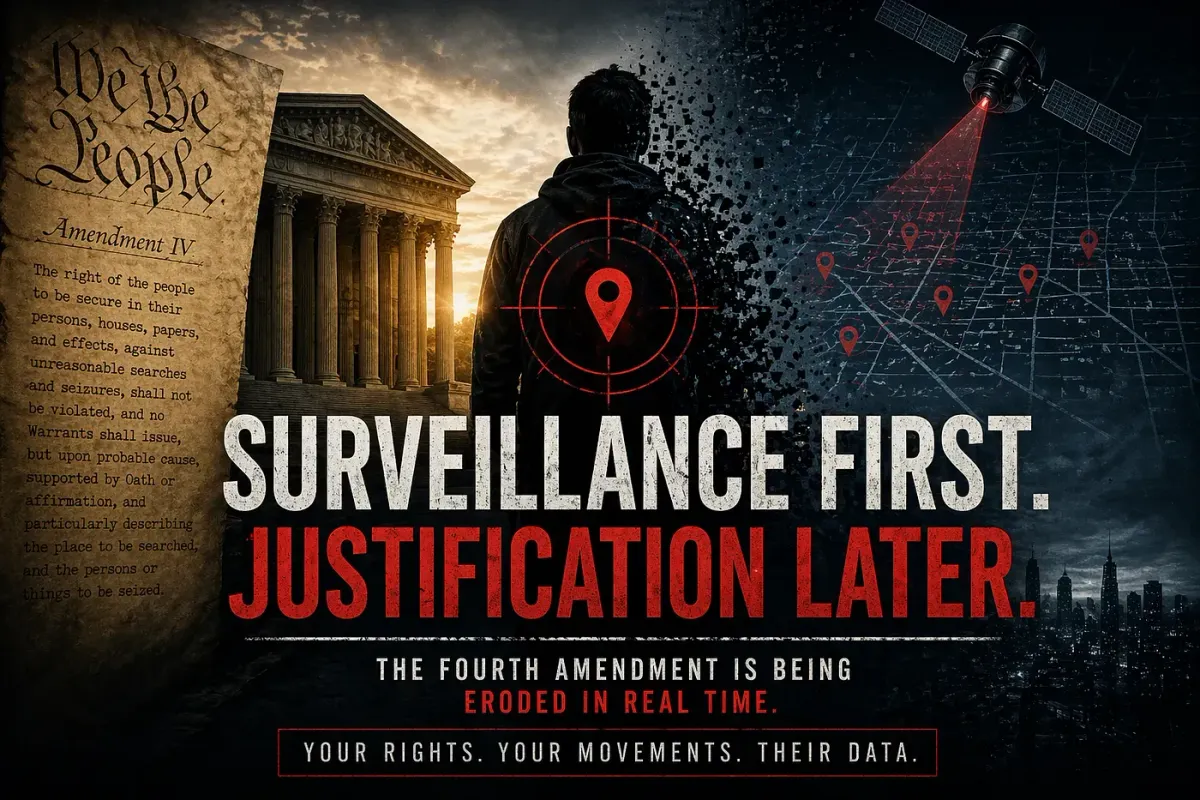
What we are witnessing is not a single violation of rights, but a systematic shift in how those rights are applied — one driven by technology and reinforced by legal workarounds. The concept that ties all of this together is technological creep: a process where tools introduced for limited, emergency use gradually expand into routine surveillance mechanisms, bypassing the core protections of the Fourth Amendment.
The Fourth Amendment was written to establish a clear barrier between the individual and the state. Before the government could intrude into a person’s life, it had to establish probable cause and obtain a warrant from a neutral judge. That process was not a formality — it was the protection. It embodied the Framers’ profound moral commitment to individual dignity, autonomy, privacy, and the presumption of innocence. Every person, regardless of wealth or status, was meant to be secure in their “persons, houses, papers, and effects.” GPS technology — and the broader ecosystem of location tracking it represents — is now being forced into that equation in a way that weakens this barrier, not by openly repealing it, but by working around it through incremental exceptions, digital innovations, and post-hoc justifications. This erosion carries a heavy moral cost, especially for marginalized communities least able to push back.
The first mechanism driving this erosion is the expansion of the exigent circumstances exception. In theory, exigency exists only for true emergencies — situations where there is no time to obtain a warrant because immediate action is required to prevent harm or the destruction of evidence. In practice, that definition is being stretched. Technologies like GPS dart systems (such as StarChase) are deployed under the claim that any failure to immediately comply with law enforcement during a vehicle pursuit constitutes an emergency. The moment that label is applied, the warrant requirement disappears. The device is fired at the fleeing vehicle, tracking begins, and the search is already underway before any judicial oversight occurs.
While these tools can genuinely enhance officer and public safety by ending dangerous high-speed chases, the ease of deployment risks turning a narrow exception into a gateway for prolonged monitoring long after the immediate threat has passed. If the claimed “emergency” is later found questionable or exaggerated, the constitutional violation has already taken place. There is often no meaningful real-time remedy for the individual — who may not even be charged with a crime. Morally, this inverts the proper order of justice: the state treats the person as a suspect first and a rights-bearing citizen second. It undermines the presumption of innocence, a foundational moral principle that protects human dignity by requiring the government to justify its intrusions rather than presuming guilt or dangerousness.
This connects directly to the principle, affirmed by the Supreme Court in United States v. Jones (2012), that physically attaching a GPS device to a vehicle constitutes a search under the Fourth Amendment. The protection rests on the idea that the government cannot trespass onto a person’s property for the purpose of gathering information without a warrant. Yet technology is rapidly moving beyond that boundary. Law enforcement no longer needs to physically touch a vehicle — or, in many cases, demonstrate individualized suspicion — to track a person’s movements. Through geofencing, cell-site data collection, and app-derived location information, individuals can be monitored continuously without any physical intrusion at all. This creates a growing conflict in the law: earlier protections were tied to physical trespass, while modern surveillance increasingly operates in the invisible digital realm, where intrusions are more pervasive, harder to detect, and potentially more chilling to personal freedom.
Geofence warrants (“reverse warrants”) vividly illustrate this shift. These orders compel companies like Google to disclose location data for every device present in a defined geographic area during a specific time window around a crime. Instead of targeting a known suspect, they sweep up the movements of potentially hundreds or thousands of innocent bystanders. Lower courts remain deeply divided on their constitutionality. The Supreme Court is now set to address key aspects of this issue in Chatrie v. United States, with oral arguments scheduled for April 27, 2026 — just days away. In that case, a geofence warrant encompassing private residences and sensitive locations was used in a bank robbery investigation. The litigation highlights how such tools can expose private movements — to a doctor, place of worship, protest, or support group — without individualized probable cause, raising serious concerns about chilling effects on vulnerable populations who already face heightened scrutiny in their daily lives.
That conflict is being driven further by reliance on the third-party doctrine. The argument is deceptively simple: if your data is held by a private company — your phone provider, a navigation app, or a data broker — then you have “voluntarily” shared it, and your reasonable expectation of privacy is diminished. This position allows law enforcement to access detailed location data without treating it as a traditional search, even though the level of intrusion is often far greater than anything the Framers could have imagined. The Supreme Court pushed back against a mechanical application of this doctrine in Carpenter v. United States (2018), ruling that the government’s acquisition of historical cell-site location information requires a warrant because it creates an “encyclopedic” record of a person’s movements over time. Yet the doctrine lingers in other digital contexts, enabling silent, continuous background tracking that turns ordinary phones and apps into de facto surveillance devices.
Even when courts step in and recognize that a constitutional line has been crossed, another mechanism often prevents meaningful correction: the good faith exception. Under this doctrine, evidence obtained through what is later deemed an unconstitutional search may still be admissible if officers claim they reasonably believed their actions were lawful at the time. This blunts the primary enforcement tool of the Fourth Amendment — the exclusionary rule. Without real consequences, the system tilts toward a “use it first and sort it out later” approach. Law enforcement agencies can experiment with new surveillance methods, push legal boundaries, and count on courts to retroactively accept (or at least not punish) the effort. In the Chatrie litigation itself, questions of good faith have played a significant role even as judges debate the underlying validity of geofence warrants. Morally, this is troubling: it signals that procedural shortcuts carry little risk for the powerful, while the individuals ensnared — frequently without resources to litigate — bear the ongoing burden of diminished liberty and dignity.
Beyond direct law enforcement deployments, a growing gray market for location data exacerbates the problem. Government agencies increasingly purchase bulk movement data from private data brokers rather than seeking warrants or deploying their own devices. This creates a dangerous loophole: the government is no longer formally “searching” or “seizing” from the individual but simply buying commercially available information — effectively engaging in what critics aptly call data laundering. Fourth Amendment protections are frequently treated as inapplicable in this commercial space. Bipartisan efforts, such as the Fourth Amendment Is Not For Sale Act, have sought to close this “data broker loophole,” yet the practice continues. The moral failing is clear: it normalizes warrantless, suspicionless surveillance of broad populations, commodifying private lives and disproportionately affecting those whose data is most readily aggregated and sold.
The most significant and troubling impact of all these practices falls on individuals who have not been charged with a crime — or who face only minor allegations. When a GPS device is deployed under a claim of exigency, location data is swept via geofence, or commercial tracking information is purchased, the intrusion happens immediately. There is no prior individualized hearing, no narrowly tailored warrant, and often no practical opportunity to object in real time. Any legal challenge comes later, if at all.
For the innocent or uncharged, the violation is often entirely remediless. Suppression of evidence offers no help to those never prosecuted. Civil lawsuits under 42 U.S.C. § 1983 — intended to hold officials accountable for constitutional violations — are routinely blocked by qualified immunity, which shields officers unless they violate “clearly established” law. In the fast-evolving realm of GPS and digital tracking, such clarity is rare, leaving marginalized individuals with virtually no meaningful way to fight back or seek redress.
This dynamic is especially acute in pretrial electronic monitoring and conditions of release or probation. GPS ankle monitors and similar devices are disproportionately imposed on marginalized individuals: poor people, racial and ethnic minorities, those with disabilities, immigrants, and others who lack the financial means to hire private attorneys or post high bail. These are precisely the communities least equipped to navigate complex constitutional challenges or assert their rights effectively. Electronic monitoring often functions as “e-carceration” — imposing severe restrictions on movement, employment opportunities, family relationships, housing, and daily autonomy that can rival or exceed the burdens of physical incarceration. Fees for the devices themselves can create insurmountable debt traps. Malfunctions or overly broad geographic restrictions can lead to technical violations, lost jobs, fractured families, and deepened poverty — all while the presumption of innocence is effectively suspended. Reports from civil liberties organizations document how such practices compound existing racial and economic disparities in the justice system, turning technology into a tool that widens inequality rather than serving neutral public safety goals.
The moral core of the Fourth Amendment is not abstract legal doctrine. It is the recognition that every human being possesses inherent dignity and autonomy that the state has no right to casually override. When surveillance tools allow tracking to begin first — with justification constructed afterward — the system inverts the Framers’ vision of limited government. It treats citizens, especially the vulnerable and unrepresented, as perpetual objects of oversight whose movements, associations, and private decisions are subject to routine state monitoring. This is not neutral technological progress; it is a quiet reallocation of power that burdens the marginalized most heavily because they lack the resources, legal representation, and political voice to resist effectively. True justice requires that constitutional protections apply equally — not as luxuries for the wealthy or after-the-fact remedies for the powerless.
The link is clear. The Fourth Amendment was designed to require the government to justify a search before it occurs. GPS technology, geofence warrants, data broker purchases, expanded exceptions, and the good faith doctrine are collectively reversing that order. Surveillance is initiated first, and justification is constructed afterward. What was once a narrow tool for genuine emergencies is drifting toward routine, low-accountability operation.
This is not the outright removal of constitutional rights. It is something more subtle, insidious, and consequential: the steady erosion of those rights through the normalization of practices that would have been unacceptable under the original constitutional framework. As the Supreme Court prepares to hear oral arguments in Chatrie v. United States on April 27, 2026, and as debates over data purchases and electronic monitoring continue, the stakes are profoundly high.
The end result is a justice system drifting from its foundational principles. Instead of requiring the government to have a compelling, individualized reason to track a person — particularly one who has not been convicted of a crime — the structure now too often permits tracking to occur first, with the expectation that a reason can be found or retroactively accepted later. Restoring the moral and legal balance demands that courts, legislatures, and the public insist on justification before the surveillance begins, especially when the human cost falls heaviest on those least able to defend themselves. The Fourth Amendment’s promise of security in our persons and effects must remain a bulwark for all citizens — not a hollow phrase eroded by technological convenience or applied unequally along lines of wealth, race, or status. Only then can we honor both the letter and the spirit of the Constitution in the digital age.
About the Author
Mike Morrison is a Hattiesburg, Mississippi bail bondsman, owner of Mike Morrison Bail Bonding, President of the Mississippi Bail Agents Association, and the 2026 PBUS National Bail Agent of the Year. For more than 35 years, he has worked in Mississippi's criminal justice system while writing about bail bonds, pretrial policy, public safety, and court accountability. His commentary has reached more than one million readers across social media in 2026. Learn more at https://linktr.ee/mdmorrison.
© 2026 Mike Morrison. All rights reserved.