The Missing Metric of Justice: Why Failure to Appear Data Defines Accountability
Accountability Is More Than a Word
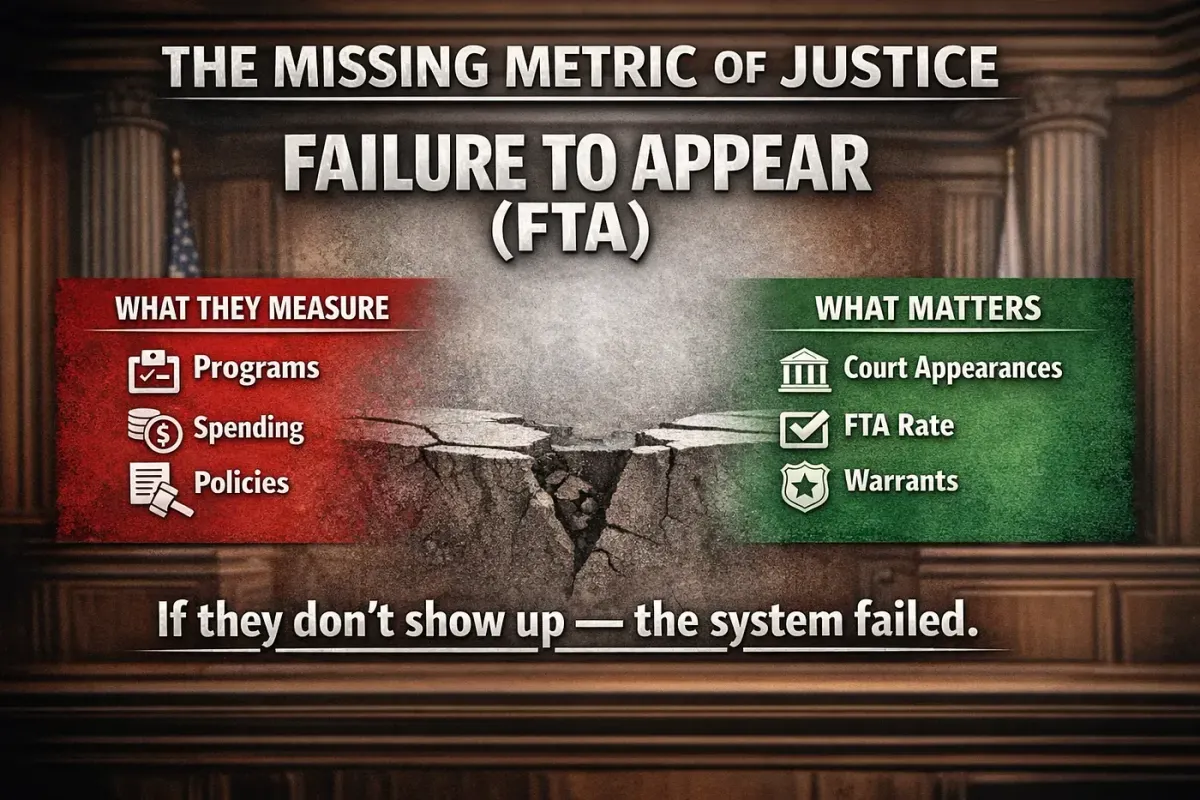
Every courtroom in America depends on people showing up. Yet across the country, no one really knows — consistently or comprehensively — how well that’s happening. Accountability demands measurement, and the failure to appear (FTA) problem shows where the justice system falls short.
When court appearances aren’t consistently tracked, aggregated, or publicized, it’s impossible to tell what’s working — and what’s failing victims, defendants, and communities. Delayed justice isn’t abstract. It means victims wait longer, cases drag on, warrants pile up, court dockets clog, and public trust quietly erodes. This isn’t about blaming clerks, judges, or staff. It’s about asking whether the system gives them the data and tools to deliver results. A justice process that operates without reliable performance measurement leaves everyone — professionals and the public — working in the dark.
The Data Gap
National, centralized, up-to-date tracking of FTA doesn’t exist in any comprehensive form. The Bureau of Justice Statistics’ last detailed national snapshot on felony defendants in large urban counties was from 2009, showing roughly 17% of released defendants missed at least one court date (though 97% eventually appeared within a year). Since then, we’ve relied on fragmented state and local data with inconsistent definitions and limited public reporting.
Recent snapshots show the problem is real and uneven:
In New York (2022 data), the statewide FTA rate for released cases was 17%, ranging from 13% for violent felonies to as high as 28% for misdemeanors like petit larceny. Rates varied significantly by county and charge type.
Broader estimates put FTA per court date at 10–20% in many jurisdictions, with some local studies showing rates as high as 39–50% for defendants missing at least one hearing.
A January 2026 analysis of booking data from 562 jails nationwide found that at least 13% of all jail bookings involve an FTA charge — with roughly half of those (about 546,000 bookings per year) involving only an FTA warrant and no new underlying offense. That adds up to roughly 52,000 fewer people in jail on any given day and millions of unnecessary jail nights annually.
The National Center for State Courts has highlighted the issue: national estimates of missed appearances are rare because data collection is inconsistent and definitions vary widely by jurisdiction and case type. Pew Charitable Trusts notes that most states still underuse simple, proven tools like court-date reminders, even though rigorous studies show they can reduce FTA rates by 11–61%.
While national data remains fragmented, jurisdictions that have tracked outcomes over time provide a clearer picture of system performance. In Yolo County, California, post-reform reporting revealed measurable increases in failures to appear and compliance challenges following expanded reliance on non-financial release mechanisms. These findings are significant because they move the discussion from theory to observed performance — demonstrating what happens when accountability structures are reduced in real-world court operations. Where consistent tracking exists, the results reinforce a central truth: outcomes change when accountability mechanisms change.
Why Doesn’t Anyone Talk About It?
That question cuts to the heart of it: Why isn’t FTA a major topic at judicial conferences, pretrial summits, or policy forums?
Part of the reason is the very data gap you identify — no centralized, standardized metrics to drive focused discussion. Conversations often center on pretrial detention rates, racial disparities, or overall incarceration trends. Those matter, but they sometimes overshadow the downstream performance question: Does the system actually deliver timely justice and court appearances?
When FTA does surface, it’s frequently framed around individual barriers — transportation, childcare, forgetfulness, or scheduling conflicts. Those factors are real, but the framing can downplay the systemic costs: delayed resolutions for victims, new warrants that strain law enforcement and courts, and eroded confidence when accountability feels optional. FTA isn’t victimless. It creates real friction in the pursuit of fair and efficient justice.
The Performance Test for Justice
How well is the judicial system actually performing on this basic function?
The honest answer? We don’t fully know. And that uncertainty undermines reform efforts across the board. Outcomes like appearance rates, warrant issuance, and time-to-resolution should be treated as core performance indicators. Without them, accountability stays rhetorical rather than operational.
What Communities Can Do
The good news is that meaningful improvement doesn’t require expensive overhauls:
Standardize and publish data. States and the federal government could expand or revive consistent national reporting (building on BJS and NCSC models) with uniform definitions and public dashboards. Transparency itself often drives improvement.
Deploy proven tools. Automated text, phone, or email reminders — especially opt-out systems — consistently boost appearance rates. Some jurisdictions have seen reductions of 20% or more in warrants and related incarceration. Pair them with clearer notices, transportation support where feasible, and flexible scheduling or virtual options to remove logistical barriers.
Align incentives thoughtfully. Historical data and comparative studies show that financial conditions with professional sureties (commercial bail bonds) have often produced stronger appearance rates than pure recognizance release in certain contexts. Defendants released on surety bonds have shown FTA rates around 18%, compared to 26% for own recognizance and 30% for unsecured pretrial services releases in key analyses.
What is often missing from the policy discussion is a clear understanding of why certain release mechanisms outperform others. Surety bail is not simply a financial condition — it is a structured accountability system. It introduces continuous human engagement through family involvement, active monitoring, reminder systems, and, when necessary, recovery efforts that return defendants to court.
Unlike unsecured release models, where responsibility is diffused across overloaded public systems, surety bail assigns direct responsibility to a private party with a vested financial and professional interest in performance. That alignment of incentives is not theoretical — it is operational. It produces measurable results in appearance rates because someone is actively responsible for ensuring compliance.
When failure to appear is treated as a key performance metric, the distinction becomes clear: systems with active accountability mechanisms consistently outperform those that rely solely on voluntary compliance.
This advantage stems from the surety’s financial skin in the game (forfeiting the full bond amount on non-appearance), active reminders, follow-up, and recovery efforts that bring defendants back to court — adding structure and accountability at no direct cost to taxpayers. We need better data broken down by release type to evaluate this tool fairly alongside others.
Make FTA reduction a visible goal. Lower churn from preventable warrants frees jail space, court time, and law enforcement resources for higher-priority public safety work.
Accountability Is a Shared Responsibility
Accountability isn’t finger-pointing — it’s building systems that make success measurable, progress visible, and continuous improvement possible. Taxpayers, victims, defendants, clerks, judges, and citizens all deserve to know how well the system is performing on fundamentals like getting people to court — including the role different release mechanisms, such as surety bail, play in driving results.
When outcomes aren’t measured, we fly blind. Shining a consistent light on FTA data — including outcomes by release type — is one of the most straightforward ways to restore trust and demonstrate real progress. Knowing whether our courts are delivering timely, fair justice shouldn’t be controversial — it should be the baseline expectation.
“Accountability isn’t finger-pointing — it’s building systems that make success measurable, progress visible, and improvement possible.”
Because justice isn’t just about cases resolved — it’s about a system that can prove it’s working.
If failure to appear is the system’s most basic test of accountability, then the tools that consistently reduce it should not be sidelined — they should be central to the conversation. Any serious effort to measure justice must also be willing to measure which mechanisms deliver results. When that comparison is made transparently, the role of surety bail becomes not just relevant — but essential.
About the Author
Mike Morrison is a Hattiesburg, Mississippi bail bondsman, owner of Mike Morrison Bail Bonding, President of the Mississippi Bail Agents Association, and the 2026 PBUS National Bail Agent of the Year. For more than 35 years, he has worked in Mississippi's criminal justice system while writing about bail bonds, pretrial policy, public safety, and court accountability. His commentary has reached more than one million readers across social media in 2026. Learn more at https://linktr.ee/mdmorrison.
© 2026 Mike Morrison. All rights reserved.