The Quiet Surrender: How the Anti-Surety Movement Is Fulfilling Washington’s Worst Fear About Factions and Lost Accountability
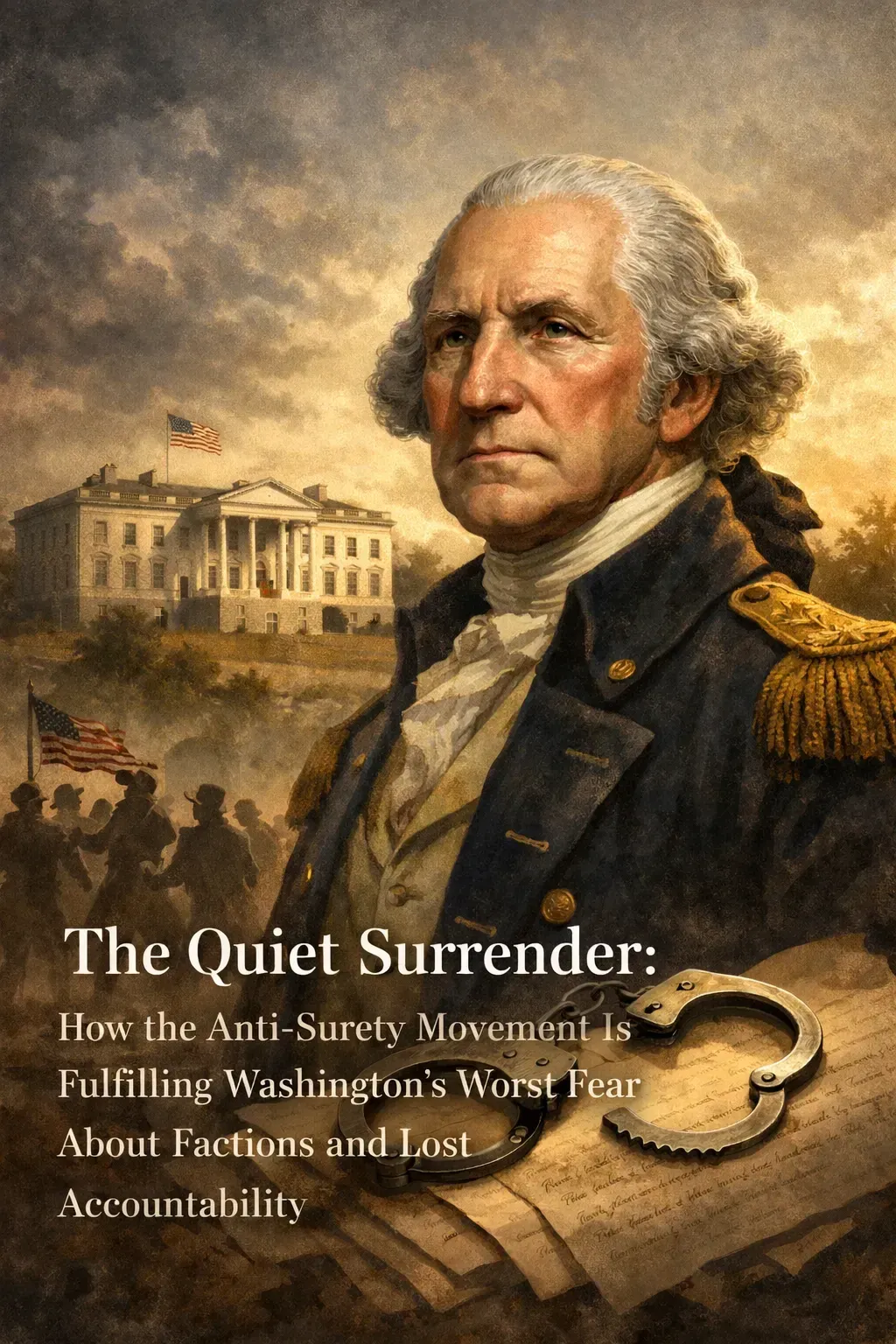
George Washington, the Spirit of Party, and the Republic We Were Warned Not to Lose: How the Erosion of Accountability Now Threatens Public Safety and the Integrity of Our Justice System
Picture this: It’s 1796. George Washington, the man who could have been king but chose to step down after two terms, sits down to pen his Farewell Address. He’s not fretting about British redcoats or French intrigue this time. No, the Father of His Country is sounding the alarm about something sneakier and far more dangerous — an enemy lurking inside the young republic itself.
He calls it the “spirit of party” — that fiery, divisive force rooted in human passion that turns neighbors into rivals and policy into a power grab. Washington didn’t pull this warning out of thin air. He’d watched early factions forming in his own cabinet, seen how loyalty to a group could trump duty to the nation. In his own words:
“The alternate domination of one faction over another, sharpened by the spirit of revenge… is itself a frightful despotism.”
And: “It serves always to distract the Public Councils and enfeeble the Public Administration. It agitates the Community with ill-founded Jealousies and false alarms…”
He feared that cunning, ambitious, unprincipled men would use these factions like “potent engines” to subvert the people’s power, eventually destroying the very institutions that helped them rise. Washington had led troops against the Whiskey Rebellion in 1794, riding out himself to enforce federal law against defiant factions. He knew firsthand: when ideology or grievance overrides consistent rules, accountability crumbles, and the republic drifts toward weakness.
Washington wasn’t anti-democracy — he was pro-republic. He believed liberty needed sturdy guardrails: clear laws, enforced consistently, with real consequences for breaking them. Without that backbone of accountability, good intentions pave the road to chaos. He warned that small deviations, justified as “progress,” would accumulate until the system no longer reflected common sense and mutual interests, but the “ill-concerted projects of faction.”
Fast-forward to today. That quiet surrender Washington dreaded? It’s playing out in courtrooms across America, dressed up as compassionate reform.
The justice system isn’t some abstract philosophy seminar — it’s a machine that runs on compliance. People get released pretrial with a promise to show up. Courts issue orders expecting obedience. When those promises mean something, the whole thing hums along. When they don’t? Cue the breakdowns.
Enter the Anti-Surety Movement — the push to sideline traditional cash bail and surety bonds in favor of risk-assessment algorithms, policy checklists, and “trust-based” releases. It sounds modern and humane on paper. But in practice, it swaps enforceable responsibility for hopeful predictions. Instead of a defendant with skin in the game (and a bondsman plus family co-signers holding them accountable), you get data points fed into a bureaucratic model. Personal agency takes a backseat to ideology.
Look at the results in places that went all-in:
New Jersey’s 2017 cash bail overhaul.
Illinois’ 2023 SAFE-T Act eliminating cash bail statewide.
No-cash experiments in Philadelphia and Chicago.
Reports from these jurisdictions show rising failures to appear, more violations of release conditions, and overloaded courts scrambling to enforce what used to be straightforward. The financial stake that once motivated people to show up? Gone. The third-party oversight that surety bonds provide? Replaced by optimism and paperwork.
Washington would recognize the pattern: a faction-driven narrative (“bail is unfair”) reshaping enforcement, turning consistent standards into flexible discretion. Loyalty to the agenda edges out duty to equal justice and public safety.
This isn’t about left or right. It’s about drift — the exact internal decay Washington warned would distract councils, enfeeble administration, and let unprincipled shifts undermine what the Founders built. He saw factions starting with plausible pretexts, then gradually impairing the “energy of the system” until it couldn’t confine citizens “within the limits prescribed by the laws.”
Bail surety isn’t just an industry — it’s a practical tool of accountability. It puts real obligation on the defendant, backed by someone who has incentive (and liability) to make sure they return. Remove that, and you don’t eliminate the need for enforcement; you just weaken the mechanism that delivers it. The result? Courts lose authority, victims lose confidence, and the public starts wondering why the system feels optional for some but not others.
Washington wasn’t a pessimist, but he was a realist. He knew republics don’t collapse with a bang — they erode through small, repeated choices where principle yields to preference. He urged Americans to resist “the spirit of innovation upon [the Constitution’s] principles, however specious the pretexts.”
The anti-surety push, however well-intentioned in spots, fits that description: a gradual transformation that replaces structure with flexibility and accountability with interpretation. History already wrote the warning label. The question now is whether we’re paying attention — or sleepwalking into the very factional surrender Washington feared most.
Because once accountability drifts away, systems don’t magically self-correct. They keep sliding until public faith in the law itself erodes. And a republic without that faith? That’s when the quiet surrender becomes permanent.
About the Author
Mike Morrison is a Hattiesburg, Mississippi bail bondsman, owner of Mike Morrison Bail Bonding, President of the Mississippi Bail Agents Association, and the 2026 PBUS National Bail Agent of the Year. For more than 35 years, he has worked in Mississippi's criminal justice system while writing about bail bonds, pretrial policy, public safety, and court accountability. His commentary has reached more than one million readers across social media in 2026. Learn more at https://linktr.ee/mdmorrison.
© 2026 Mike Morrison. All rights reserved.