Trading One Addiction for Another
A reality families must face in recovery
The call came on a Tuesday morning — a mother in Hattiesburg, her voice caught between relief and dread. Her son had been clean from methamphetamine for seven months. He had not missed a single court date. But the night before, she had found him awake at 4 a.m., hunched over his phone, having lost $2,300 on a sports betting app he had downloaded the week he left treatment. “We thought we were finally through it,” she told me. “Now I don’t know what we’re in.”
She was not through it. She was in a different chapter of the same story. And in 35 years of working as a bail agent in Mississippi — processing arrests, sitting with families in crisis, watching patterns repeat across generations — I have seen that chapter play out more times than I can count.
Families celebrate when a loved one breaks free from drugs or alcohol. Hope returns to the home. For a time, things appear to improve. Then, quietly or dramatically, a new compulsive behavior takes hold — and the cycle begins again.
The substance changes. The pattern of seeking relief through compulsion often does not.
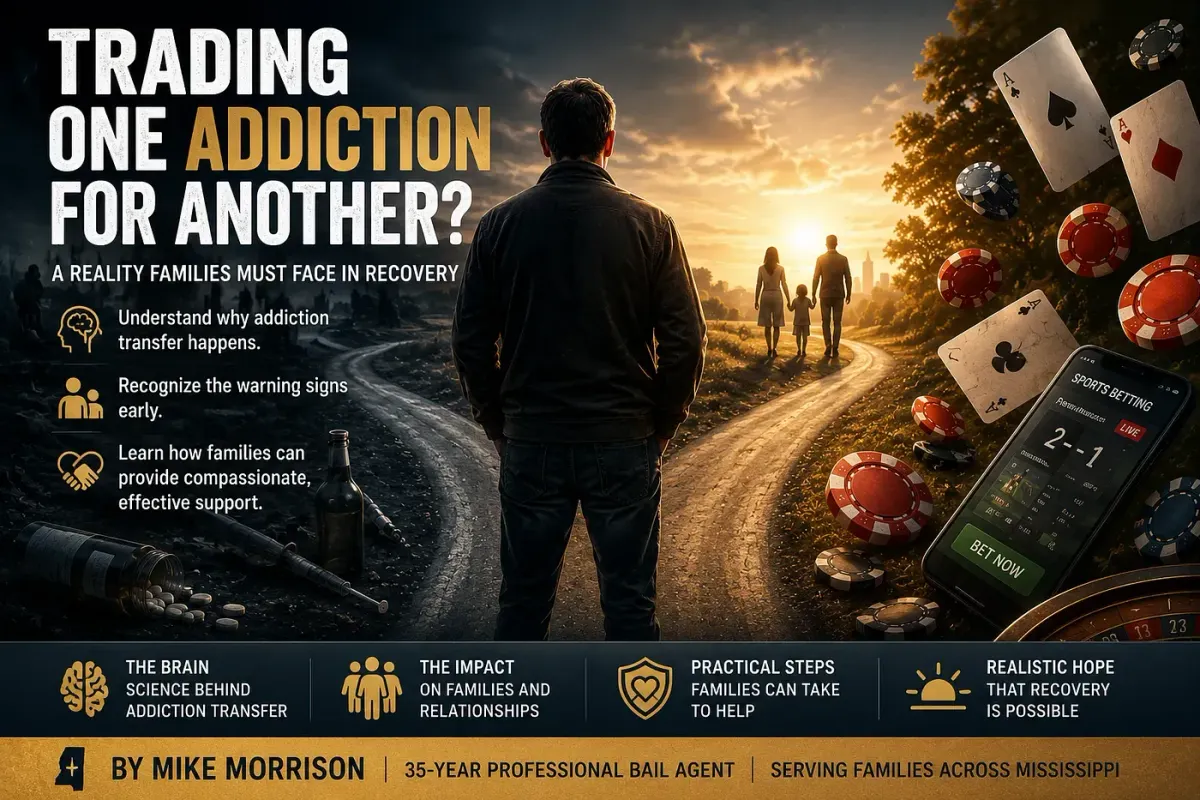
This is known as addiction transfer — sometimes called cross-addiction or replacement addiction. It occurs when a person overcomes their primary substance addiction but develops a new compulsive behavior to fill the void. The replacements are more varied than most families realize.
Many trade their substance for the adrenaline of casino floors or the constant pull of sports betting apps. Others shift into intense video gaming, chasing achievement highs and escapism. Some turn to food, gaining weight rapidly as chemical highs give way to sugar and bingeing. Pornography and compulsive sexual behavior are also common substitutes, as are workaholism, excessive exercise, compulsive shopping, and endless social media use.
This is not evidence of weak character or lack of desire for recovery. From both physiological and behavioral standpoints, it reflects the brain attempting to manage a deep void while still healing from the original addiction. Families need to understand this dynamic so they can respond with clarity and compassion instead of confusion and repeated heartbreak.
The brain’s reward system lies at the heart of why this happens. Addiction floods that system with intense dopamine surges far exceeding what normal life provides. When the substance is removed, the brain remains in a heightened state of vulnerability — still craving the intensity it was trained to expect, but no longer receiving it.
Gambling is particularly dangerous as a substitute because it mimics the pharmacology of stimulant drugs almost exactly. The anticipation of a bet, the spike of a win, the compulsion to chase a loss — these activate the same neural circuits as cocaine or meth. Sports betting apps make it worse: they remove every natural friction point. There is no drive to a casino, no cash changing hands, no social witness to the behavior. The slot machine is in your pocket, available at 4 a.m. on a Tuesday.
Unresolved trauma, anxiety, depression, boredom, or poor coping mechanisms create the opening. The individual, often unconsciously, seeks out new behaviors that deliver similar sensations of excitement, escape, numbing, or accomplishment. The behaviors may feel harmless or even productive at first, but they can become just as destructive — financially, emotionally, and relationally — as the original addiction. In some cases, they pave the road back to substance use.
Families experience this shift as whiplash. The relief of seeing progress gives way to new worry, exhaustion, and sometimes resentment.
Children feel the emotional inconsistency. Marriages strain under repeated instability. The person in recovery often carries shame, which deepens isolation and accelerates the problem.
Recognizing this as a neurological and emotional process — not a personal betrayal — changes how families respond. It moves the conversation from blame toward practical support and realistic expectations.
Awareness is one of the most powerful tools families can possess. When you understand the potential for addiction transfer, you can watch for early warning signs: escalating time or money spent on a new activity, increasing secrecy, irritability when the behavior is interrupted, or using it as the primary way to handle stress or difficult emotions.
Open, honest communication becomes essential. Creating space for conversations without judgment allows the person in recovery to be candid about their struggles. Simple statements like “I’ve noticed you’ve been pulled into this lately, and I’m concerned because I care about your recovery” can open doors that lectures and frustration tend to close.
Treatment and support systems must also adapt. The most effective approaches address the whole person rather than isolating one behavior. Therapies that strengthen coping skills, emotional regulation, and impulse control — combined with proper attention to underlying mental health issues — offer the best foundation. Peer support groups and family involvement further strengthen the recovery environment.
Equally important is helping rebuild a life with real structure and purpose. The void left by the original addiction must eventually be filled with genuine connection, meaningful activity, and healthy sources of satisfaction. Regular routines, physical exercise, spiritual practice, creative outlets, or service to others can all serve as powerful stabilizers.
Families themselves cannot pour from an empty cup. Setting healthy boundaries is not rejection — it is necessary protection for everyone involved. Seeking support through groups like Al-Anon or Nar-Anon allows family members to maintain their own emotional health while staying engaged in the process.
The mother who called me on that Tuesday morning asked a question I have heard in different forms hundreds of times over 35 years: “Is this ever going to end?”
My honest answer is that recovery rarely moves in a straight line. But in three and a half decades of this work — watching families fracture and rebuild, watching people hit bottom and claw their way back — I have seen enough genuine, lasting change to know that it is possible. Addiction transfer does not mean failure. It simply reveals that deeper, more comprehensive healing is still needed.
Families are not powerless observers in this struggle. Your awareness, steady presence, realistic expectations, and willingness to adapt your support can make the difference between cycling through the same patterns and building something more stable and lasting. In Mississippi and everywhere else, that kind of patient, clear-eyed love remains one of the most powerful forces in recovery.
About the Author
Mike Morrison is the 2026 PBUS National Bail Agent of the Year, President of the Mississippi Bail Agents Association, and owner of Mike Morrison Bail Bonding in Hattiesburg, Mississippi. A licensed bail agent with more than 35 years of experience, he writes on bail bonds, pretrial release, public safety, criminal justice, and court accountability. Morrison's work is based on daily experience in the courtroom and has reached more than one million readers across social media in 2026. Learn more at https://linktr.ee/mdmorrison.