Understanding the "Anti-Surety Movement"
Why the Fight Over Surety Bail Is Really a Fight Over Accountability
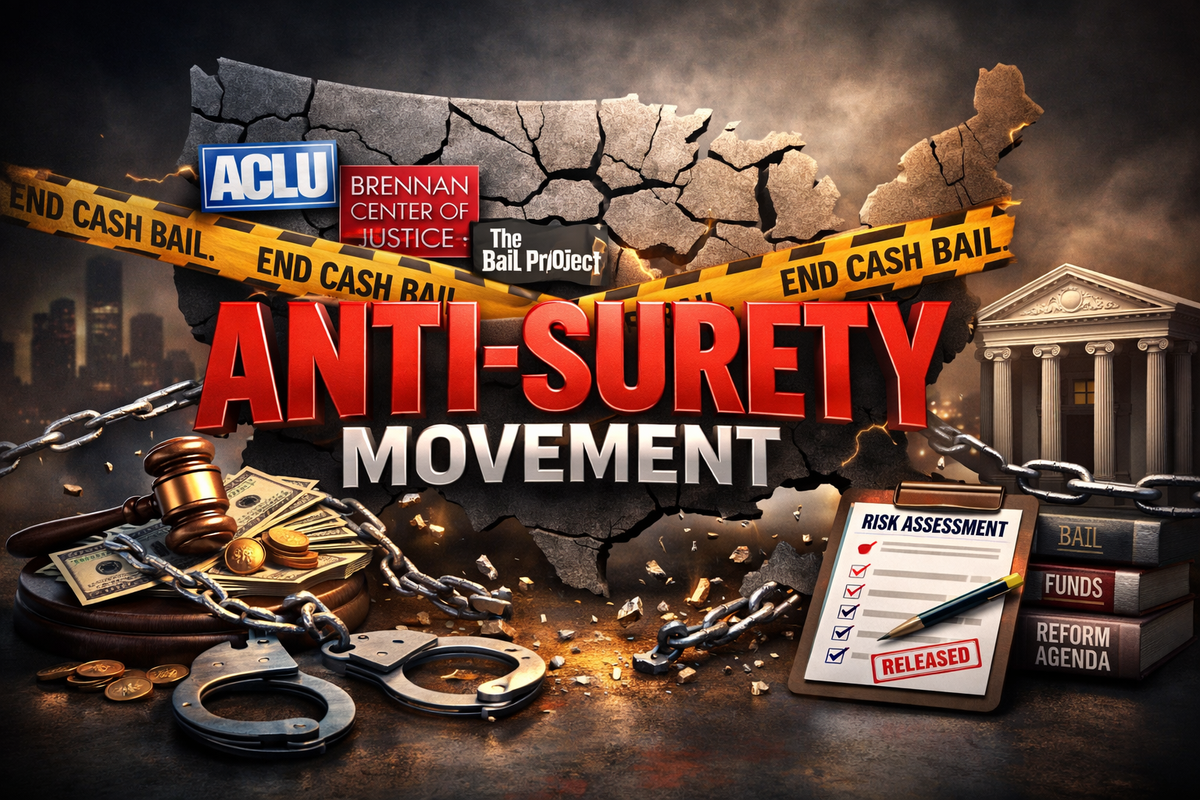
During the Professional Bail Agents of the United States (PBUS) Winter Conference, Mike Morrison introduced a term that captures a growing national trend affecting the bail profession: the “Anti-Surety Movement.” That moment was important because it gave a name to something many bail professionals across America had already been seeing in their own states, their own courts, and their own communities.
The phrase is not directed at a single organization. It does not mean every group involved in bail reform operates under one formal structure. Instead, it describes a broad network of advocacy groups, legal organizations, policy centers, nonprofit bail funds, taxpayer-funded initiatives, foundations, academics, and government pretrial programs that often share the same policy objective: the systematic reduction or elimination of commercial surety bail.
Under this framework, organizations such as the ACLU, the Brennan Center, the MacArthur Justice Center, taxpayer-funded bail reform initiatives, bail funds, and nonprofit programs like The Bail Project operate within a larger ideological ecosystem. These organizations may differ in structure, funding, public messaging, and strategy, but many promote similar outcomes: replacing financial accountability with risk-assessment models, unsecured release, personal recognizance bonds, or government-administered pretrial programs.
That is why the term matters.
For years, the bail profession has been forced to respond to isolated attacks as though each proposal stood alone. One state considers a new court rule. Another state expands release on recognizance. A nonprofit bail fund launches in another jurisdiction. A foundation funds a new research project. A legislature changes detention standards. A court decision limits financial conditions of release. Each event may appear separate on the surface, but when viewed together, a clear pattern emerges.
That pattern is the Anti-Surety Movement.
The term is intended to provide clarity rather than rhetoric. It recognizes that these efforts frequently rely on academic models, pilot programs, advocacy-driven data, and foundation-funded policy campaigns to support reforms that are often tested in real-world court systems before long-term outcomes are fully understood. The courtroom becomes the laboratory. Communities become the test subjects. Victims, law enforcement, judges, prosecutors, clerks, taxpayers, and families are left to deal with the consequences.
Since the term was introduced, the evidence has only become clearer. Across the country, reformers have continued to push systems that reduce judicial discretion, weaken financial accountability, and transfer responsibility from private surety professionals to government agencies. These policies are often sold as compassion, fairness, or modernization. But in practice, they frequently create a system where accountability becomes harder to measure, harder to enforce, and easier to ignore.
This is the central problem.
Bail is often mischaracterized as a financial transaction, but that description misses its purpose entirely. Bail is a structured mechanism that ensures responsibility. It places obligation on the defendant. It requires a third party to stand behind that obligation. It gives the court a practical means of enforcement. It is not theoretical. It is operational.
Surety bail works because someone has skin in the game.
A professional bail agent is not simply posting paper. The agent assumes financial risk. The family or cosigner often assumes responsibility. The defendant is reminded that release is not freedom without obligation. It is release conditioned on returning to court and complying with the process. When the defendant fails to appear, the surety system has a direct financial incentive and legal authority to locate that defendant and return him or her to court.
That is accountability.
The Anti-Surety Movement does not remove the need for accountability. It removes the mechanism that enforces it. In its place, it offers alternatives that rely on prediction rather than responsibility, recommendation rather than obligation, and policy language rather than real enforcement. Risk assessments, unsecured bonds, court reminders, and government supervision may have a role in certain cases, but they are not the same as surety accountability.
When a defendant is released with no meaningful financial obligation, no responsible third party, and no practical enforcement mechanism, the system is no longer grounded in accountability. It is grounded in hope.
That is not reform. That is a gamble.
Nevada provides one example of what happens when reform moves faster than reality. Reformers promised that changes to bail laws would help low-income defendants accused of minor offenses. But law enforcement leaders have warned that the practical result has been far more serious. Sheriff Brad Pope of the Lyon County Sheriff’s Office stated in his January 16, 2026 “Message of the Week” that these laws have allowed serious and repeat offenders back into communities where they commit more crimes. That warning reflects what bail professionals, prosecutors, victims, and law enforcement have been saying for years: when accountability is weakened, public safety pays the price.
Nevada is not alone.
New York adopted sweeping bail reforms and later faced public backlash after repeat offenders were released and rearrested. Illinois eliminated cash bail statewide under the SAFE-T Act. New Jersey replaced much of its traditional bail system with a government pretrial model. Philadelphia, Chicago, Washington, D.C., and other jurisdictions have experimented with reduced financial accountability and expanded government release systems. Each jurisdiction has its own facts, laws, and outcomes, but the direction is familiar: less surety bail, more government control, more reliance on prediction, and less private-sector accountability.
The Anti-Surety Movement presents these changes as progress. But progress must be measured by results, not slogans.
Do defendants return to court?
Are victims protected?
Are judges able to enforce their orders?
Are failures to appear reduced or increased?
Are new crimes being committed by defendants already released?
Are taxpayers paying more for government programs that produce weaker accountability?
Are communities safer?
These are the questions that matter.
Too often, bail reform debates avoid those questions by focusing almost entirely on the defendant’s release while ignoring what happens after release. But pretrial justice does not end when someone walks out of jail. That is only the beginning. The system still has to move the case forward. The defendant still has to appear. Victims still deserve protection. Witnesses still matter. Courts still need authority. Communities still deserve safety.
An arrest without court appearance is not accountability.
A release decision without enforcement is not justice.
A policy that sounds compassionate but produces more victims is not reform.
From the perspective of the professional bail industry, the Anti-Surety Movement represents a coordinated shift away from a private-sector accountability model toward centralized, government-managed pretrial systems. Supporters of surety bail contend that this transition reduces financial responsibility for defendants, transfers costs to taxpayers, weakens enforcement mechanisms, and removes one of the few systems that has historically helped ensure court appearance at no direct cost to the public.
That cost issue is critical.
Professional bail operates as a private-sector accountability system. The taxpayer does not pay the bail agent to supervise the defendant. The taxpayer does not pay the surety company to assume risk. The taxpayer does not pay the bail agent to locate the defendant who fails to appear. But when surety bail is replaced with government pretrial services, those responsibilities do not disappear. They are transferred.
Someone still has to monitor defendants.
Someone still has to send reminders.
Someone still has to supervise release conditions.
Someone still has to respond when defendants fail to appear.
Someone still has to deal with new crimes committed while cases are pending.
Under government pretrial systems, that someone is usually the taxpayer.
This is why the Anti-Surety Movement must be understood as more than a debate over bail. It is a debate over who carries responsibility in the criminal justice system. Is responsibility carried by the defendant, the family, the professional bail agent, and the surety company? Or is it shifted to government agencies, taxpayers, and communities after the fact?
The answer matters.
Bail reformers often argue that financial conditions are unfair. But they rarely acknowledge that surety bail includes personal responsibility, family involvement, court accountability, and private financial risk. They also rarely explain how government systems will enforce compliance when defendants choose not to appear. A court reminder can help someone who forgot. It cannot compel someone who does not intend to return.
That is the missing piece in much of the reform conversation.
The justice system depends on compliance, and compliance depends on accountability. Courts issue orders with the expectation that those orders will be obeyed. When a defendant is released, the court is trusting that person to return. But trust alone is not a system. Trust without enforcement becomes weakness. And a justice system that cannot enforce its own orders eventually loses public confidence.
That is why professional surety bail remains important.
The bail profession does not claim that every defendant should remain in jail. It does not claim that every case requires the same response. It does not argue against fairness. What the profession argues is that release must be tied to responsibility. Court appearance must matter. Victims must not be forgotten. Judges must retain discretion. Public safety must remain part of the equation.
Fairness and public safety are not enemies.
They are inseparable.
A system that ignores fairness will lose legitimacy. A system that ignores public safety will lose the trust of the people it is supposed to protect. True reform must balance both. The Anti-Surety Movement too often treats release as the primary measure of success while giving far less attention to appearance rates, repeat offending, victim safety, court delays, and taxpayer cost.
That is not enough.
The professional bail industry must continue explaining what surety bail actually does. Bail agents are not outsiders to the justice system. They are part of the practical accountability structure that helps courts function. They work nights, weekends, holidays, and emergency calls. They deal with families in crisis. They explain court obligations. They remind defendants where to be and when to be there. They help keep cases moving. When necessary, they help return defendants to custody.
That work is rarely understood by policymakers who view bail only through ideology.
It is also rarely understood by national organizations that study criminal justice from a distance but do not live with the daily consequences inside local communities. Real criminal justice does not happen in a classroom, a foundation boardroom, or a policy paper. It happens in courtrooms, jails, sheriff’s offices, clerk’s offices, neighborhoods, and families.
That is where policy becomes reality.
When the Anti-Surety Movement pushes reforms without fully accounting for real-world consequences, local communities are left to absorb the damage. Law enforcement takes the blame when someone is released and commits another crime. Judges are criticized when defendants do not appear. Prosecutors are forced to manage delayed cases. Victims are told to keep waiting. Taxpayers fund new bureaucracies. Meanwhile, the organizations that promoted the reforms often move on to the next campaign.
Responsibility should not work that way.
If reformers want to replace surety bail, they should be required to prove that the replacement performs better. Not in theory. Not in slogans. Not in selective studies. In real courtrooms with real defendants and measurable outcomes.
The standard should be clear.
Does the alternative produce better court appearance?
Does it reduce repeat offending?
Does it protect victims?
Does it save taxpayers money?
Does it help judges enforce their orders?
Does it strengthen or weaken public confidence in the justice system?
If the answer is no, then the policy should not be called reform.
It should be called what it is: an experiment.
The term “Anti-Surety Movement” helps policymakers, practitioners, and the public understand that bail reform debates are not isolated policy discussions. They are part of a broader national campaign to fundamentally restructure pretrial justice in the United States. That campaign deserves scrutiny. It deserves direct questions. It deserves honest measurement.
Professional bail agents should not be afraid to name what is happening.
The Anti-Surety Movement is real. It is active. It is well-funded. It is organized around a common objective. It has shaped legislation, litigation, public messaging, nonprofit activity, and government policy across the country. And if the bail profession fails to explain it clearly, others will continue defining the conversation for us.
That is why the term was introduced at the PBUS Winter Conference.
It gave the profession language.
It gave policymakers a framework.
It gave the public a way to understand that this is not simply about one bill, one court rule, one nonprofit, or one state. It is about the future of pretrial accountability in America.
The issue is not whether the justice system should be fair. It must be fair. The issue is whether fairness can survive without accountability. The issue is whether public safety can be protected by systems that rely more on prediction than enforcement. The issue is whether taxpayers should be forced to fund government replacements for a private-sector system that has worked for generations.
The American criminal justice system cannot function on theory alone. It requires appearance. It requires compliance. It requires consequences. It requires accountability.
That is what surety bail provides.
And that is what the Anti-Surety Movement seeks to remove.
Mike Morrison writes about public safety, criminal justice policy, court accountability, and the role of professional surety bail in the American legal system.
About the Author
Mike Morrison is the 2026 PBUS National Bail Agent of the Year and President of the Mississippi Bail Agents Association. With more than 35 years of experience as a licensed professional bail agent and owner of Mike Morrison Bail Bonding Company in Hattiesburg, Mississippi, he writes regularly on bail bonds, pretrial policy, public safety, victims, courts, and accountability. His commentary has reached more than one million readers across social media in 2026.
Learn more at https://linktr.ee/mdmorrison.
© 2026 Mike Morrison. All rights reserved.