When the Science Is for Sale: Outcome Selection Bias and the Bail Reform Playbook
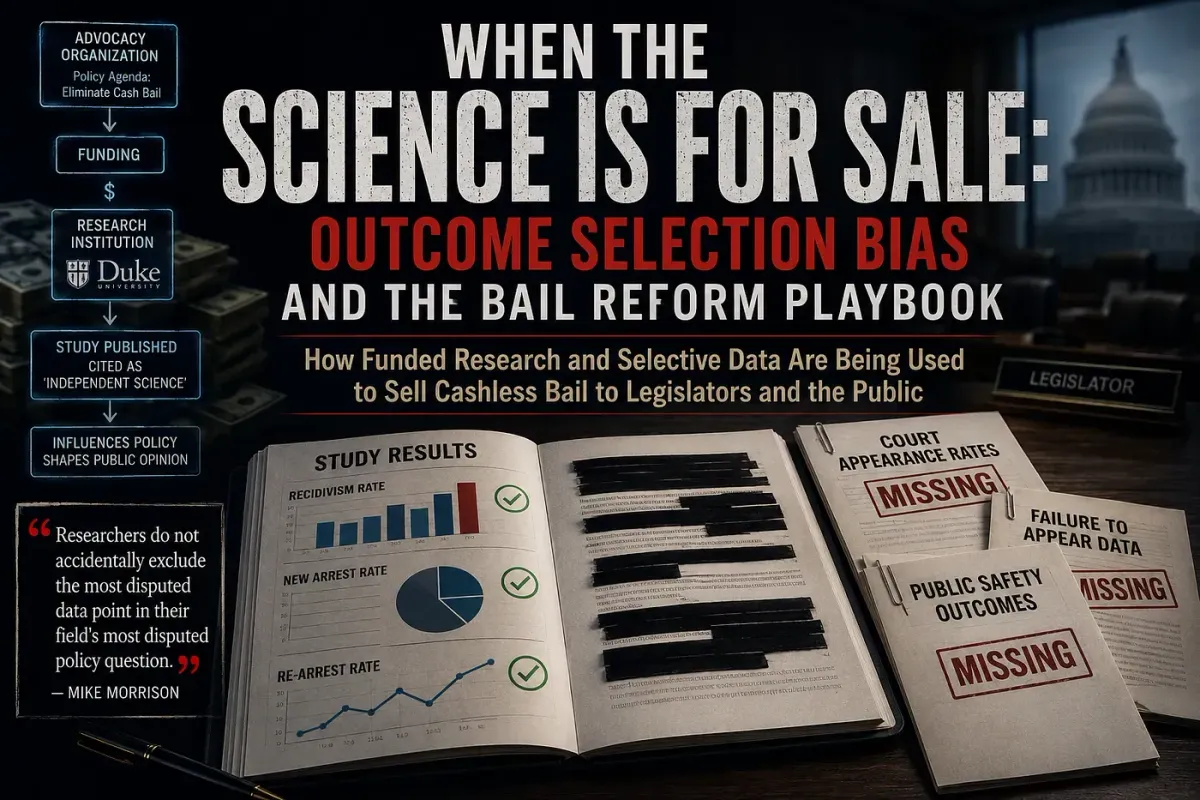
How Funded Research and Selective Data Are Being Used to Sell Cashless Bail to Legislators and the Public
There is a moment in every policy debate when the conversation shifts from honest disagreement to something more calculated. In the fight over cashless bail, that moment arrived when well-funded advocacy organizations discovered that the most effective way to win a legislative argument was not to make the better case — it was to buy the better study.
I have spent 35 years working inside the criminal justice system. I have learned to read numbers the way a mechanic reads an engine. You listen for what is missing as much as what is there. And what has been consistently, deliberately missing from the academic research driving bail reform is the data that tells the truth.
That absence has a name. It is called outcome selection bias, and it is often the quiet engine behind studies that arrive at predetermined conclusions.
The mechanism is straightforward. A researcher — or more precisely, a researcher’s funder — decides in advance what a successful outcome looks like. They design the study to measure exactly that outcome and exclude the variables that would complicate the narrative. The result carries a university letterhead, gets published with appropriate academic ceremony, and lands in legislative testimony as independent science. Nobody reads the footnotes. Nobody asks who paid for it.
In Harris County, Texas, this playbook was run with remarkable transparency for anyone willing to look. Arnold Ventures, an organization with a declared policy agenda to eliminate commercial surety bail nationwide, funded research through the Wilson Center for Science and Justice at Duke University to assess Harris County’s court-ordered bail reforms. The study received wide attention. Reform advocates cited it as proof that cashless release worked.
What the study measured was recidivism. What it deliberately did not measure was court appearance rates — the single most contested metric in the entire bail reform debate, and the one variable that most directly exposes the failure of releasing defendants without financial accountability. That omission was not an accident. Researchers do not accidentally exclude the most disputed data point in their field’s most disputed policy question. According to reporting by the Texas Tribune, appearance rates and the reasons for missed hearings were described as topics for future reports — meaning the funded study was published and circulated as a success story while the most damaging data was still being withheld.
Meanwhile, Harris County Court Watch documented failure to appear rates as high as 82% across criminal courtrooms following the elimination of cash bail. That number did not appear in the Duke study. It appeared in court monitoring data that the funded research had no interest in counting.
Yolo County, California told the same story with documented proof. In August 2022, Yolo County District Attorney Jeff Reisig published an analysis of re-offense rates for individuals released under the court-ordered Zero Bail policy. Of 595 individuals studied, 70.6% were re-arrested and 20% were arrested for violent crimes. A follow-up comparative study published in February 2023 found that zero bail defendants were rearrested on 163% more charges than those who posted bail, reoffended 70% more often, faced felony charges 90% more often, and were accused of three times as many violent crimes. The Yolo County Superior Court had kept the Zero Bail policy in effect for 13 months.
Reform advocates attacked the methodology. That was predictable. What they could not explain away was the core finding — that removing financial accountability produced a documented, measurable collapse in compliance and public safety outcomes that their own preferred studies had been specifically designed not to measure.
This is what credibility laundering looks like in practice. Private advocacy money flows into a prestigious institution. The institution produces findings shaped by the funder’s policy goals. Those findings travel back into the public debate stripped of their origin, wearing the borrowed authority of academic independence. By the time a state legislator hears the citation, Arnold Ventures and its agenda are nowhere in the room.
The surety bail industry does not operate that way. When a bail bond agent writes a bond, he is personally and financially guaranteeing that defendant’s appearance. There is no study design that lets him exclude the inconvenient outcomes. Every missed court date costs him. That accountability is precisely what outcome selection bias is designed to make invisible.
Policymakers deserve to know what they are actually reading when a bail reform study lands on their desk. The question is not whether the research carries a prestigious name. The question is who decided what to measure — and what they chose to leave out. The data that answers that question already exists. It simply was not included.
About the Author
Mike Morrison is the 2026 PBUS National Bail Agent of the Year, President of the Mississippi Bail Agents Association, and owner of Mike Morrison Bail Bonding in Hattiesburg, Mississippi. A licensed bail agent with more than 35 years of experience, he writes on bail bonds, pretrial release, public safety, criminal justice, and court accountability. Morrison's work is based on daily experience in the courtroom and has reached more than one million readers across social media in 2026. Learn more at https://linktr.ee/mdmorrison.