Where Does the Right to Bail Come From?
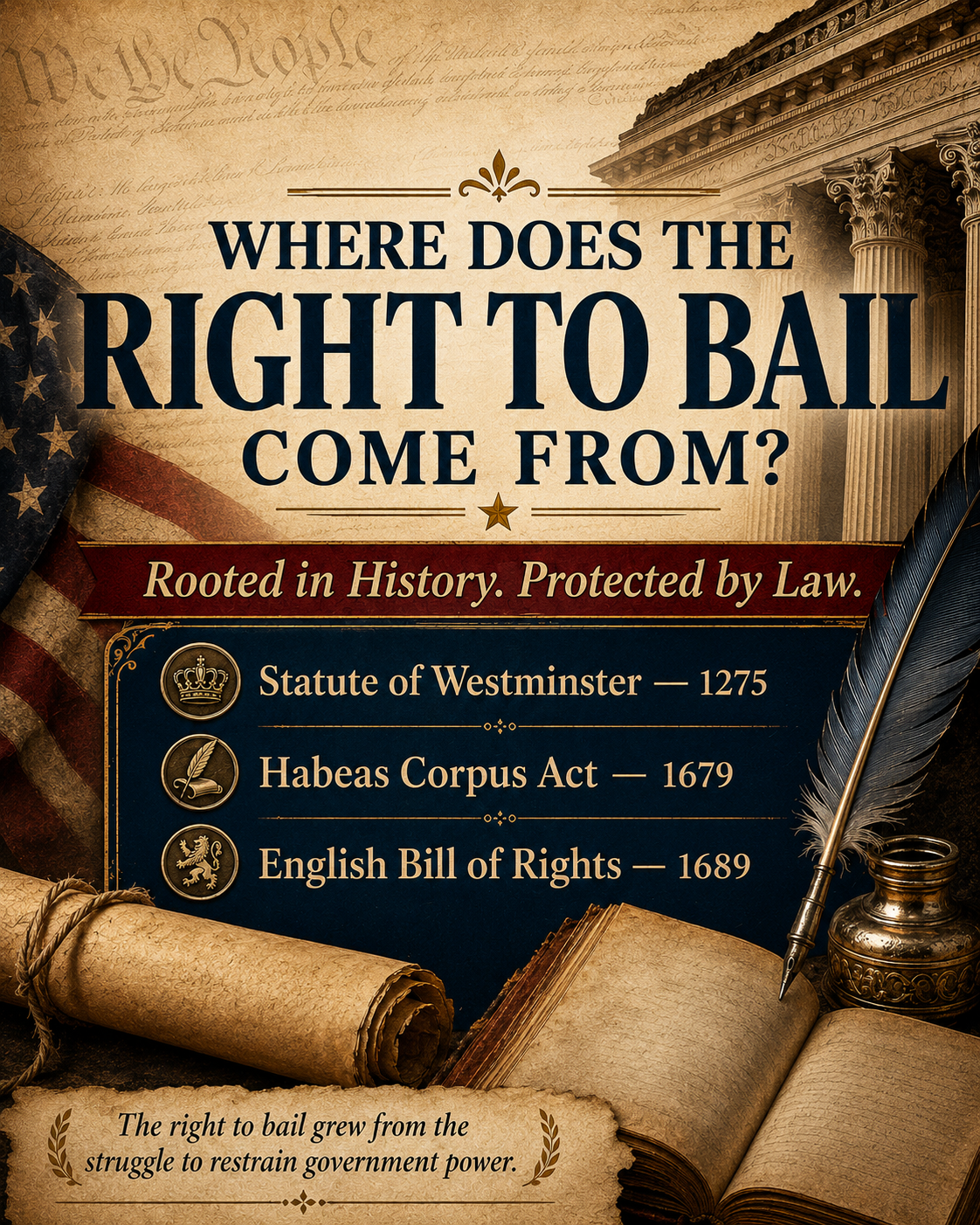
Most Americans have heard the words "excessive bail shall not be required," but far fewer have stopped to ask why those words were placed in the Bill of Rights. They were not written to make the criminal justice system more convenient, and they were not written for the benefit of any profession or organization. They were written because history had already demonstrated what happens when government holds the unchecked power to arrest an individual, place that person behind bars and control the terms of release.
The Constitution is often discussed as though it were a list of instructions telling citizens what they may do. In reality, much of the Constitution and the Bill of Rights exists to tell the government what it may not do. Government may not deprive a person of liberty without due process. It may not conduct unreasonable searches. It may not compel a person to testify against himself. It may not impose cruel punishment, and it may not use bail as a backdoor method of keeping an accused person locked up.
That last point is where the history of bail becomes a story worth telling.
The foundations of bail reach back more than seven centuries into English law. The Statute of Westminster of 1275 attempted to identify which offenses were bailable and which were not, placing legal boundaries around the power of sheriffs and other officials to decide who remained imprisoned before trial. But government is inventive, and officials soon discovered a way to defeat the purpose of bail without ever technically denying it: declare that release was available, then set the amount so high that release was practically impossible. The jail door was supposedly unlocked, but the key had been placed on the other side of the kingdom. That abuse helped produce the English Bill of Rights of 1689 and its declaration that excessive bail ought not be required — a principle the American founders carried directly into the Eighth Amendment a century later.
The Eighth Amendment did not appear because the founders believed every person accused of every crime should automatically walk free. It appeared because they understood that the power to detain is one of the most serious powers government possesses. The amendment places a constitutional boundary between legitimate pretrial decision-making and the use of bail as punishment before conviction. The Supreme Court drew that boundary plainly in Stack v. Boyle (1951), holding that bail set higher than the amount reasonably calculated to assure a defendant's appearance is excessive under the Eighth Amendment. Decades later, in United States v. Salerno (1987), the Court upheld the government's authority to detain genuinely dangerous defendants — but only through carefully limited procedures, declaring that in our society "liberty is the norm" and pretrial detention "the carefully limited exception." Both sides of the balance are constitutional. Neither side is unlimited.
Mississippi's Constitution is even more direct, with protections tracing back to the state's original Constitution of 1817. Article 3, Section 29 provides that before conviction, people are generally "bailable by sufficient sureties," subject to the serious-offense exceptions and procedures written into that section. When bail is denied in qualifying cases, the judge must place the reasons for denial into the record, and the Constitution provides a mechanism for emergency review. Those requirements matter because liberty cannot depend upon an unexplained decision made behind a courtroom door.
Bail is therefore not a gift from government. It is part of the legal structure designed to restrain government while still allowing the courts to protect the public and require a defendant's appearance. An arrest is an accusation, not a conviction. A defendant may ultimately be found guilty, but until the criminal process has run its course, the government must operate within the boundaries established by the Constitution, state law and the rules of the court.
That principle brings us directly into the modern debate over government-operated and government-funded pretrial release programs.
A government pretrial program is not separate from government simply because it is called a "service," a "program" or an "alternative." Changing the name on the door does not change who owns the building. When a court agency, county department or government contractor collects information from an accused person, evaluates that person, recommends conditions of release, monitors behavior, reports alleged violations or influences whether the person remains free, it is exercising governmental power. In the federal system, pretrial services officers are specifically authorized by statute to collect information relating to bail and to supervise defendants.
That does not mean every pretrial program is unconstitutional. It means every government pretrial program must remain restricted by the Constitution. Courts have long held the lawful authority to impose reasonable release conditions — but that authority comes with the same constitutional obligations that govern every other exercise of government power. Due process, judicial oversight, individualized decision-making and protection against excessive conditions do not disappear merely because confinement has been replaced with supervision. A reporting requirement, electronic monitor, travel restriction, drug-testing order, curfew or home-detention condition may be less severe than a jail cell, but each still represents government control over a person who has not been convicted.
Government should not be permitted to do indirectly through a pretrial program what it could not constitutionally do directly through the jail.
The program should not become the investigator, the decision-maker, the supervisor and the enforcement authority without meaningful judicial review. It should not impose unnecessary conditions merely because public funding is available to pay for them. It should not gather unlimited personal information without a legitimate purpose, and it should not transform pretrial release into a government-controlled probation system for people who have not been found guilty.
The Constitution follows the government wherever the government goes. It follows the government into the courtroom. It follows the government into the jail. It follows the government into a pretrial services office, and it follows the government when supervision is placed around a person's ankle instead of bars around a jail cell.
This is precisely where professional surety bail stands apart. A surety bond is a private financial guarantee that the defendant will return to court — accountability created among the defendant, the indemnitor, the bail agent and the surety, not imposed by a government supervisor. It does not eliminate the authority of the judge, and it does not determine guilt or innocence. But because it is private, it carries none of the constitutional dangers that arise when the same government that made the arrest also evaluates, monitors and reports on the person it arrested. The accused returns to family, employment and legal counsel, and the government stays where the founders put it: behind constitutional limits.
Our right to bail grew from centuries of hard experience with government power. It exists because earlier generations understood that government must never be allowed to imprison first and explain itself later. As the nation continues debating pretrial release, detention and publicly funded supervision, that history cannot be ignored — because government-run pretrial programs are an extension of the very government the right to bail was designed to restrain. The constitutional restrictions do not end when the jail door opens.
Michael D. Morrison is the 2026 PBUS National Bail Agent of the Year and President of the Mississippi Bail Agents Association. With over 35 years of experience as a licensed bail agent and owner of Mike Morrison Bail Bonding Company in Hattiesburg, Mississippi, he writes regularly about pretrial policy, public safety, and the real-world workings of America's criminal justice system at Mike Morrison | Public Safety & Accountability. His commentary has reached more than one million views across social media in 2026 alone, and he frequently presents on bail policy and professional standards at the Mississippi Judicial College.