Why Aggregate Bail Reform Studies Can Miss Key Dimensions of Pretrial Outcomes
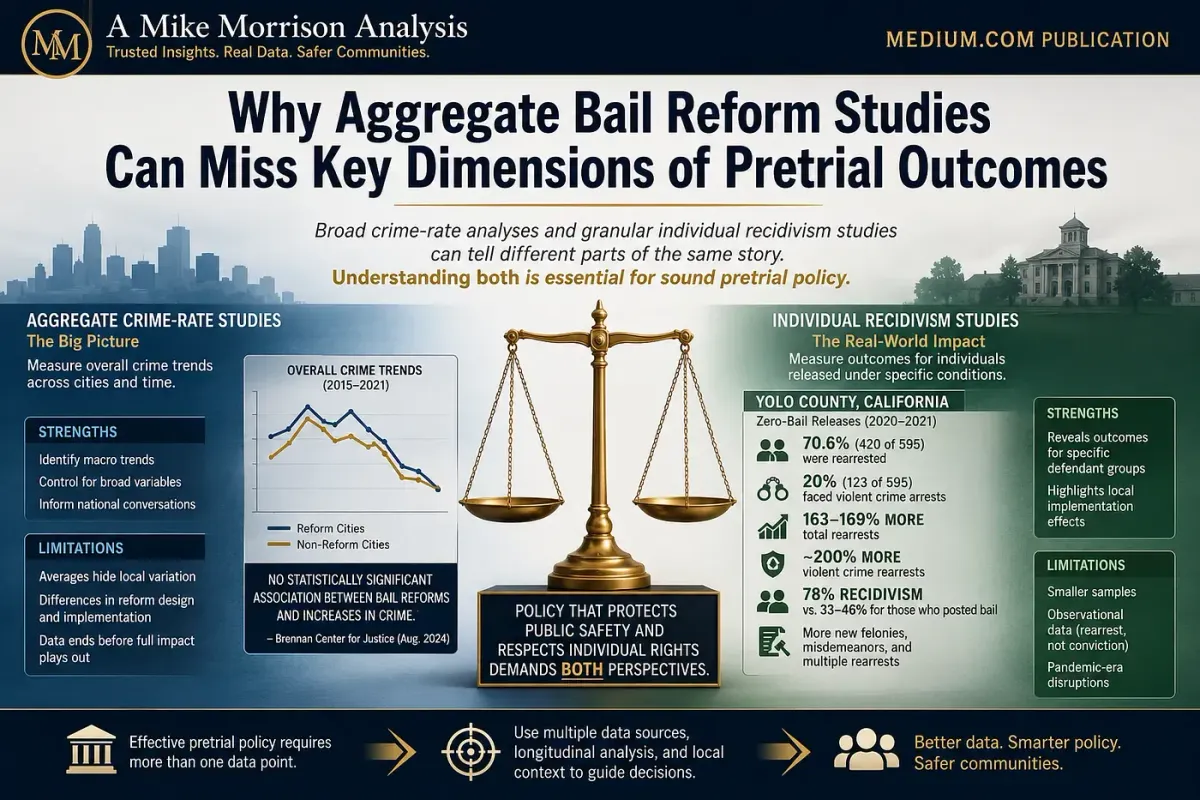
Broad crime-rate analyses and granular individual recidivism studies can tell different parts of the same story. Understanding both is essential for sound pretrial policy.
The debate over bail reform centers on a core question: how best to balance public safety, court appearance, and fairness in pretrial release decisions. Proponents emphasize reducing unnecessary detention, while critics highlight risks when financial conditions or supervision are significantly weakened.
In August 2024, the Brennan Center for Justice published Bail Reform and Public Safety, reviewing crime trends from 2015 to 2021 across 33 cities — 22 with various forms of bail reform and 11 without. The report found no statistically significant association between bail reforms and increases in overall crime or violent crime.
This type of analysis is frequently cited in policy discussions. However, its limitations become clearer when compared with detailed individual-level data from specific jurisdictions, such as Yolo County, California.
The Brennan Center Analysis: Strengths and Constraints
The Brennan Center study aggregates city-level crime data to compare jurisdictions with legislative, court-ordered, or prosecutorial bail changes against those without. It attempts to account for the confounding effects of the COVID-19 pandemic and related disruptions.
Main conclusion: Crime trends moved similarly in reform and non-reform cities, with no clear link to bail policy shifts.
Key limitations:
- Data ends in 2021, excluding later implementation experiences and subsequent crime trends.
- Reliance on aggregate city-level statistics, which can average out important differences in reform design, released populations, supervision quality, and local practices.
- Common challenges in multi-jurisdictional econometric work, including selection of comparison sites and control for concurrent variables.
Such studies are useful for identifying broad patterns. However, they are less equipped to examine outcomes for specific categories of defendants under different release conditions.
A Critical Analytical Distinction
A jurisdiction may show stable overall crime trends while simultaneously experiencing significantly higher rates of repeat offending among specific categories of pretrial releases. This distinction between jurisdiction-wide crime rate studies and individual-level recidivism outcome studies forms the intellectual backbone of evaluating bail policy.
Aggregate crime statistics can remain relatively steady even if a subset of released individuals reoffends at elevated rates — especially when overall arrest volumes fluctuate due to changes in policing, reporting practices, or other systemic factors.
Yolo County’s Experience with Zero Bail
Yolo County implemented emergency zero-dollar bail for most misdemeanors and many lower-level felonies during the COVID-19 period and extended key elements locally. The Yolo County District Attorney’s Office conducted comparative analyses focused on individual outcomes rather than county-wide crime totals.
Key findings (from reviews covering 2020–2021 releases, with updates through early 2024):
- In a review of 595 zero-bail releases, approximately 70.6% (420 individuals) were rearrested; 20% (123 individuals) faced arrests involving violent crimes.
- Matched samples (~100 individuals per group): Zero-bail releases were compared to comparable individuals who posted bail pre-policy (2016–2019), tracked over 18 months.
- The zero-bail group showed 163–169% more total rearrests and roughly 200% more violent crime rearrests.
- Recidivism rates reached ~78% for zero-bail releases versus 33–46% for the posted-bail group.
- The zero-bail group also recorded substantially higher numbers of new felonies, misdemeanors, and multiple rearrests.
These comparisons focus on rearrests for similar offense categories and attempt matching on prior characteristics, though they remain observational.
Caveats and Broader California Context
As with any local study, limitations exist: modest sample sizes in the matched groups, overlap with pandemic-era disruptions to arrests and court operations, use of rearrest rather than conviction data, and the inherent challenges of pre/post comparisons.
Broader research by the Public Policy Institute of California on the statewide emergency bail orders found elevated felony rearrest likelihoods in the short term in counties that extended the policy, though patterns varied by offense type and timing.
Understanding the Role of Financial Conditions
Financial conditions are not merely punitive. Supporters argue they function as behavioral incentives that reinforce court appearance obligations, help maintain family or community involvement in the process, and create structured accountability mechanisms that many unsecured release systems lack.
When these incentives are removed without equivalent supervision structures, some moderate-risk defendants may reoffend at higher rates — a pattern observed in certain local data even when overall jurisdiction crime statistics do not shift dramatically.
Reconciling the Evidence
Large-scale studies excel at macro trends but can dilute signals from particular implementations. Individual-level analyses like Yolo County’s illuminate potential costs for specific defendant cohorts released under reduced or unsecured conditions. Both perspectives matter.
Effective pretrial systems typically combine validated risk assessment tools, appropriate supervision levels, and targeted use of financial conditions where they demonstrably improve appearance rates and reduce reoffending. Broad presumptions against financial conditions risk overlooking important variation across offense types and risk profiles.
High-profile cases of pretrial reoffending contribute to public concern, even amid national crime declines after the 2020 spike. Dismissing such cases outright risks underweighting practical implementation challenges.
Conclusion: Toward Better Policy Data
The Brennan Center report provides one valuable lens on bail reform, but it should be considered alongside more granular studies that track individual outcomes beyond 2021. The future of pretrial policy should be guided not by any single approach or ideology, but by transparent longitudinal data, measurable outcomes, and an honest willingness to evaluate both successes and failures across diverse jurisdictions.
Transparent, multi-method evidence offers the best path to policies that protect public safety while advancing fairness in the justice system.
What data or experiences from your own community inform your view on this issue?
About the Author
Mike Morrison is the 2026 PBUS National Bail Agent of the Year, President of the Mississippi Bail Agents Association, and owner of Mike Morrison Bail Bonding in Hattiesburg, Mississippi. A licensed bail agent with more than 35 years of experience, he writes on bail bonds, pretrial release, public safety, criminal justice, and court accountability. Morrison's work is based on daily experience in the courtroom and has reached more than one million readers across social media in 2026. Learn more at https://linktr.ee/mdmorrison.