Why are bail agents refusing to write bonds in certain jurisdictions?
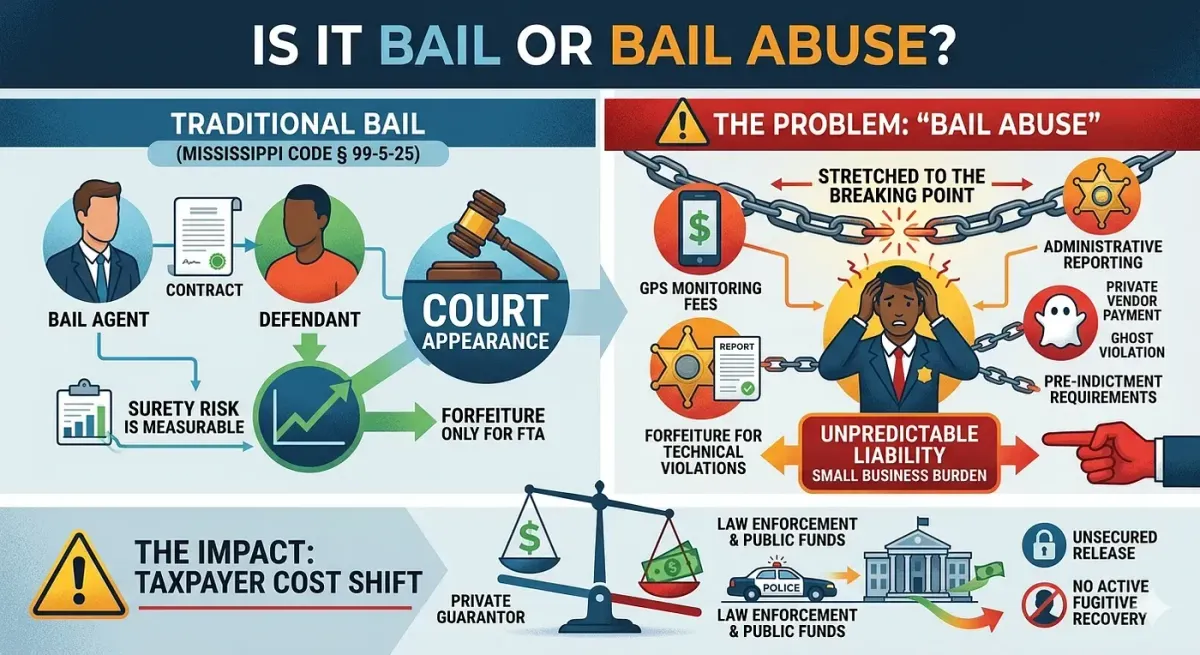
It is a simple matter of survival: you cannot insure a risk that you are not allowed to manage. Bail agents are leaving certain counties because some local practices have transformed the bail bond from a guarantee of a defendant’s appearance in court into a guarantee of the defendant’s ongoing compliance with a variety of conditions unrelated to appearance. This expansion of liability stretches the legal definition of surety to the breaking point, creating a system where local bail agents are held financially responsible for obligations they cannot control, cannot monitor, and often are never notified about until it is too late.
Nothing in this article questions the authority of Mississippi courts to enforce lawful bond forfeitures when a defendant fails to appear. That responsibility has always been, and remains, the foundation upon which the commercial surety system operates.
At the center of this issue is a simple but critical principle found in Mississippi Code § 99–5–25, which states: “(1)(a) The purpose of bail is to guarantee appearance and a bail bond shall not be forfeited for any other reason.” That principle has guided Mississippi’s commercial surety system for generations. Professional bail agents have never objected to being held accountable when a defendant fails to appear in court. The issue discussed here is not whether defendants should appear in court — they absolutely should. The question is whether the legal obligation of the surety may be expanded beyond the statutory purpose established by the Legislature.
Historically, that clarity allowed the commercial surety system to function efficiently. Bail agents accepted financial risk based upon one measurable obligation — ensuring the defendant appeared when required by the court. However, in recent years, some local practices have begun attaching additional conditions to release that extend beyond appearance, including monthly GPS monitoring fees owed to private vendors and periodic administrative reporting requirements unrelated to scheduled court proceedings. When those additional obligations become the basis for bond forfeiture, the surety’s liability is no longer limited to guaranteeing appearance but instead becomes an open-ended guarantee of supervision and financial compliance — obligations the surety never agreed to assume and was never intended by statute to insure.
The Private Contract Conflict
When a court orders GPS monitoring through a private vendor and enforces payment through the threat of bond forfeiture, it effectively inserts a third-party financial obligation into a contract that was never designed to include it. A bail bond is a contract between the State and the Surety; the surety guarantees the defendant’s appearance in court — nothing more. Courts unquestionably possess the authority to impose lawful conditions of release. The issue is whether those conditions may expand the surety’s financial obligation beyond the statutory purpose of bail.
By enforcing payment to a private vendor through the mechanism of forfeiture, the court is functioning as a collection arm for a third-party company. The surety never agreed to guarantee that private debt, has no contractual relationship with the vendor, and has no legal authority to compel payment or enforce the vendor’s contract. This creates a situation in which a small business is financially penalized for an obligation it did not assume, cannot control, and cannot effectively manage. Over the life of a case, these GPS obligations can quietly exceed the value of the bond itself, effectively creating a second layer of financial exposure that was never contemplated when the surety underwrote the bond.
Lack of Notice and the “Ghost Violation”
In a traditional Failure to Appear (FTA), the violation is clear, documented on the court docket, and the surety is given a defined opportunity to locate and surrender the defendant. That structure allows the commercial surety system to function because the bail agent knows when the obligation has been breached and has the ability to respond. The risk is identifiable, the violation is documented, and the surety has both notice and an opportunity to mitigate its loss.
In contrast, liability is increasingly being created through scheduled “sign-in” court dates that are imposed as conditions of release, even when a defendant has not yet been indicted by a grand jury. In many instances, bonds remain active for extended periods — sometimes exceeding two years — while the case has not progressed to formal charges. During that time, defendants may be required to appear repeatedly or report solely to maintain compliance with administrative conditions rather than to participate in an actual court proceeding related to the adjudication of their case. When one of those imposed appearances is missed, the violation may be treated the same as a traditional Failure to Appear, exposing the surety to bond forfeiture even though the missed appearance did not involve a trial setting, plea hearing, or other proceeding tied directly to the statutory purpose of bail. As the duration of the bond increases, so does the number of administrative compliance events capable of triggering liability, expanding the surety’s exposure far beyond the single risk the bond was originally written to insure.
The Impact on Small Business and the Taxpayer
For the small, family-owned bail companies that make up the majority of the profession in Mississippi, these expanding obligations create an unsustainable business model. These are local businesses — not large compliance-driven corporations — yet they are increasingly expected to monitor private vendor payments, administrative reporting requirements, and other conditions they neither control nor are consistently notified about. A professional surety can effectively manage the risk of a defendant’s court appearance. It cannot reasonably underwrite an ever-expanding list of obligations that exist outside the surety contract and beyond its ability to supervise.
At the same time, every other participant in this system is compensated for the role they perform. GPS vendors are paid for their services. Monitoring companies receive their fees. Administrative systems are funded through public resources or private contracts. The professional bail agent stands alone as the only participant expected to absorb financial liability for obligations over which it has little or no practical control. The result is not simply increased business risk — it is the transfer of responsibility from the parties who administer these programs to a private surety that neither created nor manages them.
When risk becomes arbitrary and untethered from the statutory purpose of bail, responsible businesses respond the same way any prudent insurer would — they reduce their exposure or withdraw from the market altogether. Insurance cannot function where the insured risk is constantly redefined after the contract has been executed. As commercial sureties leave these jurisdictions, the consequences extend far beyond the bail industry. Fewer licensed bail agents mean fewer defendants have access to professional surety bail, leaving courts with fewer release options and increasing reliance on unsecured release mechanisms, including signature bonds.
When defendants released without a financial guarantor fail to appear, remove monitoring devices, or ignore court-ordered conditions, there is no private bail agent with both the financial incentive and legal authority to locate and surrender that individual. The responsibility shifts entirely to taxpayer-funded law enforcement agencies, increasing public expense while reducing one of the private-sector accountability mechanisms that has historically supported Mississippi’s criminal justice system.
Conclusion The question is not why bail bond companies are leaving; it is whether the current practices in these counties are sustainable or consistent with Mississippi law. Mississippi Code § 99–5–25 provides a clear standard. The purpose of bail is to guarantee a defendant’s appearance in court, and a bail bond shall not be forfeited for any other reason. That statutory framework has allowed Mississippi’s commercial surety system to operate successfully for generations because both the courts and the surety understood the obligation being guaranteed.
When local practices move beyond that standard and begin enforcing private financial obligations or administrative compliance through the mechanism of bond forfeiture, the nature of the surety’s obligation fundamentally changes. The issue is not whether courts may impose lawful conditions of release upon defendants; they unquestionably may. The issue is whether those additional conditions may expand the statutory and contractual liability of a commercial surety beyond what the Legislature has defined as the purpose of bail.
Until that distinction is clarified, the pattern of market withdrawal will continue. Responsible bail agents cannot insure risks they are neither authorized nor able to manage. As professional sureties leave these jurisdictions, access to surety bail will continue to contract, and the balance of accountability, efficiency, and cost that has historically supported Mississippi’s criminal justice system will continue to erode.