The Politics of Defunding: What the Retreat from Public Safety Cost Us — and What Mississippi Can Teach America
The defund movement damaged more than police budgets. It weakened accountability, discouraged officers, empowered non-prosecution policies, and left high-crime neighborhoods paying the price.
By Michael D. Morrison
Public safety in America works like a single chain with three links. Police make the arrest. Courts secure the defendant's appearance and hold the dangerous. Prosecutors bring the charge and see it through. When all three links hold, communities get accountability — and accountability is what actually breaks the cycle of violence. When any link fails, the whole chain fails, no matter how strong the other two remain.
Over the past six years, America ran an experiment on that chain. A political movement — promoted by elected officials, funded by national money, and cheered in the press — deliberately weakened all three links at once: police budgets were cut, pretrial accountability was stripped from courts, and prosecutors were elected on promises not to prosecute. Communities paid for that experiment in blood, measured it in homicide records, and have spent the years since reversing it. Now, in an election year, some of the politicians who promoted it are trying to erase their role in it.
That last part is why this needs to be written down now — because the erasure is happening in real time, on the record, this very week.
The candidate who deleted the evidence
Abdul El-Sayed, the front-runner in Michigan's Democratic Senate primary, has spent months insisting he "never, never called for defunding" the police. Then CNN's KFile reporting reviewed his 2020 interviews and found him saying, in his own words: "We do need to defund the police." Before launching his campaign, he deleted thousands of tweets — about a dozen of them supporting the defund movement, including one calling police "standing armies we deploy against our own people." His campaign now says his views have "become more nuanced."
Watch what a politician does when confronted with his own record. El-Sayed didn't defend his position. He didn't renounce it. He deleted it. And if the experiment he championed had worked, he wouldn't need to. Politicians do not delete their successes; they run on them. The deletions are an admission — so consider what, exactly, is being deleted. Start with the first link in the chain: the police themselves.
The first link: what defunding actually did
"Defund the police" was not just a hashtag. In 2020 budget votes, activists won more than $840 million in direct cuts to real police departments. New York approved a plan described as shifting or cutting roughly $1 billion from the NYPD budget — critics disputed how much of it was true cuts versus accounting transfers, but the political message was unmistakable. Los Angeles cut $150 million. Austin diverted $150 million. Homicides surged to record levels in more than a dozen major cities.
And then nearly every one of those cities quietly put the money back. Los Angeles restored its funding to hire 250 officers. Even Minneapolis — the birthplace of the movement — watched its own voters reject a ballot measure to dismantle the police department. Read that again: the people who actually live in the neighborhoods most affected by crime never wanted this. They wanted better policing, not less of it.
The budgets came back. The officers didn't. NYPD retirements jumped 72 percent in 2020 alone. And while national staffing has improved from the worst of the post-2020 exodus, the Police Executive Research Forum reported that responding agencies remained 5.2 percent below their January 2020 sworn-staffing levels as of January 2025. A budget cut can be reversed with one council vote. A generation of experienced officers who walked away because their elected leaders called them the problem cannot.
But here is what the coverage of defunding always missed: even a fully staffed, fully funded police department only controls the first link in the chain. An officer's job ends at the arrest. What happens next belongs to the courts — and the same movement that cut the budgets was quietly breaking that second link at the same time.
The second link: courts without accountability
An arrest means nothing if the system behind it will not prosecute the crime or secure the defendant's appearance in court. That word — appearance — is the entire foundation of pretrial justice. A criminal case cannot be resolved, a victim cannot see justice, and accountability cannot exist if the defendant simply doesn't show up.
Surety bail exists to solve exactly that problem, and it solves it with a mechanism no government program has ever replicated: private financial responsibility. When a bail agent writes a bond, the agent's company is on the hook. If the defendant fails to appear, the agent doesn't file a report and move on — the agent pays, and goes and finds him, at no cost to the taxpayer. Every incentive in the surety profession points toward one outcome: the defendant standing in front of the judge on his court date. Compare that to government-run pretrial release programs, where no one is financially responsible when a defendant vanishes, no one is charged with retrieving him, and failure is absorbed silently by the docket — and by the victim waiting for a trial that never comes.
New York's 2020 bail law is the clearest example of reform done blind. It didn't merely restrict cash bail — it left New York unusual among the states: judges there are generally not allowed to base pretrial detention decisions on the public-safety risk a defendant poses. New York's reformers refused to let judges even ask the question.
The evidence deserves an honest hearing on both sides. Studies — most prominently from the Brennan Center — found no statistical link between bail reform and overall crime rates across the cities they measured. But the research itself deserves scrutiny: grant records show Arnold Ventures, a major financial supporter of pretrial reform, also funded a $5.5 million research initiative evaluating New York's bail law — the movement's own funder underwriting the evaluation of the policy it championed. And other analyses cut the other way: one competing study of Cook County, Illinois — a disputed analysis, with other researchers reaching different conclusions from the same county's data — found a 33 percent increase in new violent crimes committed by released defendants. And notice what never gets studied at all: the government release programs themselves. The surety bail profession gets blamed for every system failure, while programs with no accountability mechanism whatsoever escape scrutiny entirely. Judge them all by the same standard — appearance rates, outcomes, responsibility when things go wrong — and let the comparison speak.
 Michael D. Morrison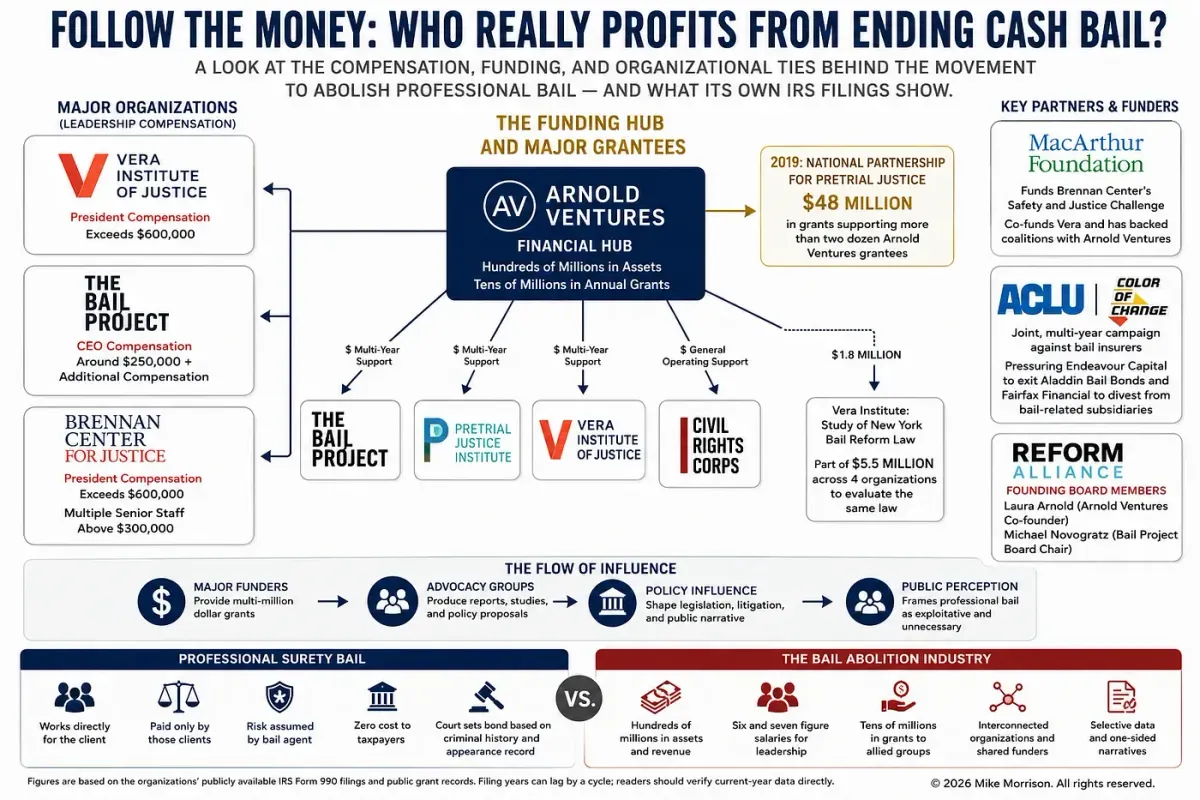
The third link: prosecutors who chose not to prosecute
A police officer can make the arrest, and a court can secure the defendant's appearance — and it all still comes to nothing if the prosecutor declines to bring the charge. That is the third link, and it was targeted just as deliberately as the first two: the decade-long campaign to elect "progressive prosecutors," heavily supported in selected races by Soros-funded PACs and allied groups — a strategy George Soros has publicly defended in his own writing, so this is a critique of a stated project, not a conspiracy theory. By the Law Enforcement Legal Defense Fund's accounting — an advocacy group's estimate, and it should be labeled as such — $13 million flowed into just ten DA races between 2018 and 2021, making Soros-linked money the largest funding source in nearly every one, and the group puts total spending on prosecutor races over the decade at roughly $50 million. In Philadelphia, roughly $1.7 million helped elect Larry Krasner in a primary with 17 percent turnout — a district attorney effectively installed by fewer than 7 percent of eligible voters.
What these offices did with the power is the point. A DA's decision not to prosecute is nearly unreviewable — no appeal, no check. Whole categories of crimes went uncharged. Felonies were downgraded. Bail went unrequested. Policies too unpopular to pass any legislature were enacted through the simple refusal to enforce the law. That is the cycle of violence in miniature: when arrest carries no consequence, arrest deters nothing — and the same offenders cycle back through the system, and through their victims' lives, again and again.
The voters rendered their verdict. San Francisco recalled Chesa Boudin with 60 percent of the vote. Los Angeles rejected George Gascón by 23 points. Alameda County recalled Pamela Price in two years. Kim Foxx declined to run again in Chicago; Kim Gardner resigned in St. Louis; Marilyn Mosby lost her Baltimore primary. These were not conservative electorates. These were the most liberal cities in America, judging the experiment by its outcomes.
To be fair about what this is and is not: donating to candidates is legal, much of this giving was disclosed, and police unions and wealthy donors spent millions on the other side of these recalls. This is not a shadowy plot; it is an open political project — one that voters examined up close and rejected.
So that is the experiment: all three links of the chain — police, courts, prosecution — weakened at the same time, in the same cities, by the same movement. Which raises the obvious question a fair reader should ask: what happens when a state does the opposite and strengthens all three at once? That test has been running for five years, and it has been running in Mississippi.
What Jackson teaches — including this summer
In 2021, Jackson had the highest homicide rate of any major American city: 99.5 killings per 100,000 residents. Mississippi's response was the opposite of defunding. JPD hired more than 40 new officers. The Legislature and Governor Reeves expanded the Capitol Police footprint — over loud objections about the process, and that debate was worth having. What followed is on the record: five consecutive years of declining homicides, a 91 percent homicide solve rate in 2025 against a national average of 58.6 percent, and the lowest start to a year since 2013 this past January.
A 91 percent solve rate is not just policing. It is accountability — the message, delivered case by case, that if you take a life in this city, you will be caught, you will be held, and you will be prosecuted. Criminologists have said for decades that certainty of consequence deters crime more than severity of punishment. Jackson has been proving it.
But 2026 is also teaching the harder lesson: gains are fragile. This summer the violence surged back — 41 homicides by late June, nearly all shootings, including the killing of a two-year-old boy alongside his mother and aunt in their own home. Watch what happened next, because it is the entire chain working in one week: four suspects in custody within days (the first link), one denied bond at her first appearance and another tracked to Texas and held (the second), a capital murder charge filed (the third). Local, state, and federal agencies working one case. Swift arrest. Detention of the dangerous. Prosecution to come. That is the machinery the defund-and-decline-to-prosecute movement dismantled in city after city — intact and functioning in Mississippi.
Two honest caveats, because this argument should be held to the same standard it demands of the other side: Jackson's decline tracked a national drop in violence, so no single policy gets all the credit. And even now, Jackson's homicide rate remains among the nation's highest — folks in south Jackson will tell you the numbers on paper don't yet match their streets. Both things are true. That is precisely the point. Public safety is not solved once. It is maintained — by staffed police departments, working prosecutors, accountable release, and courts empowered to hold the dangerous. Let any part of that lapse, and this summer shows how fast the ground gives way.
Judged by outcomes, not ideology
The defund experiment was tried, measured, and abandoned by nearly everyone who tried it. What remains is a political class that would rather delete the tweets than learn the lesson.
So here is the standard every criminal justice policy should meet, and the one voters should apply to every candidate of either party: judge it by outcomes, not ideology. Does it produce appearance in court? Does it protect victims? Does it hold the dangerous? Does someone — anyone — bear responsibility when it fails? If a policy cannot answer those questions, it is not reform. It is abandonment dressed up as compassion.
The residents of America's highest-crime neighborhoods answered these questions years ago. It is long past time the politicians caught up.
Michael D. Morrison is the 2026 PBUS National Bail Agent of the Year and President of the Mississippi Bail Agents Association. With over 35 years of experience as a licensed bail agent and owner of Mike Morrison Bail Bonding Company in Hattiesburg, Mississippi, he writes regularly about pretrial policy, public safety, and the real-world workings of America's criminal justice system at Mike Morrison | Public Safety & Accountability. His commentary has reached more than one million views across social media in 2026 alone, and he frequently presents on bail policy and professional standards at the Mississippi Judicial College.