The Three Biggest Bail Reform Lies Just Got Bigger
They kept the talking points. We kept the receipts."
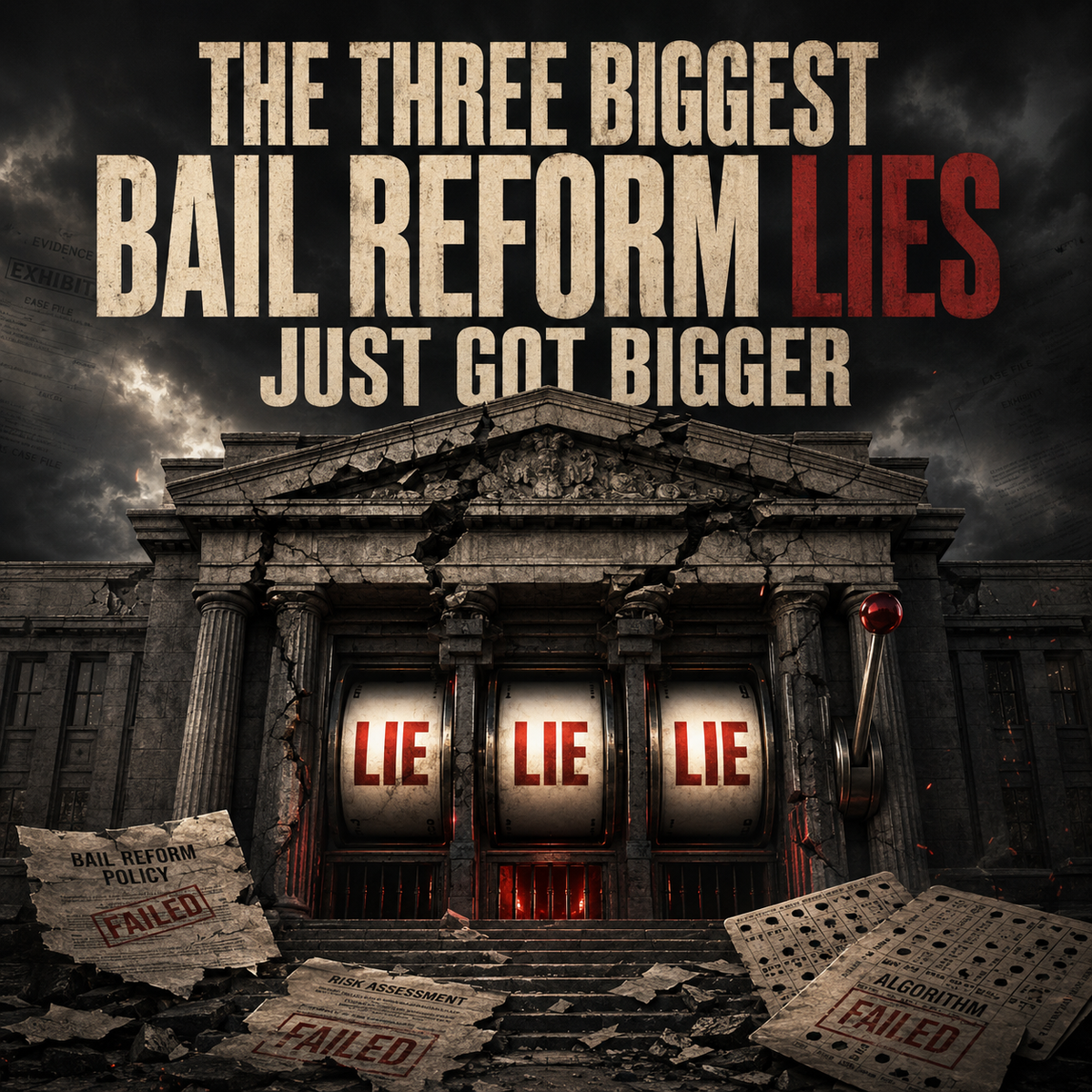
The bail reform movement treats its talking points like a losing gambler treats slot machines. When one stops paying, slide down to the next, pull the handle, and act like the last machine never existed. But three claims never leave the rotation, no matter how many times the research knocks them down: zero bail works just as well as a secured bond, risk assessments can predict human behavior, and poor people are rotting in jail because they can’t afford a bondsman.
In April 2025, AIA Surety named all three in a piece called “Do You Know the Three Biggest Bail Reform Lies of All Time?” They had the right list. What follows is that list with the receipts attached: every claim sourced, every source linked, and updated with what 2025 and 2026 added to the record. Counting down.
Lie #3: “Releasing defendants on zero bail is just as effective as a secured bond.”
The reform movement’s latest exhibit for this one came out of Los Angeles. In March 2025, the Los Angeles Superior Court released a report declaring that its own zero bail policy, the Pre-Arraignment Release Protocols it imposed in October 2023, had improved public safety, including a claimed 10 percent reduction in new criminal activity among those booked into custody. Read the letterhead before you read the findings. The court that wrote the policy wrote the report grading the policy. That is not research. That is a student filling out his own report card and acting surprised when it comes back straight A’s.
Now look at what the numbers say when someone without a stake in the outcome runs them. In February 2023, the Yolo County District Attorney published a comparative study tracking two matched groups of arrestees over 18 months: 100 released on traditional bail and 100 released on California’s COVID-era zero bail. The zero bail group was rearrested for 163 percent more crimes, committed new violent offenses 200 percent more often, new felonies 90 percent more often, and new misdemeanors 123 percent more often. Their overall recidivism rate was 78 percent, against 46 percent for those who posted bail. Same county, same courts, same time period. The only variable was whether release cost anything.
And in January 2026, peer review arrived. The American Journal of Criminal Justice published a study by economists Justin Heflin of the University of Kentucky and Bryan McCannon of Illinois Wesleyan Universityexploiting a natural experiment: when California’s statewide zero bail mandate expired, some counties kept the policy and others reinstated cash bail. Comparing them, the researchers found that eliminating cash bail produced an increase in violent crime, concentrated in assaults, the very offenses zero bail covered. The increase was, in the authors’ words, “small, but nonzero.” I’ll take that understated honesty over a court grading its own homework every time, because the direction is what matters, and the direction is up. Better still, because police clearance rates didn’t change, the researchers traced the increase to one cause: eroded deterrence. Take away the consequence and you get more crime. Any bail agent in America could have told them that for free.
The country has noticed. On August 25, 2025, President Trump signed an executive order targeting cashless bail, directing the Attorney General to identify jurisdictions that have substantially eliminated cash bail for serious crimes and putting their federal funding on the table. New Hampshire, one of the early bail reform states, rolled its reform back in 2025 after living with the results. When the White House, state legislatures, and the peer-reviewed literature are all moving the same direction, “just as effective” is a dead argument walking.
Verdict: FALSE. Now with peer review.
Lie #2: “Evidence-based risk assessments can predict a defendant’s future behavior.”
A ten-question survey that predicts the future. That was the sales pitch, and courts across America bought it. Here is the paper trail on how that purchase has aged, in chronological order.
In 2017, the AI Now Institute at New York University warned public agencies including courts to stop using “black box” scoring systems that cannot be inspected by the citizens they judge. In July 2019, twenty-seven researchers from MIT, Harvard, Princeton, NYU, UC Berkeley, and Columbia signed an open statement that pretrial risk assessments suffer from serious technical flaws, are built on distorted arrest data, and “cannot be resolved with technical fixes.” They submitted it directly to California, which was then preparing to replace cash bail with these very tools. In November 2020, California voters settled the question themselves, rejecting Proposition 25 at the ballot box and keeping the algorithm out of the bail decision.
Then the defections started. In 2020, the Pretrial Justice Institute, the organization that spent a decade selling risk assessments to courts nationwide, publicly reversed itself, declaring that the tools “can no longer be part of the solution” because they perpetuate the very racial disparities reform claimed to fix. And in June 2025, the New York Civil Liberties Union, the ACLU’s New York affiliate, published its own attack on the tools, calling them “junk science” that criminalizes poverty. And as I wrote just last week, the deep-pocketed foundation behind the most widely used tool has quietly rebranded its pretrial operation rather than defend its record.
Follow the sequence. The AI researchers said the tools don’t work. The voters said no. The salesman disowned the product. The civil rights lawyers now call it junk science. The bail industry said all of this from day one and got called obstructionists for it. Yet the tools are still running in courtrooms across America, making release decisions every single day, defended by nobody. That is not evidence-based justice. That is bureaucratic inertia wearing a lab coat.
Verdict: FALSE. And now everybody says so.
Lie #1: “People are languishing in jail because they can’t afford a bail bond.”
This is the foundation stone of the entire movement, the line that opens every fundraising letter and every legislative hearing. It gets the bail profession exactly backwards, and in 2025 it got disproven in the one place reformers point to most.
Start with how surety bail actually works, because the people repeating this lie never do. A bail bond is a financing mechanism. The family that cannot produce $10,000 produces $1,000, and most agents I know will put that on a payment plan. The agent is paid by the family, answers to the family, and carries a financial stake in getting the defendant to every court date. In 35 years in this profession, I have yet to meet the defendant the reformers describe: bond set, family willing to sign, and no way out of jail. The people who genuinely sit in jail are sitting there for reasons that have nothing to do with a bondsman’s fee: probation holds, detainers from other jurisdictions, or the hard fact that nobody in their life will sign for them, because everyone who knows them knows they will not show up for court.
Don’t take my word for it. Take Illinois’s. In September 2023, Illinois became the first state to eliminate money bail entirely. If the “languishing” story were true, the jails should have emptied and the poor should have gone free. Here is what actually happened, according to Loyola University Chicago’s Center for Criminal Justice, the research team the reform side itself relies on to evaluate the law. Two years in, the total number of people under pretrial correctional control in Illinois, meaning jail custody plus government pretrial supervision, is up 17 percent. In rural Illinois, the number of defendants under pretrial supervision grew 138 percent. And in counties like McLean, the jail didn’t empty at all: after a brief dip, the population climbed past pre-reform levels toward record occupancy.
Let that sink in. They abolished money bail, and more Illinoisans are under pretrial government control than before. They didn’t free the poor. They swapped a bail agent the family hires for a supervision bureaucracy the taxpayer funds, one that answers to nobody and grows every year. The “languishing” lie was never about freeing anyone. It was about replacing a private accountability system with a government one.
Verdict: FALSE. Disproven by bail reform’s own report card.
The lies survive because they’re funded, not because they’re true
Three lies. A decade of receipts. Zero corrections from the movement. That tells you everything. When the peer-reviewed research goes against you, when your own allies disown your tools, and when your model state produces more government control instead of less, an honest movement updates its message. A funded movement just repeats it louder.
AIA called these the three biggest bail reform lies of all time. They were right. Now the record is attached.
About the Author
Mike Morrison is the 2026 PBUS National Bail Agent of the Year and owner of Mike Morrison Bail Bonding Company in Hattiesburg, Mississippi, established in 1994. He serves as President of the Mississippi Bail Agents Association and as a national representative with the Professional Bail Agents of the United States, bringing 35 years of hands-on experience in the surety bail profession. His writing on surety bail, pretrial accountability, and public safety has earned more than one million social media views in 2026.
Independent, plain-spoken, and grounded in real-world results, not grant-funded theory.
 Michael D. Morrison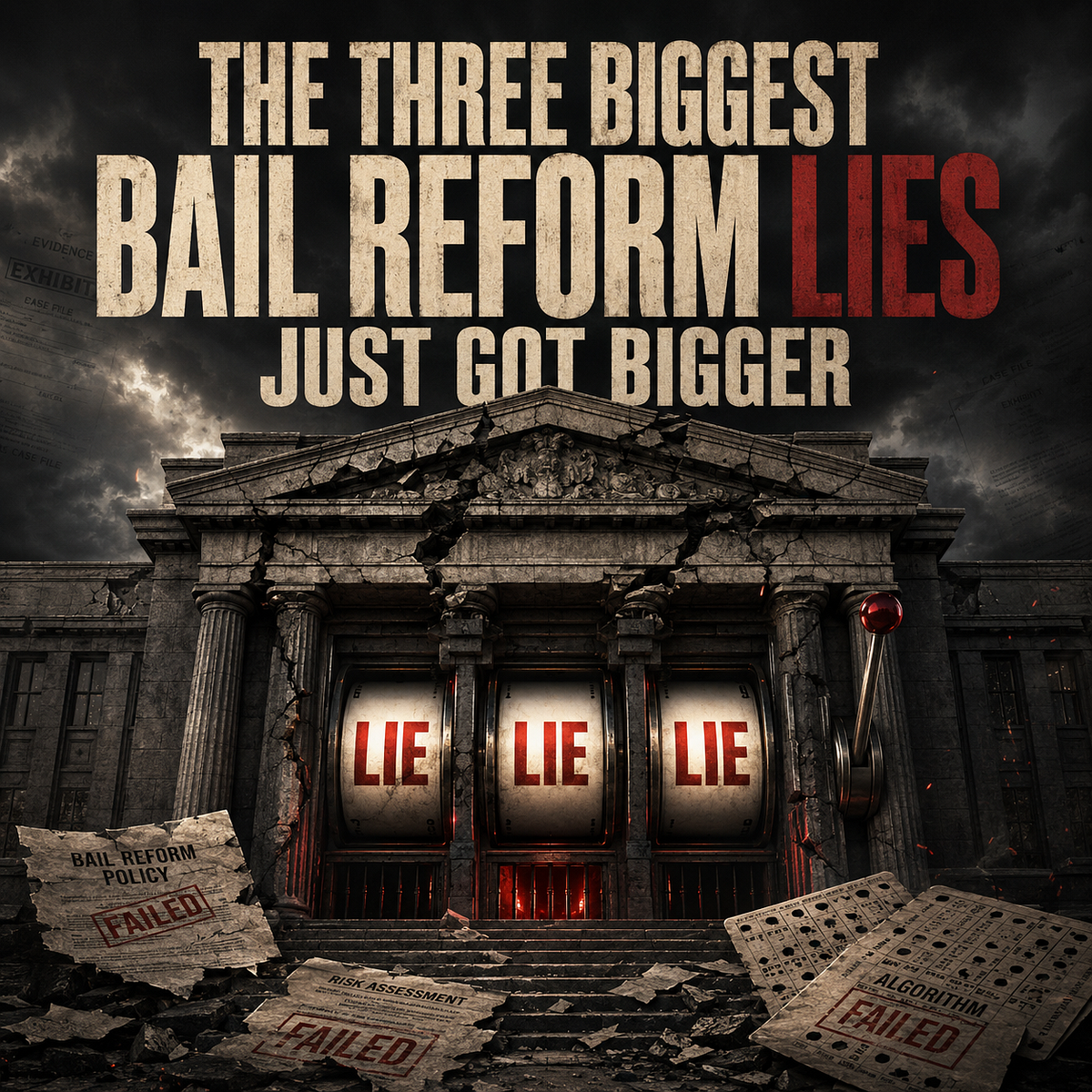
© 2026 Mike Morrison. All rights reserved.