They Were Promised a Better Life, Too
Before Americans hand the government their ownership and their freedom, they ought to look at the last country that did — and at what it looks like now.
How does one of the most prosperous nations in the hemisphere end up in the dark, standing in line for eggs, watching its own people flee by the millions? That is the question I keep coming back to every time I hear an American politician describe socialism as progress. Because Cuba already answered it, and the answer is written in six decades of decline.
Before 1959, Cuba was not a poor country waiting to be rescued. It was one of the most developed nations in the Western Hemisphere. It ranked fifth in the Americas in per-capita income, third in life expectancy, second in automobiles and telephones per person, and first in televisions. Its literacy rate stood at seventy-six percent, among the highest in Latin America, and it ranked eleventh in the world in doctors per capita. Its infant-mortality rate was the lowest in all of Latin America and the thirteenth-lowest on earth, ahead of France, Belgium, Japan, and Spain. Cuban incomes ran between fifty and sixty percent of European levels. This was a modern country with a real middle class, and that fact matters more than any other in the story. Cuba did not fall into communism out of desperation. It was talked into it.
I will not pretend it was paradise. Cuba in the 1950s lived under Fulgencio Batista, a corrupt and authoritarian strongman, and the wealth of Havana masked real poverty in the countryside. There were legitimate grievances, and honest people held them. But here is what every American needs to understand before drawing the wrong lesson from it: the revolution did not cure those grievances. It replaced a corrupt ruler the people could eventually be rid of with a permanent one they could not.
And it did all of it under a promise. Fidel Castro did not march into Havana calling himself a communist. In his own words, he said his aim was not Communism or Marxism but representative democracy and social justice in a well-planned economy. Democracy. Social justice. A planned economy that would be fair to everyone. Many of Cuba’s own wealthiest citizens welcomed him. They were sold representative government and fairness, and what they received was a one-party state, the seizure of private property, and a border they were no longer free to cross. The label was democratic. The result was not.
What followed was not progress by any measure a working family would recognize. It was decline, stretched across half a century. In 1950, Cuba ranked tenth out of forty-seven countries in the Americas in per-capita income. By 2006 it had fallen to near the bottom of that same list, ahead of only Haiti, Honduras, Nicaragua, Bolivia, El Salvador, and Paraguay. It became the only nation in Latin America where per-capita consumption of meat, grain, and root vegetables fell below what it had been in the 1950s. And the entire apparatus was propped up by an outside hand: a Soviet subsidy of roughly five billion dollars a year, about five hundred dollars for every Cuban alive. When the Soviet Union collapsed in 1990 and that hand was pulled away, Cuba’s per-capita output fell by a third within three years. A system that functions only on a foreign patron’s money was never an economy. It was life support with a flag on it.
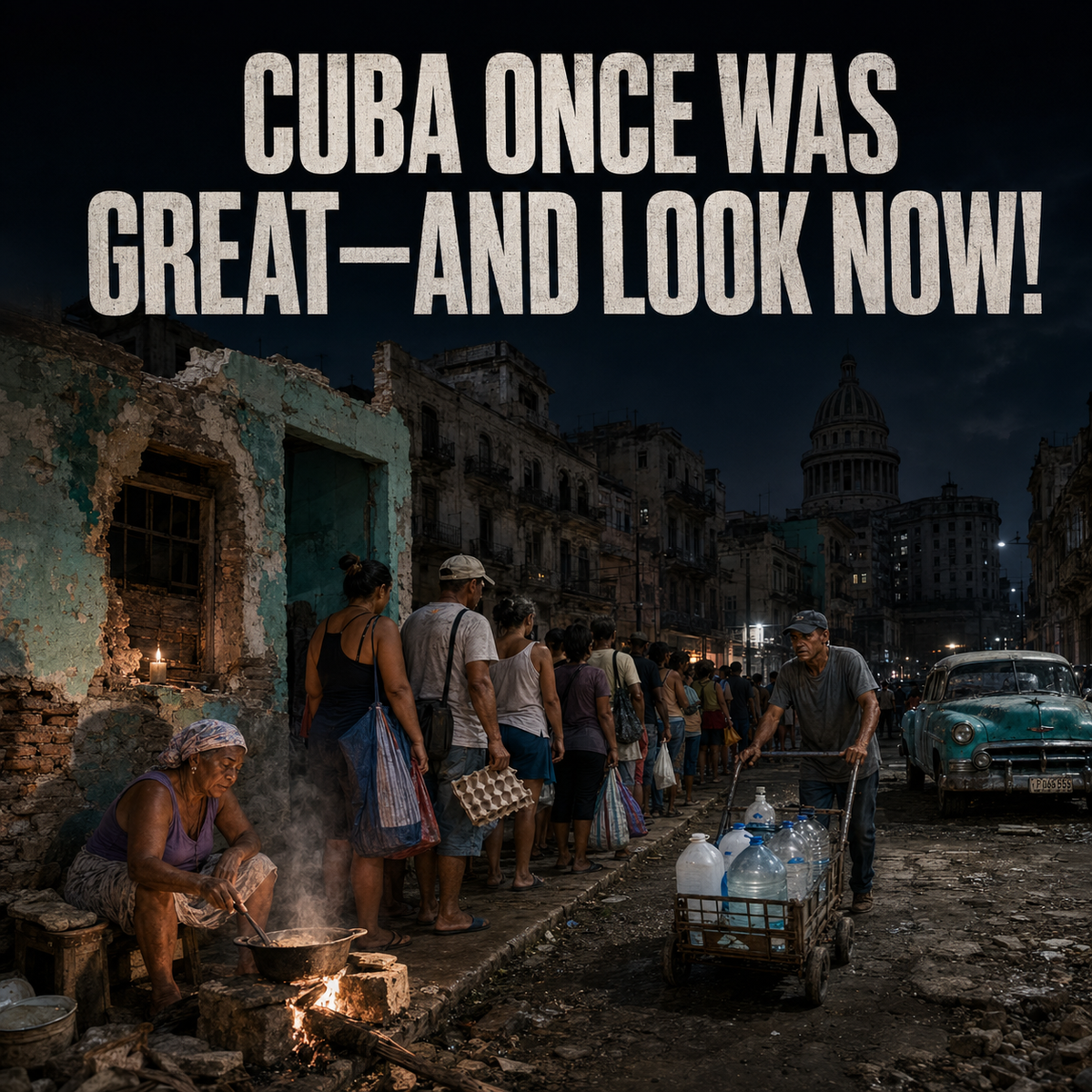
Now look at what that system has produced. In March of 2026, Cuba’s entire national power grid collapsed and all eleven million of its people went dark at once, and not for the first time. Blackouts that once lasted twelve hours now stretch beyond twenty. Food spoils. Water pumps stop. Hospitals run on generators when there is fuel to run them. A carton of thirty eggs costs more than three thousand pesos, and ordinary people skip meals because there is nothing left to cook. The economy shrank in both 2023 and 2024. And the people are delivering the one verdict a censored nation cannot silence. They are leaving. Millions of them already have.
So I will ask the question out loud that too few in this country are willing to ask. How does any American politician look at that record and call its direction healthy for three hundred and forty million people?
The honest answer is that no one sells the blackouts. No one campaigns on egg lines and generators. What gets sold is the promise, the very same one Cuba heard. Free healthcare. Free housing. Free college. Economic justice. Government ownership dressed up as fairness. And the men and women selling it here will tell you, sincerely, that Cuba is a smear, that they want something gentler and more democratic than that. But the thing that failed in Cuba was never the sales pitch. It was the mechanism. Concentrate ownership and authority in the state, strip citizens of the power to own, to build, and to leave, and you will get scarcity and dependence no matter how kind the words were. And you will get it precisely because a government that controls everything you need has no reason left to fear your vote.
Cuba’s people did not vote for darkness. They were promised representative democracy and social justice, in exactly those words, by a man who handed them the opposite. The distance between what they were promised and what they received is the entire lesson. Before Americans accept that same promise from politicians who swear this time will be different, they had better look hard at the last nation that believed it, and at the eleven million people now living in the ruins of that belief.
About the Author
Mike Morrison is the 2026 PBUS National Bail Agent of the Year and President of the Mississippi Bail Agents Association. With more than 35 years of hands-on experience as a licensed bail agent and owner of Mike Morrison Bail Bonding Company in Hattiesburg, Mississippi, he brings real-world insight to America’s most important conversations on criminal justice, pretrial policy, public safety, and good governance.
Morrison writes and speaks from the front lines — courtrooms, jails, and communities — rather than from theory. His commentary on policy, taxes, justice reform, and the daily realities facing working Americans has earned more than one million views across social media in 2026 alone. He regularly presents on bail policy and professional standards at the Mississippi Judicial College and leads ethics and training programs for bail professionals nationwide.
Independent, plain-spoken, and grounded in practical experience, Mike is committed to clear-eyed analysis that cuts through political noise — whether the topic is public safety, government accountability, or the true cost of policy decisions on Mississippi families and the nation.
 Michael D. Morrison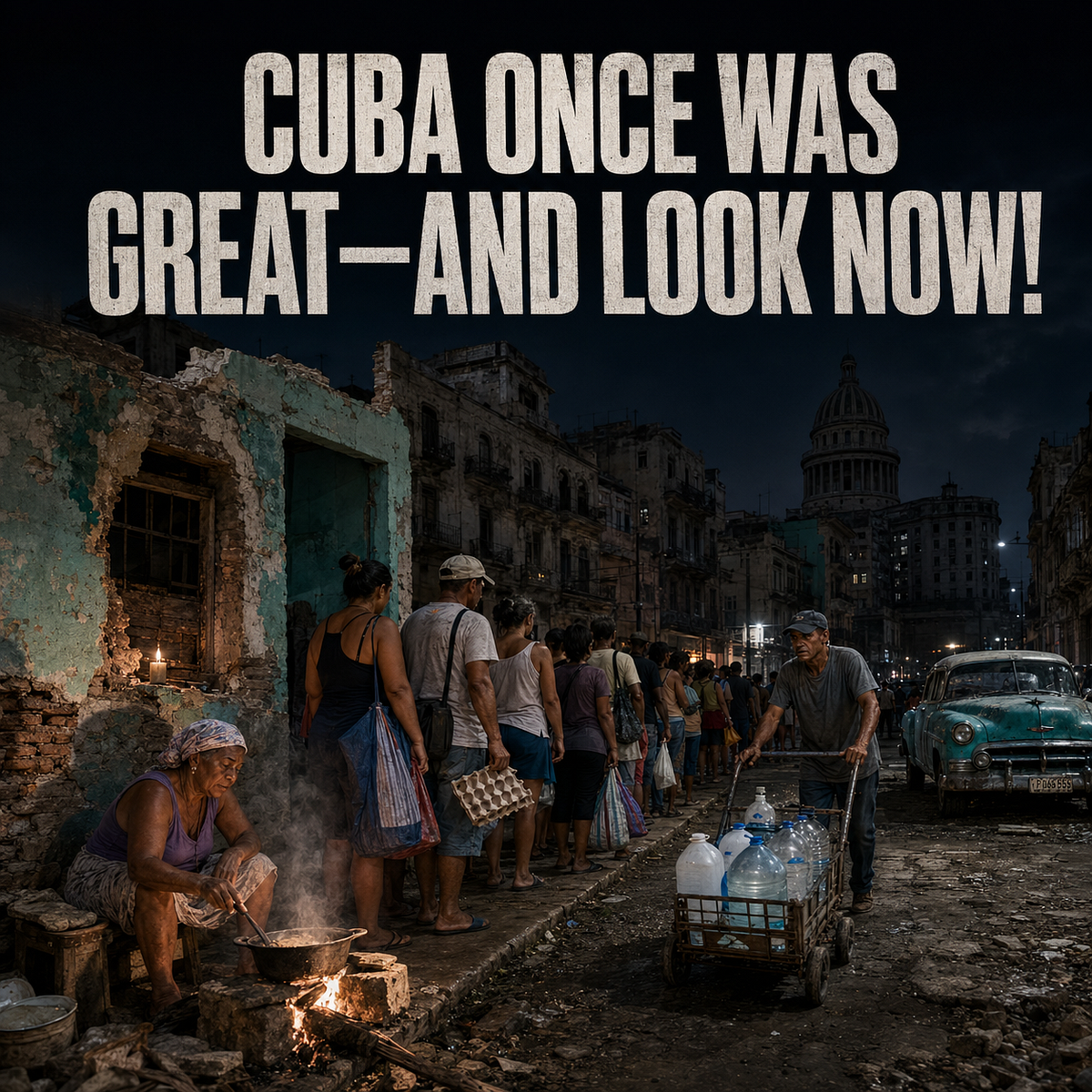
© 2026 Mike Morrison. All rights reserved.