What Are We Being Asked to Give Up?

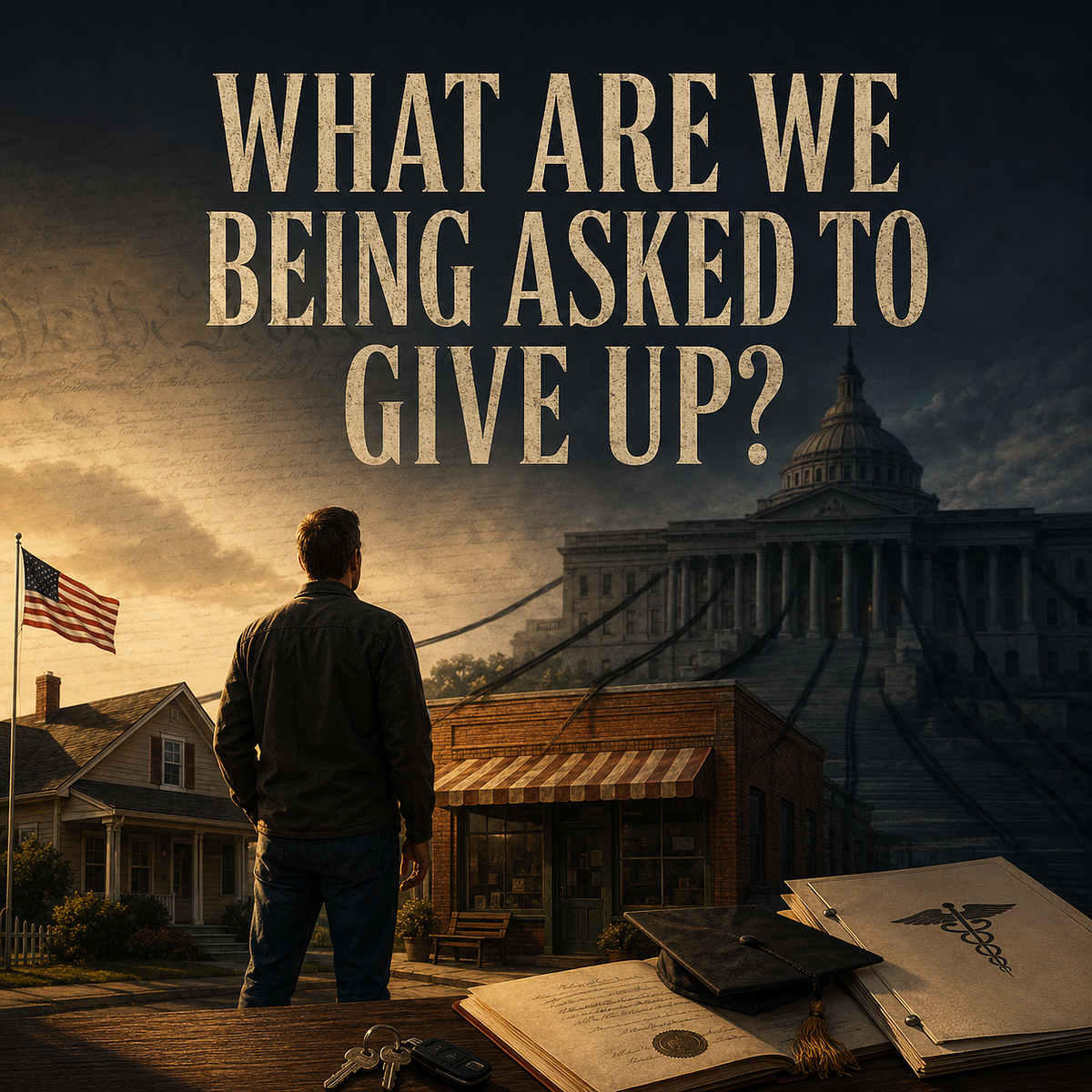
The real question isn’t capitalism versus socialism. It’s whether the citizen still controls the government — or whether the government has quietly begun to control the citizen.
Why are so many politicians trying to change the political system that made America the freest and most successful nation in the world? That is the question I keep coming back to.
Western values are not complicated. The rule of law. Individual liberty. Equality before the law. Freedom of speech and religion. Due process. Private property. Representative government. Respect for minority rights. An independent judiciary. A government restrained by a Constitution and accountable to the people it serves. Those values do not guarantee that every person will succeed or that government will never fail. They guarantee something more important: the opportunity to direct your own life without government directing it for you.
Yet a growing political movement now treats many of those values as obstacles to progress. Private ownership becomes exploitation. Personal responsibility becomes oppression. Law enforcement becomes inherently unjust. Free enterprise becomes greed. Disagreement becomes intolerance. And the Constitution itself becomes a problem the moment it prevents politicians from doing what they want.
The Democratic Socialists of America is one example of that movement, but it is not the whole of it. DSA’s own program calls for public ownership of America’s largest corporations and major parts of our energy and transportation systems. It wants a new constitutional structure, reduced Supreme Court authority, voting rights for noncitizens, universal rent control, government-funded healthcare and college, and the cancellation of student debt. Its abolition wing advocates cutting police budgets year after year toward zero and, ultimately, abolishing police and prisons. This is not someone misrepresenting their position. It is what they publish themselves.
Any one of those proposals can be debated on its own. Taken together, they reveal something far larger than an argument over healthcare, tuition, or wages. They represent a steady transfer of responsibility, ownership, and authority away from the individual and toward the government. That is where I begin asking: what the hell are we doing?
Young Americans have every reason to be frustrated. Housing is expensive. College debt is real. Healthcare costs too much. Large corporations exercise too much political influence, and too many working people believe the system no longer rewards their effort. Those are legitimate problems, and they deserve serious answers.
There is also a harder truth that too many people are afraid to say out loud. A good many young adults want from others what they have never earned — the money, the property, the lifestyle that someone else built — and they want government to take those things and hand them over simply because they want them. Spoiled, entitled, and lazy is not too strong a description. They see what another person has today and ignore the years of work, sacrifice, risk, failure, and discipline it took to earn it. Wanting what someone else has does not create a right to it.
But politicians are not offering serious answers either when they promise that government can provide everything while controlling nothing. Every promise creates authority somewhere. If government guarantees your housing, your healthcare, your education, your employment, your transportation, your income, and your retirement, then government must hold the money and the power to deliver all of it. It must tax, regulate, own, ration, approve, and deny. Sooner or later, the institution that promises to meet every need also acquires influence over nearly every choice. That is not freedom simply because people voted for it.
Gallup found in 2025 that Americans between 18 and 34 now view socialism more favorably than capitalism, 49 percent to 43 percent. Yet the same country still overwhelmingly supports free enterprise and small business. That contradiction tells me most young people are not rejecting opportunity, ownership, or independence at all. They are being sold a political label without being shown the entire package.
They hear free healthcare, but not government control. They hear free college, but not who pays for it. They hear affordable housing, but not who owns it. They hear economic equality, but not who decides what equality requires. They hear democratic socialism and assume the word democratic guarantees their freedom.
Are young people ignorant? Some may be. But the larger failure belongs to the generations that never taught them why these freedoms matter in the first place. We have spent years teaching America’s failures while treating its achievements as something requiring an apology. We taught young people what to demand from their country without ever teaching them what has to be protected from their government. Now politicians are offering them security in exchange for independence and calling it progress.
None of this means America is finished reforming. Free enterprise without competition can turn corrupt. Corporations should not be able to purchase government influence. Healthcare and education should not financially destroy working families. The rule of law must apply equally, and opportunity must be real for the people willing to chase it. But correcting those failures does not require abandoning the very values that let Americans own property, build businesses, speak freely, worship openly, challenge their government, and make their own decisions.
That is the heart of it. The debate is not really between capitalism and socialism. It is between a citizen who controls the government and a government that increasingly controls the citizen. Before we accept the next promise of something government will provide, we ought to ask what authority government must acquire in order to provide it.
So the question stands. Are Americans — and young Americans especially — being offered a better life? Or are they being sold their own freedom, one government promise at a time?
 Michael D. Morrison