What The Bail Project Leaves Out
It asks the public to distrust every judge, prosecutor, and bail agent — so its own numbers, client stories, and payroll deserve exactly the same scrutiny.
The Bail Project has built a national campaign around a simple message: poor people are sitting in jail because they cannot afford freedom. It supports that message with large numbers, carefully selected client stories, and research produced by organizations that share its opposition to financial conditions of release.
The problem is not always that the numbers are invented. The problem is how they are used, what they actually measure, and how much information is removed before they reach the public.
Start with the claim that nearly half a million people are “trapped in jail right now.” The figure appears to originate with a Bureau of Justice Statistics count of 450,600 unconvicted jail inmates at midyear 2024. The Bail Project is using a two-year-old national snapshot to describe how many people are supposedly in jail right now in July 2026. The federal report also says these individuals were awaiting court action or being held for other reasons. It does not conclude that all 450,600 were detained because they could not afford bail.
The Bail Project then says approximately seventy percent were accused of nonviolent offenses. That claim is especially questionable because sixty-nine percent is also the percentage of the 2024 jail population classified as unconvicted. The post provides no source establishing that approximately seventy percent of those 450,600 people were accused of nonviolent offenses. That claim should not be confused with the separate federal statistic showing that sixty-nine percent of the 2024 jail population was classified as unconvicted.
Even if the nonviolent percentage were established, nonviolent does not mean victimless. Shoplifting has a victim. Burglary has a victim. Fraud has a victim. Drug trafficking harms families and communities. Property crimes can financially devastate individuals and small businesses. The term describes a legal classification; it does not tell us that the conduct was minor, that no one was harmed, or that the defendant presented no risk.
The organization’s own client stories demonstrate how this framing works. Taylor is portrayed as someone jailed because she was short on money while furnishing an apartment. The article eventually acknowledges that she intentionally shoplifted merchandise from Walmart because she thought she could get away with it. Thomas is introduced as a truck driver jailed after a “routine workplace dispute.” Only later do we learn that he was charged with battery, trespassing, and grand theft auto. The vehicle charge was dismissed, but he accepted a plea agreement on the remaining charges.
These are not complete case reviews. They are personal narratives written from the defendant’s perspective and published to support a fundraising and policy campaign. The reader is not shown the arrest report, criminal history, prior failures to appear, release status, evidence presented to the court, or the reasons the judge selected the bond amount.
The Bail Project also routinely presents the face value of a bond as though that entire amount must be paid to obtain release. When professional surety bail is permitted, the family commonly pays a regulated premium representing a fraction of the bond—often approximately ten percent, depending on state law—while the bail agent guarantees the full amount to the court. A $10,000 bond may therefore involve a $1,000 premium rather than a $10,000 cash payment. If a bond was ordered cash-only, if surety bail was prohibited, or if additional collateral was required, those facts should be disclosed. The Bail Project generally leaves that distinction unexplained.
The amount of bail did not originate with a bail agent. A judge set it after considering the charge and the information presented about the defendant. That may include criminal history, previous court appearances, other pending cases, community ties, existing release conditions, flight risk, and danger to the public. Judges can make mistakes, and bail decisions should be subject to review. But the public cannot evaluate a decision honestly when one side removes nearly everything the judge considered.
Drug cases contain another part of the story that The Bail Project seldom acknowledges. Families sometimes decide not to arrange an immediate release because they are watching someone destroy himself through addiction. They may need time to find a treatment facility, determine what insurance will cover, arrange transportation, or develop a plan that does not return the person directly to the same drugs and the same environment. Jail is not a substitute for appropriate treatment, and withdrawal must be handled medically. But families confronted with addiction know that immediate release without a plan is not always the act of compassion an outside organization assumes it to be.
When a charitable bail organization enters the case, it can override that family decision without possessing the family’s knowledge or accepting its long-term responsibility. The organization pays the bail, counts another release, and adds the case to its statistics. The family remains after the publicity is over.
Then there is the financial structure behind the message. According to The Bail Project’s latest publicly available Form 990, the organization reported $13.87 million in expenses for the fiscal year ending June 2025. Executive compensation and other salaries and wages totaled approximately $8.45 million—about sixty-one percent of all expenses before separately reported employee benefits are included. The filing lists base compensation of $253,499 for the chief executive officer, $225,368 for the chief impact officer, $218,785 for the chief operating officer, $204,485 for the chief financial officer, $198,088 for general counsel, and $190,496 for the director of communications. Several also received additional compensation.
There is nothing inherently improper about a nonprofit paying qualified employees. The issue is transparency and perspective. The Bail Project presents itself publicly as a charitable operation using donations to bring poor people home. Its financial filings show a large national advocacy organization with substantial assets, a multimillion-dollar payroll, senior executives earning six-figure compensation, communications personnel, policy staff, legal staff, and an institutional interest in sustaining the campaign against financial bail.
That campaign depends heavily on statistics obtained from the Prison Policy Initiative, Vera Institute of Justice, Brennan Center for Justice, Inquest, and other organizations that generally support reducing incarceration or eliminating financial bail. One advocacy organization cites another, which cites an estimate assembled from different years, jurisdictions, and data systems. The resulting claim is then repeated across reports, social media, news coverage, and fundraising material until repetition gives it the appearance of an independently verified fact. A July 2026 In These Times viewpoint provides a clear example. It was written not by an independent reporter, but by Jeremy Cherson, The Bail Project’s Director of Communications, and repeats the same claims while citing The Bail Project and organizations that support similar policies.
The Bail Project does the same thing with its own results. It reports that its clients attended approximately ninety-one percent of individual court appearances and declares that this proves bail does not make people return to court. But its clients received bail assistance, court reminders, transportation, and other support. The figure is not a controlled comparison of otherwise identical defendants. It measures individual appearances rather than clearly telling the public how many clients completed every appearance required in their cases.
Its Tulsa County study admitted that it was not designed to make apples-to-apples comparisons among release groups. The same report found that forty-three percent of defendants released through commercial bail attended every required hearing, compared with twenty-nine percent of those who paid cash themselves. Despite acknowledging the study’s limitations, The Bail Project used it to suggest that commercial bail offered no appearance advantage.
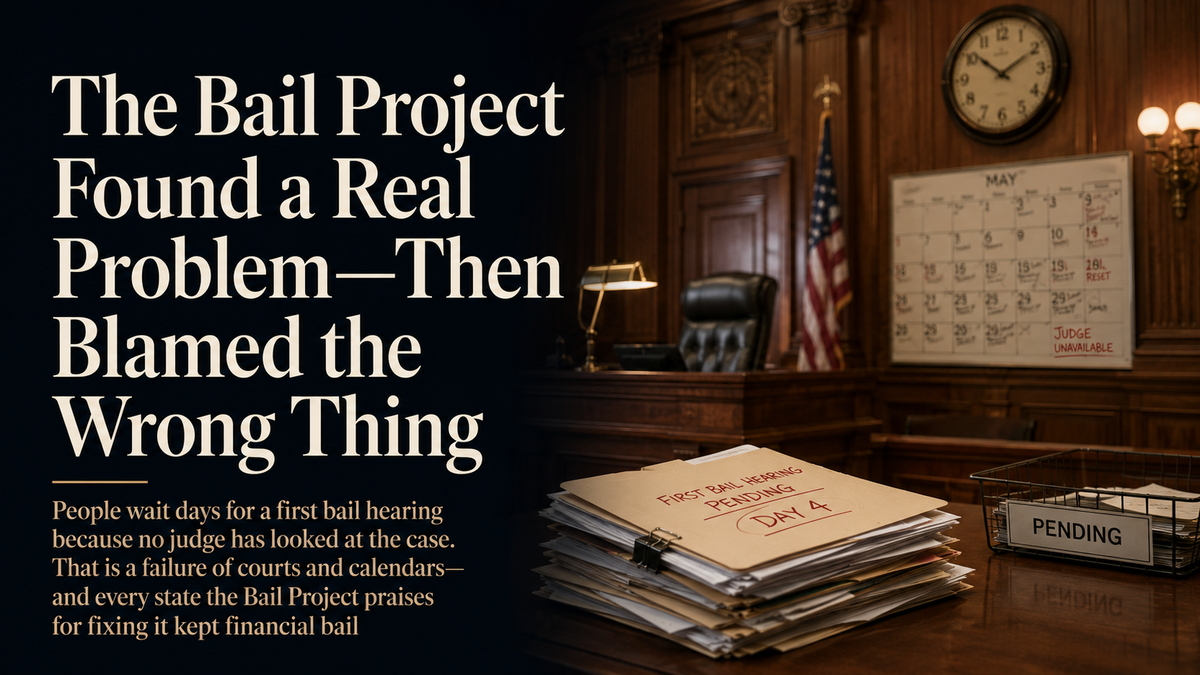
The public deserves an honest discussion about pretrial release. Bail should be reasonable. Cases should proceed without unnecessary delay. Judges should consider a defendant’s financial circumstances along with the charge, criminal history, risk of flight, and danger to the community. No one benefits when a person is forgotten in jail because the court failed to act.
But honesty requires the whole record. It requires current data, clearly defined terms, complete case information, accurate descriptions of release options, transparent methodology, and recognition of victims. It also requires The Bail Project to disclose the institutional and financial structure supporting its advocacy.
The Bail Project asks the public to question every decision made by a judge, prosecutor, law-enforcement officer, or bail agent. It is entirely reasonable for the public to examine The Bail Project’s decisions, statistics, spending, and omissions with the same level of scrutiny.
 Michael D. Morrison
 Michael D. Morrison