Eight Years Later, the Record Speaks for Itself
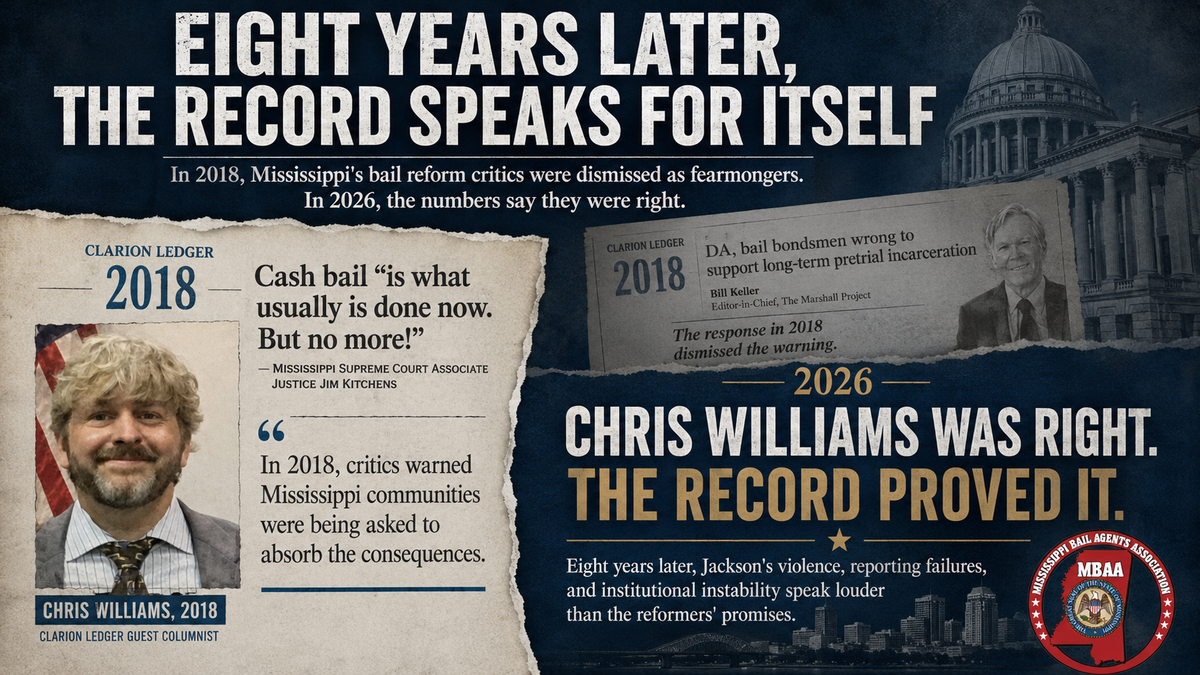
In 2018, Mississippi's bail reform critics were dismissed as fearmongers. In 2026, the numbers say they were right.
State leaders rarely go back and check their own work. Once a policy is passed, the people who championed it move on to the next cause, and the communities left living with the results are on their own to make sense of what happened. That is exactly what occurred with Mississippi's 2017 Rules of Criminal Procedure, and eight years is enough distance to finally look back honestly at what that decision produced.
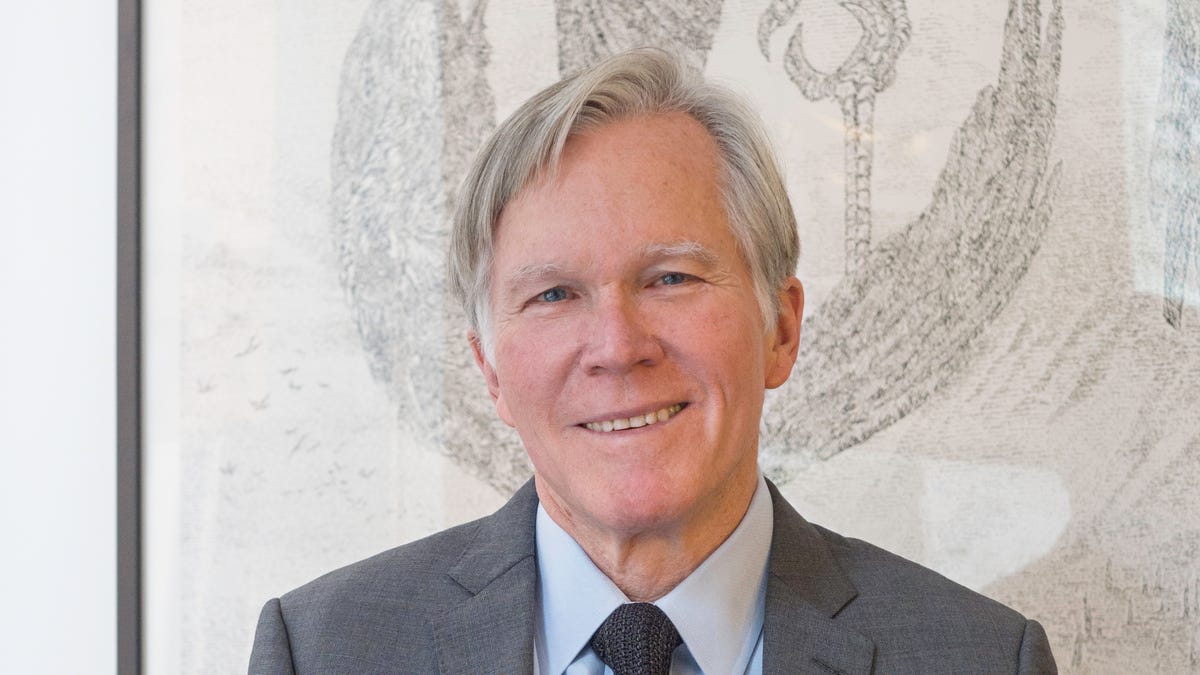
In August 2018, Mississippi Bail Agents Association president Chris Williams wrote in the Clarion Ledger that the MacArthur Justice Center and Equal Justice Under Law were playing a dangerous game with Mississippi communities. Williams argued that the lawsuits driving the state's bail reform were not really about isolated court-procedure violations. They were leverage, aimed at cash-strapped cities that could not afford to fight outside legal money in court, and the settlements that followed went well beyond the original complaints, gutting bail bonds for misdemeanor offenses statewide. Bill Keller of the Marshall Project answered him a week later, dismissing Williams as a man entitled to his own opinion but not his own facts, and defending the new rules as a modest, reasonable clarification of judicial discretion.
I answered Keller myself that September. The facts were straightforward then and they remain straightforward now. The bail schedules Keller's allies wanted gone had already been upheld by the Fifth and Eleventh Circuits. Those schedules exist because they work: they let someone facing a DUI, a suspended license, a bar fight, or a city ordinance violation get back to their job and their family on the same day, instead of sitting in an already overcrowded jail waiting for a docket slot. Arkansas had just published a 97.4 percent court appearance rate for defendants released on bond, real evidence that accountability built into the system produces results. I pointed out then that the organizations pushing to dismantle that system did not live in Mississippi and would not be the ones sitting in empty courtrooms while the state absorbed the consequences.
The record since then has not been kind to Keller's confidence. Insurance data collected in the first nine months after the 2017 rules took effect showed the number of bail bonds written statewide fell 19 percent, and revenue collected at the time of release fell 16 percent, a direct hit to the accountability mechanism the bail industry provides at no cost to taxpayers. That decline did not come with a corresponding win for public safety. Jackson, the state's capital and largest city, has held the highest per-capita homicide rate of any major city in the country for five consecutive years. Its population collapsed by more than 12,000 residents between 2020 and 2024, the steepest per-capita loss of any American city with more than 100,000 people, as families who could leave did. The police department meant to hold the city together burned through five chiefs in a decade, the latest resigning in 2025 and citing the toll of the job on his health.
It gets worse. The city's own homicide numbers were not just delayed or absent, they were manipulated. In 2019, WLBT caught the Jackson Police Department releasing lower year-to-date homicide and grand larceny numbers specifically on the days those statistics were shared with the public. In 2023, WLBT discovered JPD had failed to disclose 24 homicide victims to the public, and then-Chief James Davis misled the Jackson City Council with inaccurate crime statistics. Once those cases were counted, 2023's apparent 25 percent drop in killings turned into a number nearly flat with the year before. JPD did not submit required crime data to the FBI at all for 2021 and 2022, and did not restore basic modern reporting compliance until the summer of 2025. A city that has been caught more than once misrepresenting its own body count has no standing to claim its reforms are working, and reporters who cite Jackson's declining numbers without noting that history are repeating the same mistake Keller made in 2018: taking an official talking point at face value instead of checking it against the record.
None of that is a coincidence that fell out of the sky. It followed a deliberate decision, cheered on by organizations headquartered far outside Mississippi, to treat accountability as the enemy rather than the point. Keller wrote his attack on Chris Williams from behind a byline at the Marshall Project, headquartered in New York City, a continent away from the courtrooms and neighborhoods his preferred policy reshaped. He has never had to live with what Jackson became. Williams did, and so have the rest of us. This is the same pattern Mississippi has seen before: activists and journalists from outside the South arrive with a confident theory about crime and accountability, push it through the courts and the press, and leave the state to absorb whatever comes next. This time, what came next was bad, and the record of Jackson's own police department shows the city knew it and tried to hide it. The Mississippi Bail Agents Association has not had to change a word of what Williams and I said in 2018, because the record has only proven us out. Chris Williams was right, and the attacks he took in the press for saying so were wrong.
This is not a call to relitigate the past for its own sake. It's a warning for the next time a smooth-talking outside group shows up in Mississippi with a confident theory and someone else's money behind it. Before this state hands over another piece of its criminal justice system to people who will never live with what they build, Mississippi's leaders owe it to their communities to ask a simple question: what actually happened last time. In this case, the record already answers it.
Mike Morrison is the 2026 PBUS National Bail Agent of the Year and president of the Mississippi Bail Agents Association. He has worked as a licensed bail agent since 1991 and owns Mike Morrison Bail Bonding Company in Hattiesburg. Independent, plain-spoken, and with hands-on experience across three and a half decades in the industry, his commentary reached more than one million social media views in 2026.
© 2026 Mike Morrison. All rights reserved.
 Chris Williams, The Clarion-Ledger
 Bill Keller, The Clarion-Ledger