When the Cause Isn't Bail, The Bail Project Blames Bail Anyway
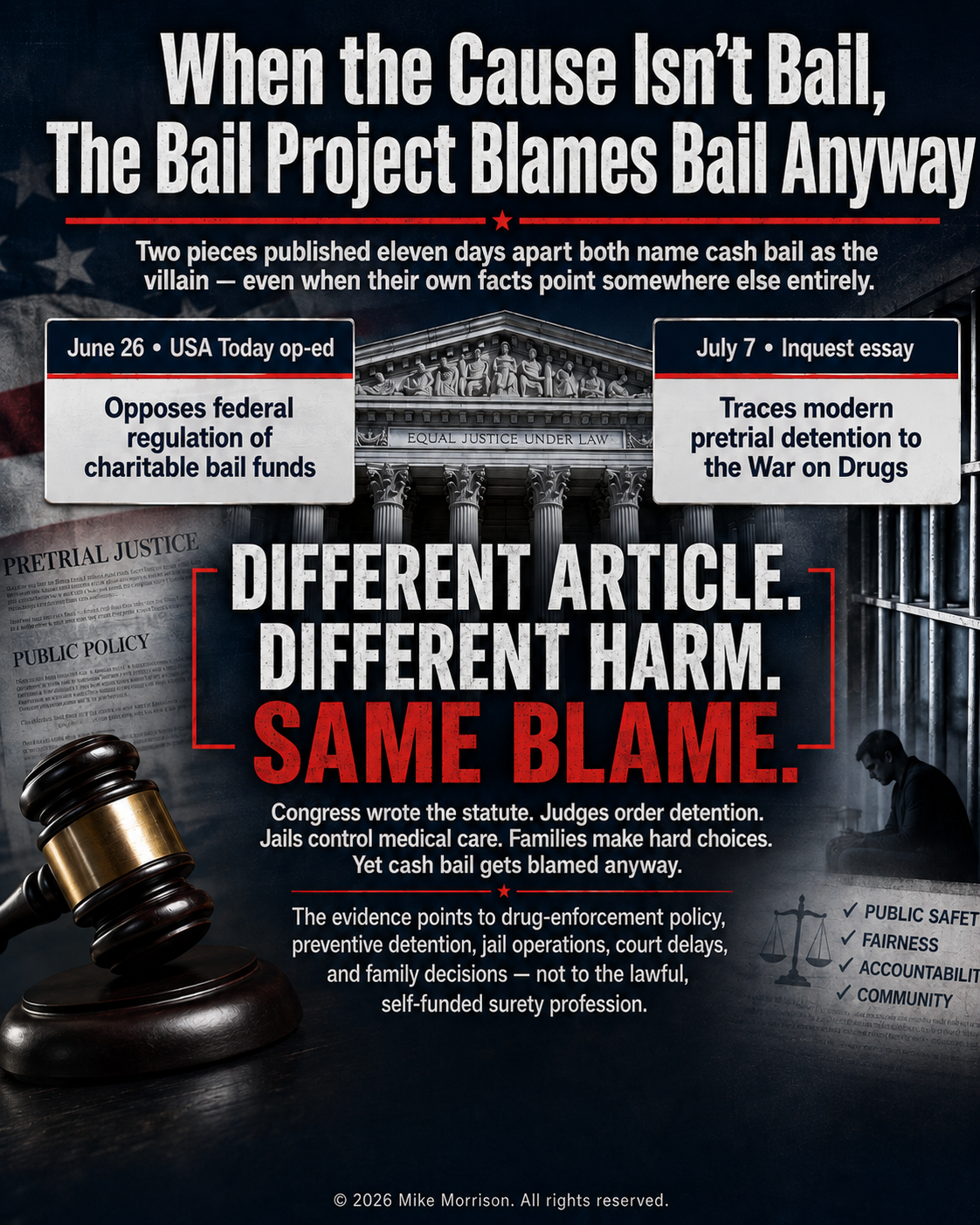
Two pieces published eleven days apart both name cash bail as the villain — even when their own facts point somewhere else entirely.
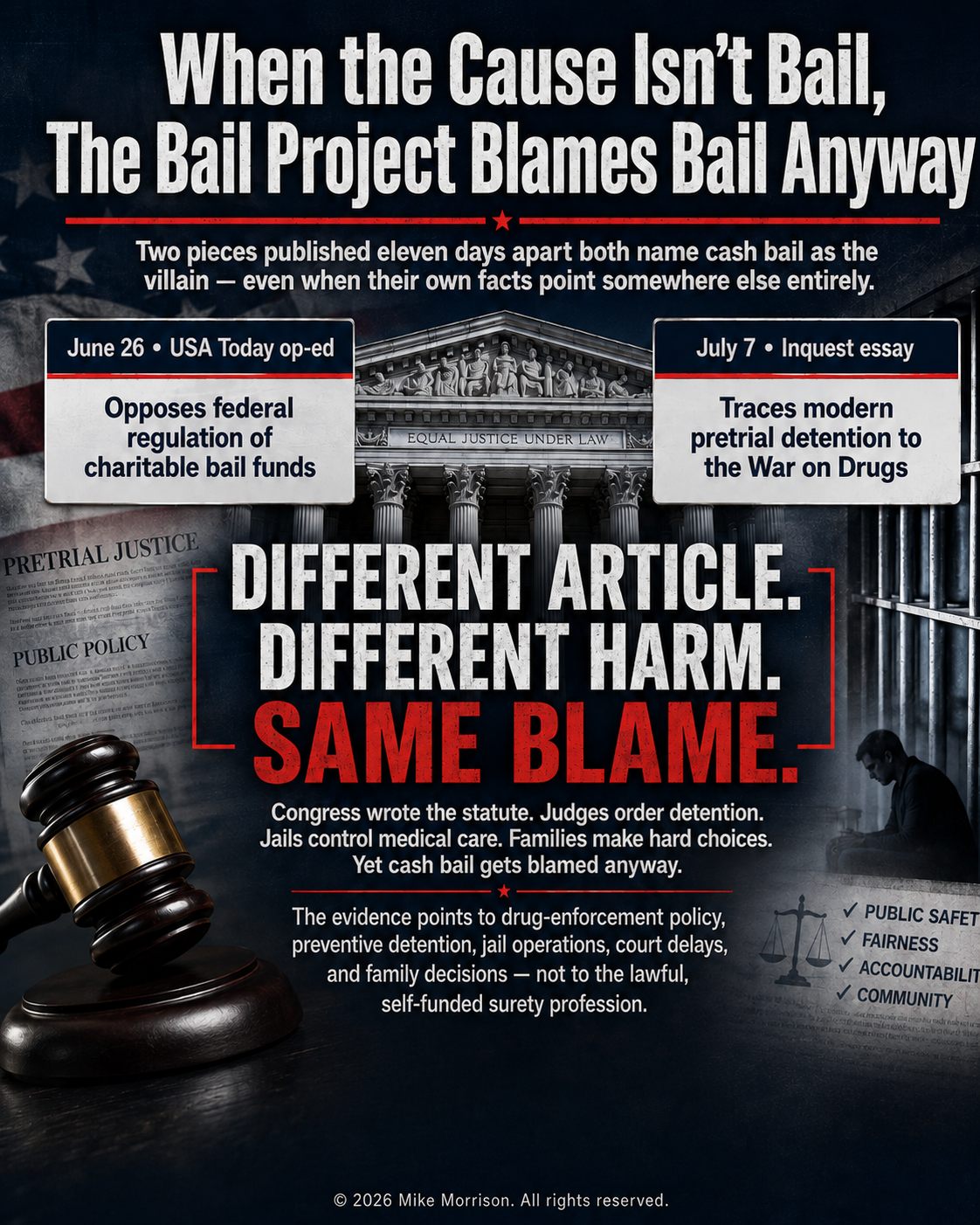
Two Bail Project pieces landed within two weeks of each other this summer: a June 26 USA Today op-ed by National Director of Policy Erin George opposing a bill moving through Congress, and a July 7 Inquest essay by Deputy Director of Policy Nicole Zayas Manzano tracing pretrial detention back to the 1971 War on Drugs. On the surface they read as different arguments — one about pending federal legislation, the other about fifty-five years of drug policy. Underneath, they run the identical play: name a real, sympathetic problem, trace it back through several intervening causes that have nothing to do with bail bonding, and land on cash bail as the culprit anyway.
Start with the USA Today op-ed. It opposes the Keeping Violent Offenders Off Our Streets Act (H.R. 6260), which passed the House 243-179 and would regulate charitable bail funds under the same framework that already governs commercial insurance. George frames that as Congress “twisting the law” to treat churches and community groups like insurance companies. That framing deserves a beat before anyone accepts it. Licensed bail agents have operated inside that exact framework for decades — state exams, bonding and collateral requirements, continuing education, and insurance-department audits — funded entirely by the premium a client pays, never by a taxpayer dollar. What the op-ed calls a novel act of hostility toward charity is, for the profession it never mentions, simply how the business has worked all along.
The op-ed's own numbers move the target further from bail bonding, not closer to it. Of the 40,000 people The Bail Project says it supported in 2025, nearly 35,000 received free bail assistance, and those clients returned to court roughly 92 percent of the time — a rate the organization cites as proof that cash bail is unnecessary. But that figure describes people paid out of the organization's own revolving fund, backed by court reminders, transportation, and case management: a program built and staffed to replicate, at donor expense, what a bail agent's financial stake in the outcome already accomplishes at no cost to the public. Showing that support and structure keep people showing up isn't a discovery. It's the argument for the surety model — funded privately, and the very thing the op-ed asks Congress to leave alone only when it's a nonprofit doing it.
Now the Inquest piece. Zayas Manzano places the origin of the modern system exactly where it belongs — with Nixon's 1971 declaration that drug abuse was “public enemy number one,” and with the 1984 Bail Reform Act, a federal statute that let judges detain people based on danger rather than flight risk alone. That's Congress and the Department of Justice, not a bail bond office in Hattiesburg. The essay's clearest examples of harm happen inside county jail medical units: a client denied Suboxone and Zoloft during withdrawal, another who went six months in Fulton County without medical care. Those are jail healthcare staffing and policy failures, decided by sheriffs and jail administrators — not the ability of anyone to post a bond. None of it traces back to a licensed bail agent's desk. Yet the essay's own language keeps cash bail as the noun doing the damage, right down to its call to remove cash bail as the fix for a chain of causation that runs through drug-enforcement priorities and jail medical policy first.
There's a sharper problem buried in the essay's centerpiece statistic. The 108,000 unconvicted people it cites as held on drug charges is a real, current Prison Policy Initiative figure, and no one needs to relitigate it. But the same 1984 statute the essay describes creates a rebuttable presumption of detention for certain drug charges — meaning some share of that 108,000 were never given a bail amount to pay in the first place. No bail agent, charitable or commercial, could have gotten them out even with unlimited resources, because a judge decided no release condition would do. Folding those cases into a cash bail narrative erases the difference between “held because bail was unaffordable” and “held because a judge ruled no bail was appropriate.” Those are two different constitutional postures, and they call for two different remedies. Collapsing them into one word is a category error dressed as data.
Zoom out from that one statistic and the same sleight of hand shows up across any general jail population count advocacy groups cite. Local jails on any given day also hold people who have already been sentenced and are simply waiting on transport to state prison. They hold people whose pretrial release was revoked for violating a condition of that release, not for failing to pay anything. And they hold people whose own families made a deliberate decision to leave them in jail a while longer — to let someone sober up, to wait for an open bed at a rehab facility, or to get a person stabilized back on medication before bringing them home to an environment that might undo it. None of that is a cash bail failure. It is, more often than advocacy groups will say, a family's own judgment call — and professional bail agents are frequently the ones sitting across the table from that family, walking through the options and helping them decide, a role that never shows up in anyone's jail count.
The pattern isn't limited to these two pieces. Georgia's bail law was described in Bail Project commentary as an attack that “restricts charitable bail funds,” though the law itself changed judicial discretion over release conditions and did not touch the licensing of any private bail business. A client story about a blind man denied a mobility cane in a Los Angeles jail was presented as evidence of cash bail's cruelty, when denying an ADA accommodation to someone already in custody is a jail-operations failure, not a bail-amount failure. Different bill, different jail, different harm. Same word doing all the blaming.
What none of these pieces ever mention is what a bail agent actually does for a family, none of it paid for by a grant or a donor. Bail bonds protect the presumption of innocence, provide accountability to the courts, shift financial risk away from taxpayers, and allow a defendant to keep working, keep supporting a family, and prepare a defense from home instead of a cell.
Just as important is what happens off the books. Professional bail agents help families navigate one of the most stressful and unfamiliar experiences of their lives. Families arrive with the same questions every time: Do we need an attorney? Where do we go for court? How should the defendant dress? What happens next? A bail agent explains the general process, encourages the family to seek qualified legal counsel, answers the practical questions, and provides reassurance in the face of the unknown — bringing calm and direction to a family in crisis, at no charge beyond the bond itself. A bail agent is more than someone who writes a bond. The agent is an educator, a guide, a steady hand for the family, and an accountability partner to the court. No advocacy report has ever counted that.
It's worth remembering what bail actually is under the law both pieces are arguing about. Mississippi's constitution, like every state's, doesn't treat bail as a policy accident waiting to be legislated out of existence. Article 3, Section 29 guarantees it as a right for the accused, prohibiting only excessive bail — not bail itself. That provision exists because the alternative to bail was never “community-based support.” The alternative to bail is detention. When an op-ed calls cash bail the price of being innocent until proven guilty, it skips past the fact that the constitutional alternative to an amount a family can pay isn't automatic release. It's a judge deciding, sometimes correctly, that no release condition is enough.
None of this means every bail amount set at every arraignment is right, or that every jail runs its medical unit well, or that court delays and addiction and disability accommodations aren't real problems deserving real fixes. They are. But naming a problem honestly means tracing it to where it actually happened — a drug-enforcement statute, a jail's staffing budget, a judge's calendar, a family's own decision — instead of routing every hardship back through the one lawful, constitutionally protected, entirely self-funded profession that never set the amount, never denied the medication, never wrote the statute, and never gets credit for the family conversation it has for free. Two pieces, eleven days apart, name the same defendant. The evidence points elsewhere both times.
About the Author Mike Morrison is the 2026 PBUS National Bail Agent of the Year and President of the Mississippi Bail Agents Association. With more than 35 years of hands-on experience as a licensed bail agent and owner of Mike Morrison Bail Bonding Company in Hattiesburg, Mississippi, he brings real-world insight to America’s most important conversations on criminal justice, pretrial policy, public safety, and good governance.
Morrison writes and speaks from the front lines — courtrooms, jails, and communities — rather than from theory. His commentary on policy, taxes, justice reform, and the daily realities facing working Americans has earned more than one million views across social media in 2026 alone. He regularly presents on bail policy and professional standards at the Mississippi Judicial College and leads ethics and training programs for bail professionals nationwide.
Independent, plain-spoken, and grounded in practical experience, Mike is committed to clear-eyed analysis that cuts through political noise — whether the topic is public safety, government accountability, or the true cost of policy decisions on Mississippi families and the nation.
© 2026 Mike Morrison. All rights reserved.
 Erin George, USA TODAY
 Inquest
 Michael D. Morrison