Profit Over People? They Have Never Met a Bail Agent

Behind the slogan is a profession built on accountability, guidance, and service to families in crisis.
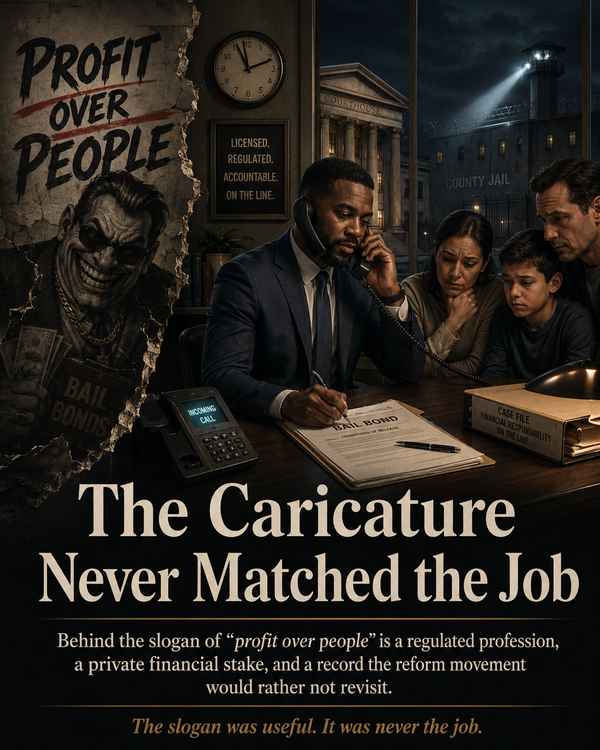
“Profit over people” has become one of the anti-surety movement’s favorite accusations against professional bail agents. It is a convenient slogan, but it is built on a false description of who we are and what we actually do. Most of the people making that accusation have never spent a day inside a bail office. They have never answered a call from a frightened mother whose son has just been arrested, spoken with a wife trying to locate her husband, or guided a family facing the criminal justice system for the first time. They know the political talking points. They do not know the profession.
Bail bonds matter for reasons that go far beyond a premium. They protect the presumption of innocence. They create real accountability to the courts. They shift the financial risk of release away from taxpayers. And they allow defendants to continue working, supporting their families, meeting with their attorneys, and preparing their defense while their cases are pending. A bail agent is more than someone who writes a bond. Agents serve as educators, guides, steady hands for families, and accountability partners to the court and the criminal justice system. That is the reality of the profession — not the slogan critics have built around it.
Accountability That Actually Works
Commercial surety bail places financial responsibility on the defendant, the family, and the licensed agent who guarantees the bond. When a defendant fails to appear, the obligation does not vanish into a government file. The agent must act, and that incentive structure produces results. Bureau of Justice Statistics data from large urban counties points in the same direction, and after accounting for relevant defendant characteristics, both the peer-reviewed work of Helland and Tabarrok and examinations of Dallas County releases have found lower failure-to-appear rates and stronger recovery of absconders under commercial surety bonds than under release on recognizance or many unsecured arrangements.
Government pretrial programs, by contrast, shift costs directly onto taxpayers. Supervision, warrant service, detention hearings, and enforcement become public expenses. Surety bail internalizes those costs through private risk instead. And compensation is not unique to this industry: attorneys charge fees, treatment providers charge fees, electronic-monitoring companies charge fees, and government pretrial programs run on taxpayer funding. The relevant question is not whether someone is paid. It is what service is delivered, who accepts responsibility, and whether the system produces accountability.
The Human Side the Critics Ignore
The work does not end when the defendant walks out of jail. Families often arrive overwhelmed and uncertain, asking basic, urgent questions: Do we need an attorney? Where do we go for court? How should the defendant dress? What happens if a court date changes? Who do we call when we don’t understand something?
A mother calls at 11 p.m., her voice shaking, trying to figure out where her son is being held and what she is supposed to do next. That call is not unusual. It is the job.
A professional bail agent helps bring order to that confusion. We explain the general process, encourage families to obtain qualified legal counsel, answer practical questions, and reinforce the defendant’s court obligations. We remain a point of contact throughout the life of the bond — without pretending to be an attorney or promising an outcome.
Courts, attorneys, law-enforcement agencies, and jail personnel each perform different functions, and families encountering the system for the first time often do not know where to begin. That guidance reduces confusion, reinforces court obligations, and keeps communication open. It is not “profit over people.” It is people helping people during a crisis.
Reducing the entire profession to the collection of a premium is convenient for advocates who want to eliminate commercial bail. Acknowledging the full role — release, accountability, guidance, and personal service — weakens their argument. It is easier to attack an industry than to admit that professional agents provide these functions without transferring the entire cost to taxpayers. No profession is free of misconduct, and bail agents who violate the law or mistreat the public should be held accountable. Professional standards, licensing, and continuing education matter. But isolated problems do not define an entire profession, and political slogans should not replace an honest examination of the service being provided.
The Real Choice
Surety bail is built around serving people in crisis while protecting the courts’ ability to function. It keeps the presumption of innocence meaningful for those who can be safely released. It places responsibility where it belongs. And it does so through licensed professionals who answer the phone when families are frightened and lost.
Before accusing professional bail agents of putting profit over people, critics should meet the people who actually perform this work — and the families who depend on them. They may discover that surety bail is not built around ignoring people. It is built around serving them.
Mike Morrison
President, Mississippi Bail Agents Association
Mike Morrison is a licensed professional bail agent and President of the Mississippi Bail Agents Association.
 Michael D. Morrison