Take the Cameras Down
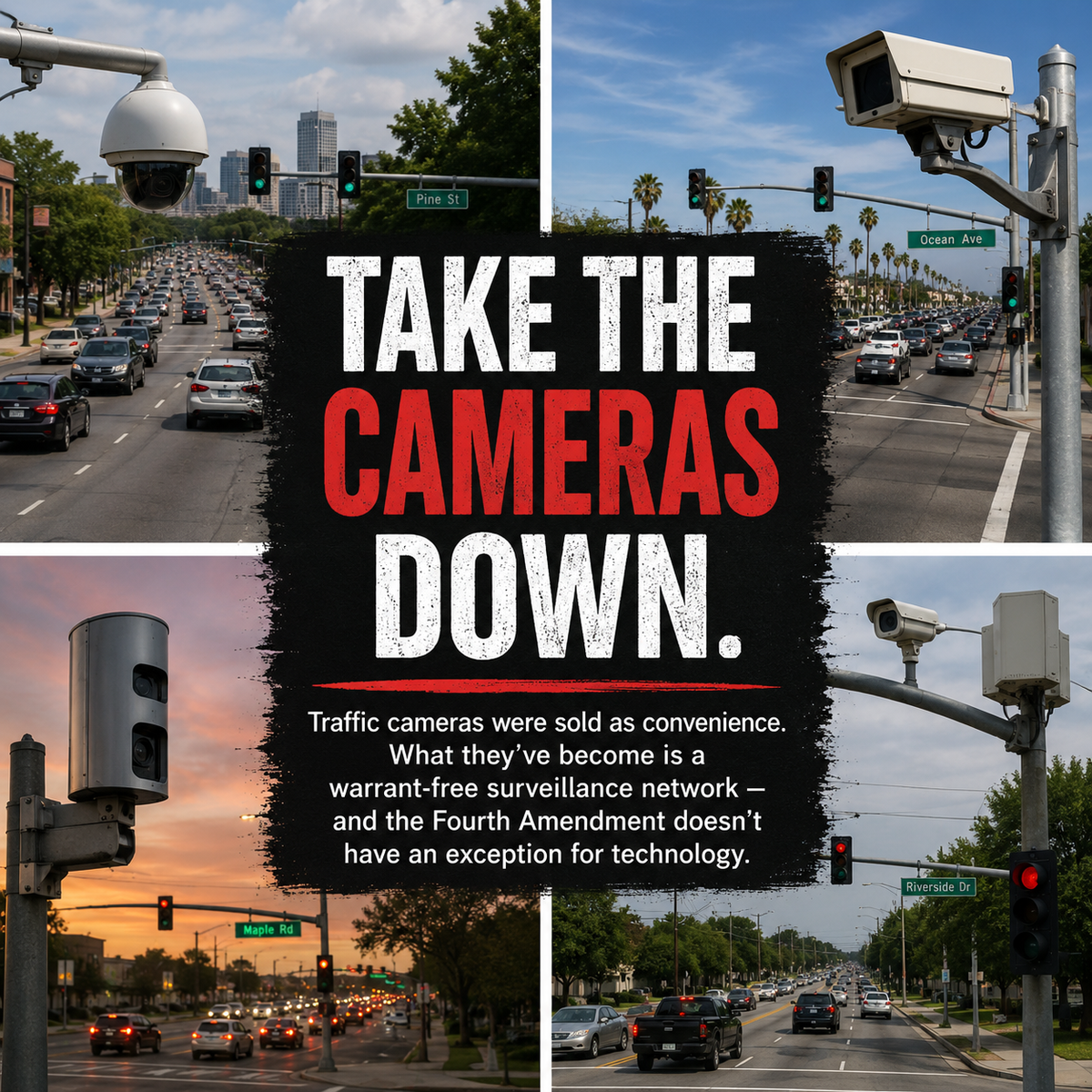
Traffic cameras were sold as convenience. What they've become is a warrant-free surveillance network — and the Fourth Amendment doesn't have an exception for technology.
I have watched this problem grow for years, and it has gotten completely out of hand. It started with the so-called motion-sensor cameras that began appearing at practically every red light and intersection. We were told this technology was about managing traffic, improving the operation of traffic signals, reducing congestion, and making our roads safer. Most people never gave those cameras much thought because there was little reason to question a device that was supposedly there to tell a traffic light when a vehicle was waiting.
But look at where we are today. Cameras are everywhere, and many of them are no longer simply detecting whether a vehicle is sitting at an intersection. License plates can be captured, vehicles can be identified, locations can be recorded, and information can be stored in databases that allow someone's movements to be searched after the fact. What began under the harmless language of traffic management and public safety has helped create an infrastructure capable of something much more intrusive: government surveillance.
I don't believe that is what most Americans agreed to when these cameras started going up.
There is a tremendous difference between police using technology to investigate a known suspect and government having the ability to search through information collected on thousands of people who are suspected of absolutely nothing. If law enforcement develops probable cause that someone committed a crime and needs access to private location information as part of that investigation, the Constitution already provides the answer. Get a warrant. Go before a judge, establish probable cause, describe what information is being sought, and explain why the government has a lawful reason to obtain it.
What concerns me is the increasingly common idea that government should be allowed to collect the information first and establish suspicion later. That turns the Fourth Amendment on its head. The government should not be able to watch everybody simply because somebody being watched might eventually become the subject of an investigation.
That is why the recent pushback from the federal courts against broad digital searches deserves our attention. Here in Mississippi, federal judges have confronted tower-dump warrants that sought information about every cellphone connecting to particular towers around crime scenes. The constitutional problem is obvious: investigators are not asking only for information belonging to someone for whom they have established probable cause. They are asking for everybody in the area and then sorting through those people to find the person they want.
The technology may be new, but the principle behind the Fourth Amendment is not. Our founders understood the danger of allowing government to conduct broad searches without particularized suspicion. They did not have cellphones, license-plate readers, searchable databases, or cameras hanging above intersections, but they understood government power. The Fourth Amendment was written to place limits on that power, not to guarantee those protections only until technology found a way around them.
And this problem is everywhere now. We have allowed surveillance technology to become part of the ordinary landscape with remarkably little public debate about what these systems actually do. Who owns the information? How long is it kept? Who can search it? Which law-enforcement agencies can access it? Is it shared across jurisdictions? Can someone's travels be reconstructed days, weeks, or months later? Most importantly, does anyone have to establish probable cause before looking?
Those questions should have been answered before this infrastructure was installed, not years afterward when we suddenly discover what it is capable of doing.
I support law enforcement, and I want police to have the tools necessary to investigate crimes and protect our communities. But supporting law enforcement has never required surrendering constitutional rights. The warrant requirement is not an inconvenience standing in the way of police work. It is one of the protections that separates legitimate government authority from unlimited government power.
We have become far too comfortable accepting policies because they arrive wrapped in the words convenience, technology, or public safety. Those words do not override the Constitution. The issue is not whether technology can help solve crimes; of course it can. The issue is how much information about innocent citizens government should be permitted to collect and retain simply because the technology now makes it possible.
If the cameras hanging over our intersections have become part of a system for tracking and storing the movements of ordinary citizens who are not suspected of committing a crime, then we have crossed a line that should never have been crossed.
Take the cameras down.
About the Author
Mike Morrison is the 2026 PBUS National Bail Agent of the Year and President of the Mississippi Bail Agents Association. With more than 35 years of hands-on experience as a licensed bail agent and owner of Mike Morrison Bail Bonding Company in Hattiesburg, Mississippi, he writes and speaks on criminal justice, pretrial policy, public safety, and good governance.
Morrison works from the front lines — courtrooms, jails, and communities — not academic theory. His commentary on policy, taxes, justice reform, and the daily realities facing working Americans has earned more than one million views across social media in 2026 alone. He regularly presents on bail policy and professional standards at the Mississippi Judicial College and leads ethics and training programs for bail professionals nationwide.
Independent, plain-spoken, and grounded in practical experience, Mike is committed to clear-eyed analysis that cuts through political noise — whether the topic is public safety, government accountability, or the true cost of policy decisions on Mississippi families and the nation.
© 2026 Mike Morrison. All rights reserved.