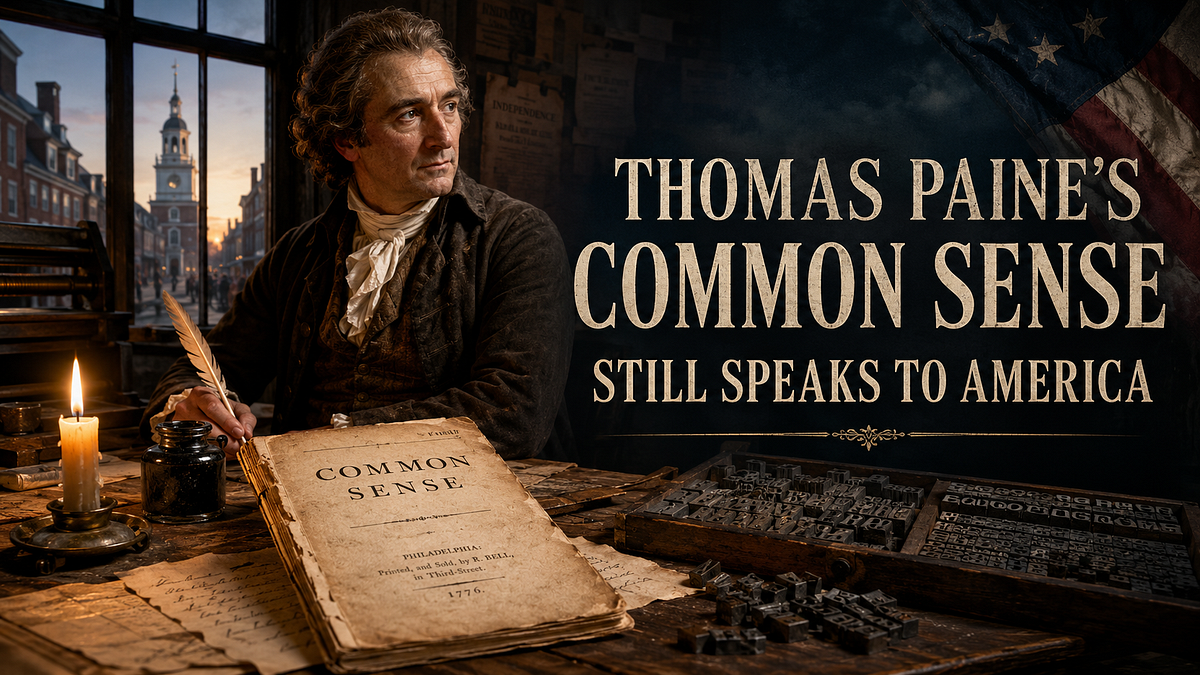
Thomas Paine’s Common Sense Still Speaks to America
There are books we read simply to learn what happened in the past, and then there are books that force us to think about what is happening around us right now. Thomas Paine’s Common Sense belongs in the second category. Published in January 1776, it was not written as an academic study for scholars or as a carefully polished speech for the political class. Paine wrote directly to ordinary people and asked them to consider one fundamental question: Why should Americans continue submitting themselves to a government that no longer represented their interests, respected their rights, or allowed them to determine their own future?
Paine understood that the argument for independence could not be built entirely around the failures of one king or one act of Parliament. The larger problem was the system itself. Americans were living under a government in which political authority flowed downward from a monarch instead of upward from the people. Hereditary power, distant government, taxation without meaningful representation, and laws imposed by officials beyond the reach of the people were not temporary mistakes that could be corrected with a few promises from England. They were the natural results of a society built around subjects serving their government rather than a government serving its citizens.
That is what makes Common Sense more than a Revolutionary-era pamphlet. Paine was challenging Americans to stop accepting an old political arrangement simply because it was familiar. He wanted them to understand that freedom required more than complaining about the decisions coming out of England. It required the courage to create something different—a nation in which government received its authority from the people, individual liberty was protected, and citizens possessed both the freedom and the responsibility to direct their own lives. Common Sense helped Americans understand that independence was not merely an act of rebellion. It was the necessary beginning of self-government.
The Democratic Socialists of America are active in our politics today, organizing in communities, supporting candidates, influencing public policy, and openly advocating an economy and society directed toward collective rather than private control. Their own materials speak of working people running the economy, expanding social ownership, organizing through labor and tenant unions, and building political power capable of fundamentally changing the American economic system. Americans have every right to consider those ideas, debate them, and support or reject them at the ballot box. But Common Sense should remind us to ask where political and economic power will ultimately reside. Will individuals remain free to own property, build businesses, make personal choices, and direct the course of their own lives, or will more of those decisions be transferred to political institutions claiming to act for the collective good? Government power does not become harmless simply because it is exercised under a compassionate slogan.
To me, Thomas Paine’s work is a reminder of why we left England and created a different kind of society. Our ancestors did not cross an ocean, fight a revolution, and establish a new nation so future generations could gradually surrender their independence to another ruling class. They rejected the idea that government should control the people from a distant seat of power. They created a constitutional republic based upon individual liberty, representative government, private rights, and limitations on political authority. The American experiment was built on the belief that the citizen does not belong to the government; the government belongs to the citizen.
That does not mean Paine opposed every public program or believed government had no responsibility toward its people. His writings beyond Common Sense reveal more complicated economic views. But complexity should not prevent us from recognizing the central warning contained in his argument: political systems must always be judged by how much power they take from ordinary people and how difficult they make it for those people to reclaim that power. Dependence on government can be presented as security, fairness, or progress, but dependence still gives someone else authority over the conditions of your life.
Nearly 250 years later, America again finds itself debating the proper relationship between the citizen, the economy, and the government. Those debates deserve more than campaign slogans and promises of benefits paid for by someone else. They require us to return to first principles and ask the same kind of direct questions Paine placed before the American people in 1776. Who holds the power? Who makes the decisions? Who owns the property? Who controls the institutions? And when government becomes too powerful, what meaningful ability does the individual citizen have to say no?
Thomas Paine called his work Common Sense because he believed the truth did not require complicated language. Freedom demands responsibility. Government must remain accountable to the people. Power must never be accepted merely because those exercising it claim to have good intentions. America became America because ordinary people finally understood that remaining comfortable under an increasingly controlling system was more dangerous than accepting the responsibility of governing themselves. That lesson did not expire when the Revolution ended. It may be more relevant today than it has been in generations.
 Michael D. Morrison