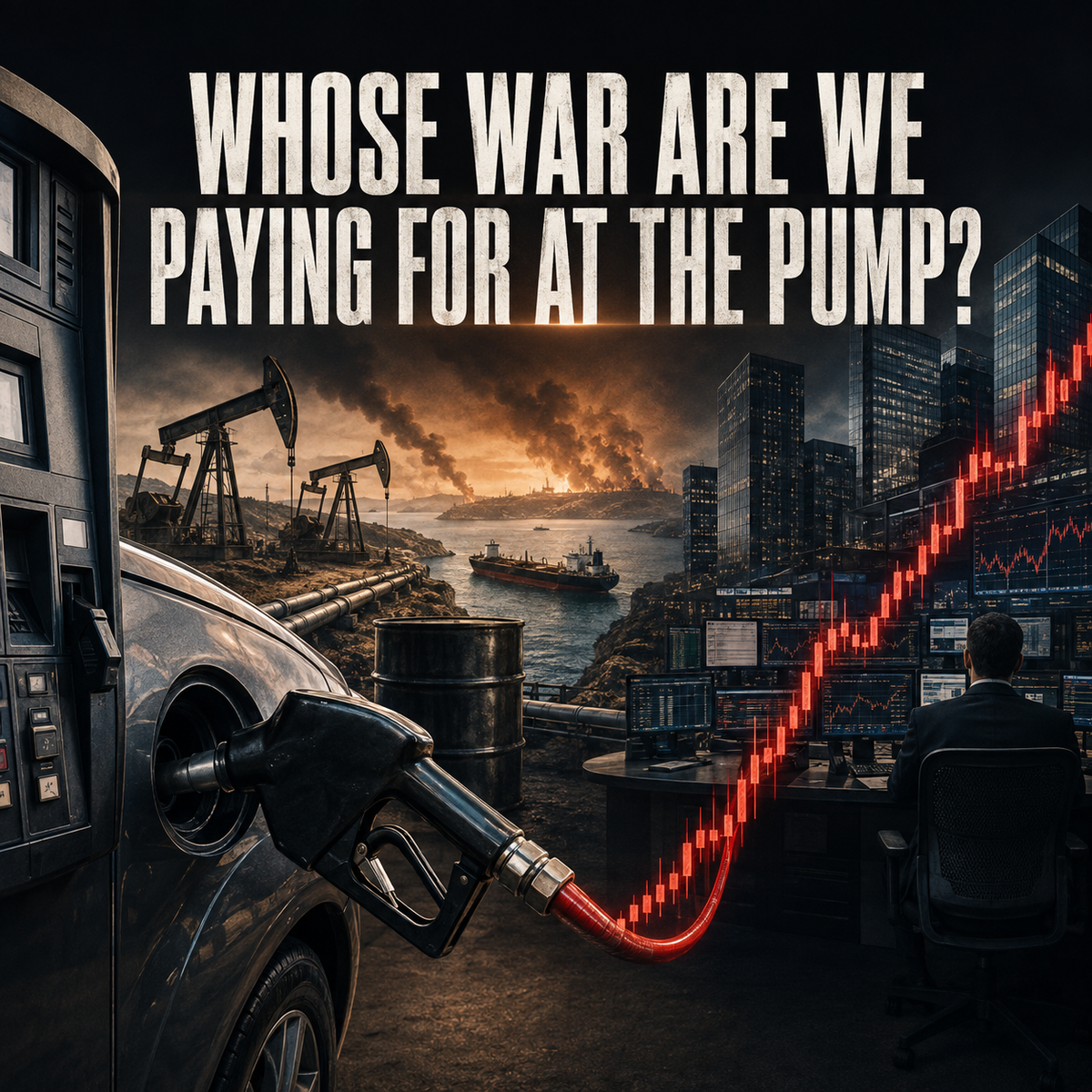
Whose War Are We Paying For at the Pump?
America built its oil-pricing system for a world that no longer exists. It’s time we said so.
While politicians spin their narratives and the news media reads whatever talking points their party handed them, a basic question goes unasked: why is American fuel still priced off a single global market when America no longer depends on that market the way it once did?
The system we use today was built for a different era — one where the United States was hostage to foreign oil and a disruption anywhere genuinely threatened our supply. That world is gone. In 2024, Canada supplied about 62% of the crude the U.S. imported, according to the American Petroleum Institute. The entire Persian Gulf — Saudi Arabia, Iraq, and every other Gulf producer combined — accounted for roughly 12% of our petroleum imports, with Saudi Arabia alone at about 7%, per the Energy Information Administration. Since 2020, the EIA reports, America has been a net petroleum exporter. The barrels being fought over near Iran were never bound for a refinery here.
And yet the moment the Strait of Hormuz makes headlines, the American pump price jumps. Crude closed above $85 a barrel at the end of July, up more than 20% in a single month, on nothing but the fighting between the U.S. and Iran. Strip the conflict away and crude sits in the low $60s to low $70s — right where it fell in late June when a deal briefly held. That premium on top isn’t supply and demand reaching American drivers. It’s an outdated pricing mechanism passing along a fear that has nothing to do with the oil we actually use.
This is the part the coverage never questions. Everyone explains how the global price works, as if explaining it settles the matter. It doesn’t. A system can be working exactly as designed and still be wrong for the country living under it. Pricing American fuel off a world benchmark made sense when we were dependent on the world. We aren’t anymore, and the pricing hasn’t caught up.
Iran understands the lag better than we do. Tehran can’t beat the U.S. Navy, so it sits on the strait and stalls. Every day it drags out a peace agreement, the fear premium stays in the price, and the barrels it still sells run higher. Holding out isn’t Iran losing the negotiation — it’s Iran exploiting a pricing system that rewards it for doing so.
It is my opinion that Americans should not be subjected to higher gas prices because of a conflict in a region we are barely supplied by. The current method of pricing crude is outdated, and understanding how it works is not the same as accepting that it should keep working this way. The system should be changed — in how crude is priced and in where America sources and receives it.
About the Author Mike Morrison is the 2026 PBUS National Bail Agent of the Year and President of the Mississippi Bail Agents Association. With more than 35 years of hands-on experience as a licensed bail agent and owner of Mike Morrison Bail Bonding Company in Hattiesburg, Mississippi, he brings real-world insight to America’s most important conversations on criminal justice, pretrial policy, public safety, and good governance.
Morrison writes and speaks from the front lines — courtrooms, jails, and communities — rather than from theory. His commentary on policy, taxes, justice reform, and the daily realities facing working Americans has earned more than one million views across social media in 2026 alone. He regularly presents on bail policy and professional standards at the Mississippi Judicial College and leads ethics and training programs for bail professionals nationwide.
Independent, plain-spoken, and grounded in practical experience, Mike is committed to clear-eyed analysis that cuts through political noise — whether the topic is public safety, government accountability, or the true cost of policy decisions on Mississippi families and the nation.
 Michael D. Morrison
© 2026 Mike Morrison. All rights reserved.